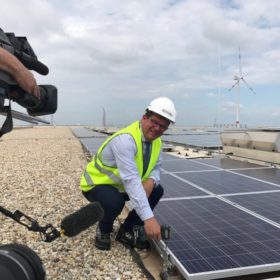
Engie to build Belgium’s largest solar park
Construction on the 100 MW Kristal Solar Park is set to start in October. The facility will be located near the town of Lommel, in the Flemish province of Limburg. The project developer, local investment agency, Limburgse investeringsmaatschappij (LRM) said the project will be 34% cheaper than expected.

Solar projects under net metering keep growing in Ukraine
Cumulative PV capacity installed under the scheme reached 90 MW at the end of June. Of this capacity, around 27 MW were deployed in the second quarter alone.

France allocates 720 MW in large-scale solar tender, final average price reaches €58.2/MWh
In the fourth of six tenders totaling 4 GW planned for the utility-scale segment, the French government selected 103 solar projects. In the next two, and final, rounds, around 1.7 GW of additional solar capacity will be assigned.
Valmont acquires 75% stake in Italian tracker provider Convert
Valmont’s global manufacturing capabilities and utility customer base is expected to help the Italian company expand activity and market share.

Albania tenders 50 MW of solar
Through the auction, the authorities in Tirana aim to build a solar park in the Akërni salt flats, near Vlorë.
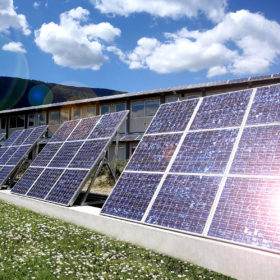
Fitch revises up outlook for French solar market
The U.S. firm expects France will reach a cumulative capacity of 28 GW by 2027, 3 GW more than previously forecast. The reasons for the increase are the renewed efforts of the French government to push for more solar, and the solar plans of big energy players such as EDF and Total.

Solar distributed generation sees strong growth in Brazil
According to a new report published by consultancy Greener, the price of DG systems keeps falling in Brazil and total installed capacity has surpassed 308 MW. In the first half of the year, newly installed capacity was around 126 MW – more than the country installed in all of last year.
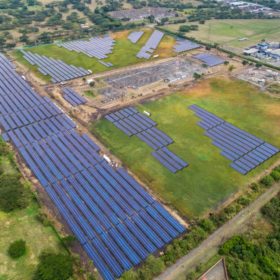
Colombia launches first RE auction
The Colombian Ministry of Mines and Energy announced that up to 1 GW of renewable energy generation capacity may be allocated. The competition will be open to solar, wind and biomass projects exceeding 10 MW in size.
Zambia seeks further financing for its 100 MW PV project pipeline
The African Development Bank is currently seeking consultants to arrange debt financing for five 20 MW projects it aims to develop under Zambia’s Renewable Energy Financing Framework.
EDP adopts blockchain to measure consumption of prosumers in Brazil
The blockchain technology, which was developed by Austrian company, Riddle&Code, is intended to help the Portuguese power provider measure the electricity consumption of each user who owns and operates a solar array installed under net metering.
