
Rooftop solar window based on semi-transparent perovskite solar cells
A prototype of an energy-harvesting, solar-powered smart window device has been developed by scientists from the U.S. Department of Energy’s Argonne National Laboratory. The window was created by integrating a semi-transparent perovskite solar cell and a multi-layer nanophotonic coating.
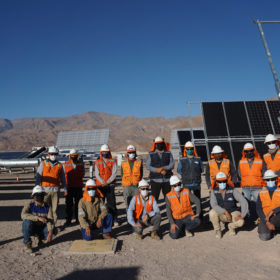
The world’s sunniest PV testing field
French energy giant Engie recently commissioned a solar module testing facility in Chile’s Atacama Desert, a region which has the world’s highest solar radiation. Thore Müller – head of bifacial PV R&D and solar services at Engie Laborelec, talked to pv magazineabout the advantages of testing panels, inverters and cleaning systems in hot, arid environments.

Redox flow battery powered by perovskite solar cells
An international team has developed an integrated solar flow battery which has been suggested as ideal for off-grid locations. The device, which combines energy conversion and storage in one unit, can be used for lighting and recharging cell phones.
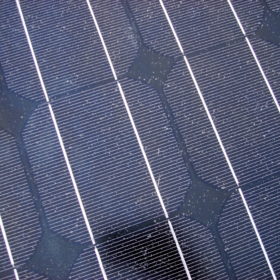
IBC solar cell with 25% efficiency
Australian researchers have revealed a new cell that builds on an earlier 24.4%-efficient device. The upgrade was achieved with an oxide-nitride-oxide passivation stack which optimized diffusion and contact-area fraction, plus improved texturing with a monoTEX surfactant.

Solar causes highest power peaks under mixed-cloud conditions
Dutch researchers have shown that power peaks caused by solar generation may be stronger under partial cloudiness than clear skies. According to their findings, mixed-cloud conditions can enhance PV power production due to light reflected off clouds, as well as their intermittent shadows on arrays, which reduce module temperatures.
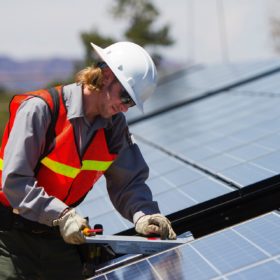
Wind direction and tilt angle approach to keeping panels cool
A technique proposed by scientists in the United Stated could raise solar plant output 5% and decrease panel degradation by more than 0.3% per year, according to the researchers. The approach is based on wind direction and speed, and module inclination.
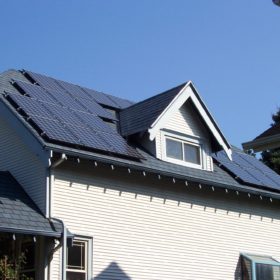
Efficient rooftop solar+storage without MPPT
A German research group is trying to determine whether the combination of solar and storage with direct coupling and without the aid of maximum power point tracking (MPPT) electronics is feasible. According to its findings, this particular configuration might be efficient, but it will likely require special panels and batteries.

Shielding PV against Earth’s magnetic field
Researchers in Kenya are seeking to reduce the influence of the Geomagnetic field on PV panel performance by replacing aluminum module frames with a steel cage. They have specified they have been unable to quantify costs related to the solution, and that more research is needed.
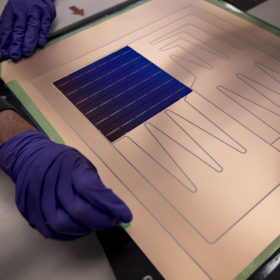
Heterojunction MWT solar module based on 23%-efficient cells
Scientists in the Netherlands have claimed that a heterojunction metal wrap-through solar module they are designing could offer a 4% performance improvement over conventional heterojunction panels.
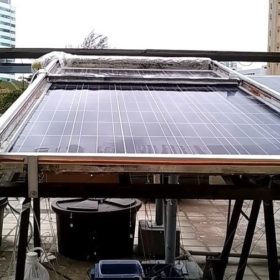
Self-cleaning PV system with active cooling tech
An international research group has developed a self-cooling PV system featuring a 250 W 60-cell polycrystalline module and a thermal collector attached to the back side of the panel. The cleaning tech is based on a microcontroller programmable integrated circuit, which controls a rotating DC motor.
