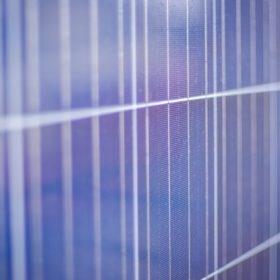
Getting the right module temperature with thermography
Researchers from Hungary have analyzed the thermal behavior of different types of PV module via thermography, and claim to have shown that theoretical models are insufficient to measure the maximum, minimum, and average temperatures of the panels. According to their analysis, glass-glass modules without frame showed the highest temperatures, while the lowest temperatures were measured for polycrystalline glass-backsheet panels with frame.

Choosing the best site for wind and solar with fuzzy logic
An international research team is proposing a fuzzy logic approach for optimal site selection of large-scale wind, solar and hybrid wind-solar power projects. The new methodology is based on criterial components for energy optimization through climatological, topographic and human factors.

A new manufacturing process for cheaper CdTe panels
US researchers have unvelied a new manufacturing process to produce cadmium telluride (CdTe) PV panels, which they claim is 45% cheaper than current industry standards. The technique relies on the use of a high-pressure Bridgman furnace, which is a kind of industrial furnace utilized for crystal growth and directional solidification of polycrystalline ingots.
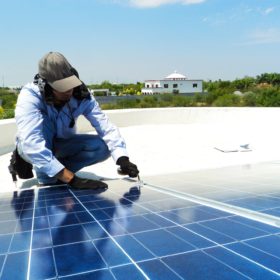
A new technique to get the right angular-tilt
UK scientists are proposing a new approach to calculating the optimum angular-tilt of PV panels for a planar surface at a particular site. In their view, the new technique may unlock innovative yield optimization methods for the installation of PV systems.

Raising the efficiency of polycrystalline cells with new luminescent EVA film
Chinese researchers have developed a pure EVA film, which they claim can enhance the conversion efficiency of conventional crystalline solar cells by around 0.50%. The film is able to convert UV light into strong visible light.
How much can you wash a wearable PV device?
UK researchers claim to have proved the viability of wearable photovoltaic devices as an integrated part of regular clothing. A solar-powered fabric textile was created by embedding micro-crystalline silicon solar cells within the fibers of a textile through thin copper wires. The scientists claim that the device can maintain its performance even after 15 domestic machine cycles, 25 hand wash cycles, and 6000 abrasion cycles.

A new approach to performance simulation of heterojunction III-V solar cells
Scientists from Italy are proposing a new theoretical approach based on the combination of the scattering matrix method (SMM) with the Hovel method. The new model is said to describe with improved accuracy the propagation of electromagnetic waves in solar cells based on indium gallium phosphide (InGaP), indium gallium arsenide (InGaAs) and germanium (Ge), taking into account the interference effects. In their view, with proper antireflective coating III-V solar cells can reach efficiencies of more than 50%.
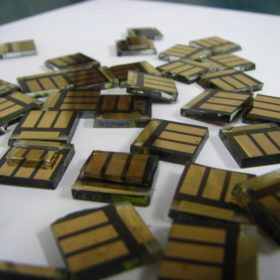
Watch how to improve perovskite solar cells in 2D!
Saudi researchers claim to have improved the thermal stability and moisture resistance of such devices by replacing 3D hybrid perovskite with two-dimensional compounds. They used organic compound ethanolamine, which is said to provide better results in slowing down the hot-carrier cooling process.

New process could yield 26.6% efficient IBC cells
Researchers in Germany are trialing a host of new processes and materials to develop interdigitated back contact solar cells. A deposition technology named ‘hot-wire’ chemical vapor deposition, is said to provide excellent passivation without the need for treatments such as recrystallization or hydrogenation.

A new front electrode structure for shingled PV panels
Researchers in Korea have proposed a new design for dividing and bonding which is said to provide higher efficiency from fewer fingers. The number of fingers optimized for division into five cells was 128 and for three, 171. Five offer power conversion efficiency of 17.346% and three 16.855%.
