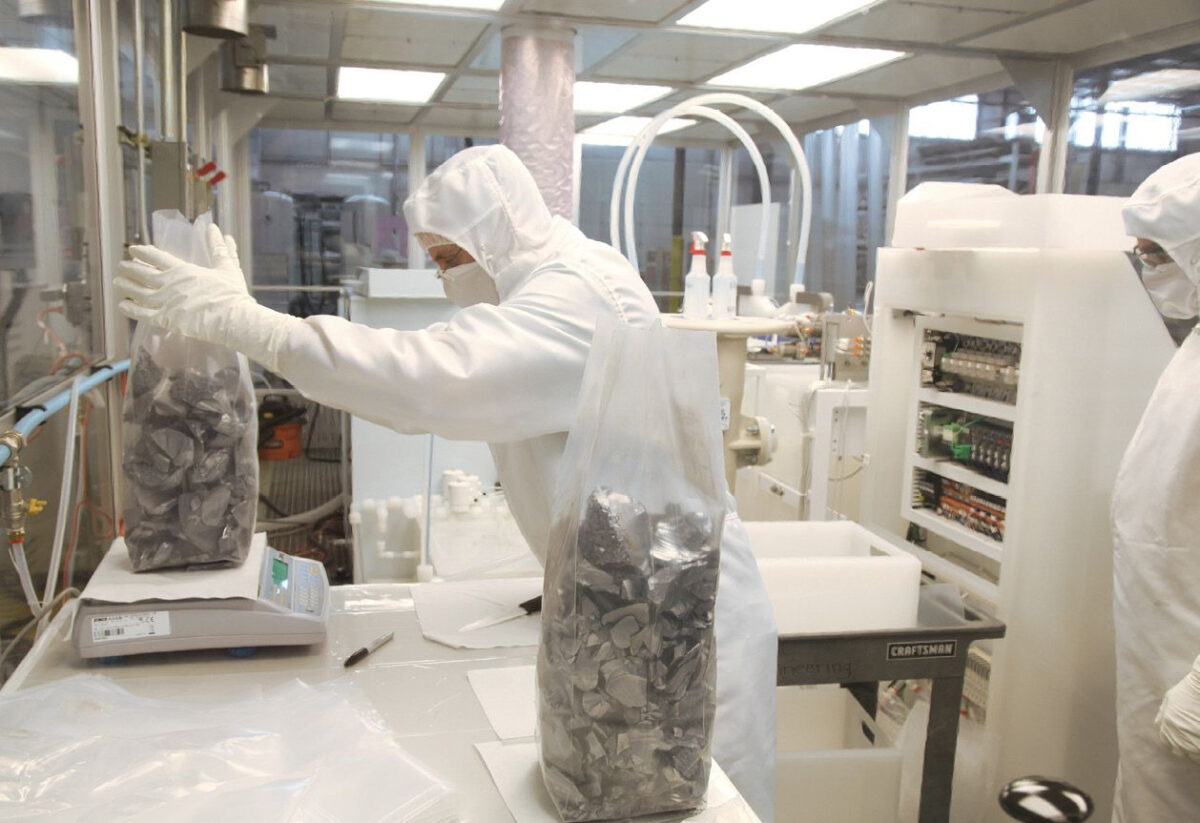





China’s largest polysilicon producers have set up a CNY 3 billion ($415 million) coordination platform in Beijing, marking the strongest indication yet that the country’s solar supply chain is moving toward structured capacity management after a prolonged price collapse.
Beijing Guanghe Qiancheng Technology Co., Ltd. was registered on Dec. 9 in the Chinese capital’s Chaoyang district as a limited company with mixed domestic and foreign investment. Industry executives describe it as a “polysilicon storage and integration platform,” although its formal business scope centers on technology and management services rather than commodity trading. Investors and officials view it as the institutional backbone for a long-discussed plan to stockpile material and calibrate supply.
The shareholder roster reflects the core of China’s upstream solar segment. An affiliate of Tongwei holds 30.35%, followed by GCL Technology at 16.79%. Oriental Hope, Daqo New Energy and Xinte Energy each own roughly 10% to 11%. Additional investors include Asia Silicon, Qinghai Lihao, Qinghai NBG New Energy, Xinjiang Goens and Beijing Zhongguang Tonghe, which is wholly owned by the China Photovoltaic Industry Association (CPIA). Liu Yiyang, CPIA’s executive secretary-general, sits on the board, signaling an industry-wide mandate.
Polysilicon prices have plunged from around CNY 300,000 per metric ton at their 2023 peak to near CNY 50,000 this year, briefly touching CNY 33,000 in mid-2024. China accounts for about 95% of global capacity, with its top five producers controlling close to 80% of world supply. The rapid buildout has pushed the sector into a severe down-cycle, leaving margins strained across the solar value chain.
China’s Ministry of Industry and Information Technology (MIIT) convened leading manufacturers and CPIA twice in mid-2024, signaling support for measures aimed at curbing redundant expansion and guiding inefficient capacity toward an exit. Guanghe Qiancheng is the first institutional outcome of those discussions.
People familiar with the plans said shareholders are expected to use the platform to discuss “reasonable” price bands, inventory targets and total reserve volumes. Industry commentary indicates that future sales prices could be raised above CNY 60,000 per ton, with about CNY 10,000 of that reflecting stockpiling costs. The company is expected to buy material when prices fall below agreed thresholds and release inventory when supply tightens, acting as a stabilizer rather than a permanent stockpiler.
Executives involved in the project have compared the approach to OPEC’s role in oil markets, while emphasizing that the platform is not intended as a classic price-fixing cartel. It operates under CPIA oversight, with regulators aware of its creation, and is formally focused on “capacity optimisation, cost efficiency and strategic cooperation” across member companies.
Key challenges remain. Coordination among competitors with differing financial pressures and expansion plans will test governance. The platform’s balance sheet is modest relative to China’s vast polysilicon output, and it must avoid regulatory concerns over market manipulation while still influencing sentiment.
A successful rollout could temper the sector’s race to the bottom, giving higher-cost or older facilities time to exit more orderly and helping preserve China’s cost and technology advantage in solar manufacturing. Failure would risk triggering another round of destabilizing price wars in an even more concentrated industry.
This content is protected by copyright and may not be reused. If you want to cooperate with us and would like to reuse some of our content, please contact: editors@pv-magazine.com.


By submitting this form you agree to pv magazine using your data for the purposes of publishing your comment.
Your personal data will only be disclosed or otherwise transmitted to third parties for the purposes of spam filtering or if this is necessary for technical maintenance of the website. Any other transfer to third parties will not take place unless this is justified on the basis of applicable data protection regulations or if pv magazine is legally obliged to do so.
You may revoke this consent at any time with effect for the future, in which case your personal data will be deleted immediately. Otherwise, your data will be deleted if pv magazine has processed your request or the purpose of data storage is fulfilled.
Further information on data privacy can be found in our Data Protection Policy.