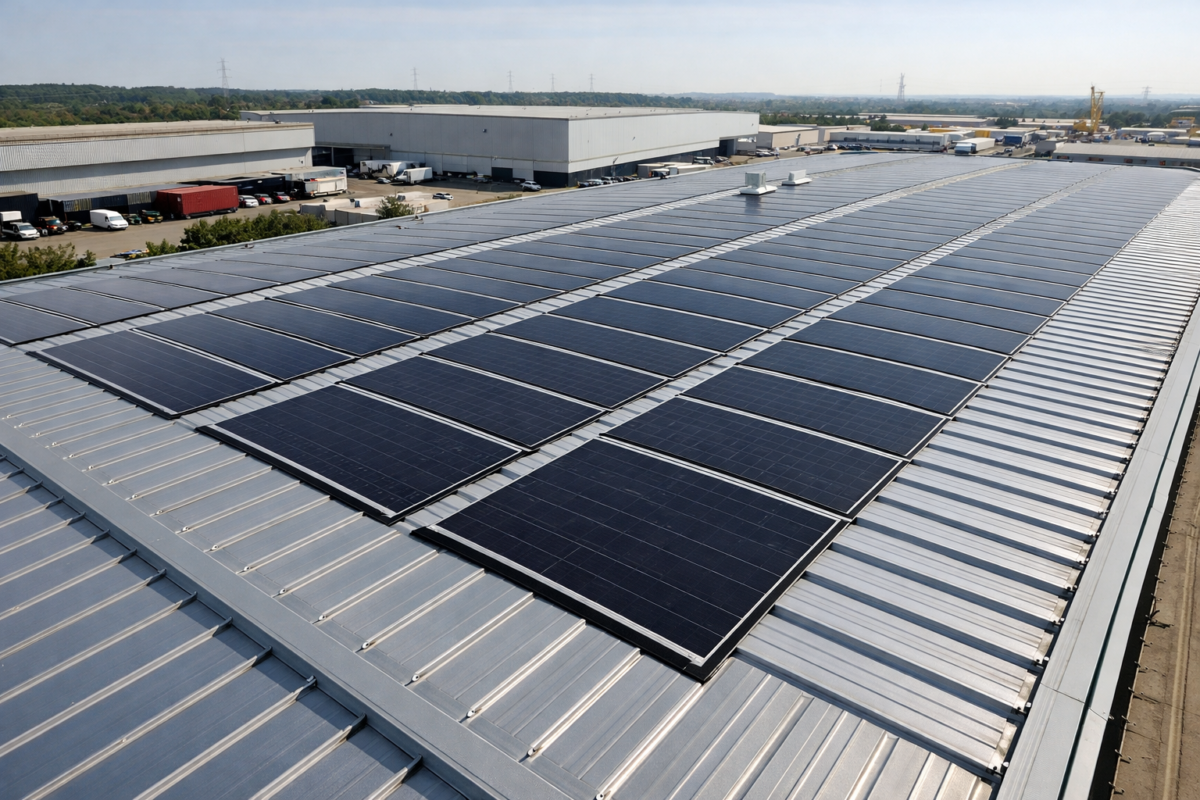





Walk around any European industrial estate and the rooftop PV story is hiding in plain sight. Kilometre after kilometre of (nearly) flat metal roofing (warehouses, logistics hubs, stores, manufacturing) with no PV panels in sight. It is not for lack of sunshine, or policy support, or investor appetite. It is because these buildings have often been constructed decades ago and sized, for cost reasons, to meet the load and overload standards of the time, with no allowance for the additional load of a future solar PV installation.
This is Europe’s rooftop solar paradox: a continent pushing hard toward 100 GW of annual PV additions, yet sitting on a vast rooftop area it cannot practically use. Our analysis at Becquerel Institute puts the scale of this constrained potential at more than 85 GW. A capacity that is technically accessible today, but locked out by one factor: the weight of conventional solar PV modules.
Standard PV panels weigh more than 10 kg per square metre, depending on glass thickness and whether modules use glass-glass or glass-backsheet configurations. For a significant share of Europe’s industrial building stock, particularly older warehouses, logistics centres, and agricultural facilities, these loads exceed the structural limits of existing roofs. Reinforcing those structures is technically possible, but in most cases the economics simply do not stack up.
Lightweight PV modules address this directly. Generally, they are at least 50% lighter than conventional PV panels, so that they can be installed on structures that would otherwise require costly reinforcement or remain off-limits for solar altogether. In many cases, they can be adhered directly to the roof surface, eliminating the need for mounting structures . The technology is not experimental, it is commercially available today, and it is opening up a frontier that conventional PV cannot reach.
A large and largely untapped market
European Union’s PV market has grown at a remarkable pace. Annual installations tripled between 2020 and 2025, reaching more than 65 GW last year, with 100 GW per year in sight by 2030. Growth has been broad-based, with Germany, Spain, and Italy leading, but meaningful contributions now come from across the continent. Rooftop and ground-mounted PV segments have expanded in roughly equal measure, and the commercial and industrial (C&I) rooftop segment is increasingly central to the growth story.
But as the most accessible rooftops fill up, a new constraint is coming into focus. In mature C&I markets (Benelux, Germany, Austria, …), the “easy” installations are slowly but surely reaching saturation. What remains is a large pool of buildings that the industry has, until now, largely passed over.
Becquerel Institute’s assessment of the lightweight PV opportunity is based on a multi-step methodology: starting from the gross technical rooftop potential of commercial and industrial buildings across Europe, then layering in building-level characteristics (roof typology, surface area, existing rooftop occupancy) and finally applying country-specific factors including construction materials, renovation rates, building age, and climate considerations such as snow loads.
The result is a realistic estimation of the addressable potential, amounting to 38 GW on industrial buildings and 48 GW on commercial buildings, for a combined total exceeding 85 GW. This is not a theoretical ceiling, it is a conservative estimate of what could be deployed on existing buildings, without structural upgrades, using lightweight modules available today.

Image: Becquerel Institute via solarintelligence.ai
The geographic distribution reflects building stock characteristics as much as solar irradiance. Spain holds the largest theoretical potential, driven by the sheer scale of its C&I building base. Italy and Germany follow closely, where ageing industrial stock and stringent snow-load norms push a high share of rooftops into the weight-constrained category. France represents an interesting case: a large industrial building stock but historically slow C&I rooftop adoption, the combination of the new energy regulations (obligation to solarise large commercial car parks, new buildings) and growing awareness of structural constraints may accelerate lightweight PV uptake significantly. The Benelux markets, particularly the Netherlands, are worth watching closely: flat roofing is ubiquitous, the C&I sector is dense, and local manufacturers are creating an integrated supply-and-install ecosystem that could serve as a model for other markets.
A market pushed by regulation and price volatility
Two forces are converging to make that pool of overlooked buildings increasingly hard to ignore. The first is regulatory. The revised Energy Performance of Buildings Directive (EPBD), published in summer 2024, gave Member States two years to transpose it into national law, a deadline that is now approaching, meaning concrete solar obligations for commercial and industrial buildings are either already in force or about to be in most European markets, obligations that cannot always be met through carports or ground-mounted systems alone. For building owners suddenly facing a mandatory solarisation requirement on a structurally constrained roof, lightweight PV shifts from a niche option to the only compliant solution. This is particularly true for heavy energy consumers in the industrial sector, where certain regional regulations are already mandating on-site solar deployment, Flanders in Belgium being a notable example.
The second force is economic. European industrial electricity prices have proven acutely vulnerable to geopolitical shocks: the 2022–2023 energy crisis triggered by Russia's invasion of Ukraine sent prices to historic highs, forcing many C&I operators to reassess their exposure to wholesale market volatility. More recently, renewed tensions in the Middle East have served as another reminder that energy price stability cannot be taken for granted. For C&I building owners, on-site solar generation is increasingly not just an ESG commitment or a cost optimisation play, it is a hedge against a risk that has shown it can materialise with little warning.
Mature and diversifying technology options
The technology itself is no longer niche. Lightweight PV modules are available in both rigid and flexible formats, predominantly using c-Si cells, with thin-film alternatives based on CIGS present in the market for specific applications.
The European manufacturing landscape is more dynamic than it might appear from the outside. Becquerel Institute tracks around 20 active lightweight PV module manufacturers across Europe, with Germany and France leading in number of players, followed by Austria, Italy, the Netherlands, and Poland (see chart below). It is worth noting that these figures encompass manufacturers across all target segments, i.e. C&I rooftop but also non-grid connected applications, and across all available technologies, from rigid and flexible c-Si to thin-film solutions. Several of these companies have emerged in the past three to five years, a sign that the market opportunity is being taken seriously.
Some have announced capacity expansion plans, pointing to a supply chain that is beginning to mature. Chinese manufacturers are also increasingly present, bringing competitive pricing but raising questions on quality and durability in some cases.

Image: Becquerel Institute via solarintelligence.ai
Beyond rooftops: the IPV opportunity
While C&I rooftops represent the core opportunity, lightweight PV is finding application across a broader range of surfaces. In building-integrated photovoltaics (BIPV), modules are incorporated directly into roofing products at the manufacturing stage, turning the building envelope itself into a power-generating surface. In vehicle-integrated photovoltaics (VIPV), low weight and flexible form factors make these modules suitable for buses, trucks, and commercial vehicles, where they power auxiliary systems and meaningfully reduce fuel consumption. Infrastructure applications (IIPV), such as bus shelters, carports, or solar canopies, represent a further emerging channel, particularly where structural constraints rule out conventional modules.
It is worth noting that not all players are targeting the same end market. A meaningful share of European lightweight PV manufacturers is focused on VIPV applications (boats, trucks, campervans, and smaller commercial vehicles) rather than grid-connected rooftop PV installations. These are real markets, but they operate on different volume assumptions, certification requirements, and sales channels than C&I rooftop solar. For investors and project developers evaluating the supply chain, understanding which manufacturers have a genuine C&I rooftop offering, with the installation track record, warranties, and bankability documentation that entails, is a critical due diligence step.
Rethinking the cost comparison
Installation approaches vary but share a common logic: reduce structural load and simplify deployment. . This simplification has a direct cost consequence: even though lightweight module costs remain higher than standard c-Si panels, reflecting lower production volumes and more specialised materials, the total installed cost picture is more nuanced than the module price alone suggests. More fundamentally, on structurally constrained buildings the relevant comparison is not lightweight PV versus conventional PV, it is lightweight PV versus no solar at all. In that framing, the economics are often straightforward, and they will only improve as volumes grow and the module cost premium narrows.
From quality to bankability
One question Becquerel Institute hears consistently from asset owners and investors: how durable are these systems? Are they bankable?
While lightweight PV has made significant progress on performance and reliability, allowing to pass all the required testing procedures, the installation quality remains the critical variable.
Unlike conventional PV, where mounting systems are well standardised, lightweight solutions often involve adhesive bonding, specialised surface preparation, and roofing-material compatibility that demands careful execution. Most serious manufacturers work with specially trained installers, in-house teams, or have developed partnerships with established building industry players, precisely to control this risk. . When properly executed, with due attention to potential areas of stagnating water, cable management, lightweight PV systems can deliver reliable long-term performance
For these very reasons, innovations and adaptations at module level are constantly flowing, with for example modified front or back layers (some preferring composites to glass), minimal framing in some cases, or new adhesive systems tested for long-term roof compatibility. For asset owners specifying these systems, due diligence on the manufacturer’s installation protocol is as important as the module datasheet. The technology is ready, and the supply chain around it is maturing.
The policy tailwind
Finally, the regulatory environment is beginning to move in favour of European manufacturers. The Net Zero Industry Act (NZIA), now being reinforced by the Industrial Acceleration Act, introduces made-in-EU requirements applying to public procurement but also auctions and support schemes. Plus, some countries like Austria and Italy are in advanced phases of domestic manufacturing support aligned with the NZIA framework. More are expected very soon (Germany, Spain).
For lightweight PV, a segment where European manufacturers are genuinely competitive, this creates a meaningful policy lever. It will not transform the market overnight, but it adds commercial certainty for manufacturers investing in capacity, and for project developers building pipelines on European supply chains.
The next frontier
Europe’s rooftop solar PV story is not finished, it is entering a more complex, more interesting chapter. The obvious installations are largely done. What remains requires smarter technology, sharper market intelligence, and a willingness to engage with buildings that do not fit the standard template.
Lightweight PV is not a niche workaround. It is, increasingly, the frontier and at 85+ GW of addressable potential across European commercial and industrial buildings, it is a frontier worth taking seriously.
Authors: Philippe Macé, COO, Becquerel Institute and Caroline Plaza, Managing Director, Becquerel Institute France
Becquerel Institute is a strategic consulting company and applied research institute specialising in solar photovoltaics and energy transition. Founded in Brussels in 2014, with regional offices in France, Italy, and Spain, the Institute provides strategic advice across all segments of the PV value chain and is a recognised partner in European and international research programmes. Becquerel Institute has recently launched Solarintelligence.ai, an AI-powered platform giving PV stakeholders immediate access to verified, actionable market intelligence.
The views and opinions expressed in this article are the author’s own, and do not necessarily reflect those held by pv magazine.
This content is protected by copyright and may not be reused. If you want to cooperate with us and would like to reuse some of our content, please contact: editors@pv-magazine.com.


By submitting this form you agree to pv magazine using your data for the purposes of publishing your comment.
Your personal data will only be disclosed or otherwise transmitted to third parties for the purposes of spam filtering or if this is necessary for technical maintenance of the website. Any other transfer to third parties will not take place unless this is justified on the basis of applicable data protection regulations or if pv magazine is legally obliged to do so.
You may revoke this consent at any time with effect for the future, in which case your personal data will be deleted immediately. Otherwise, your data will be deleted if pv magazine has processed your request or the purpose of data storage is fulfilled.
Further information on data privacy can be found in our Data Protection Policy.