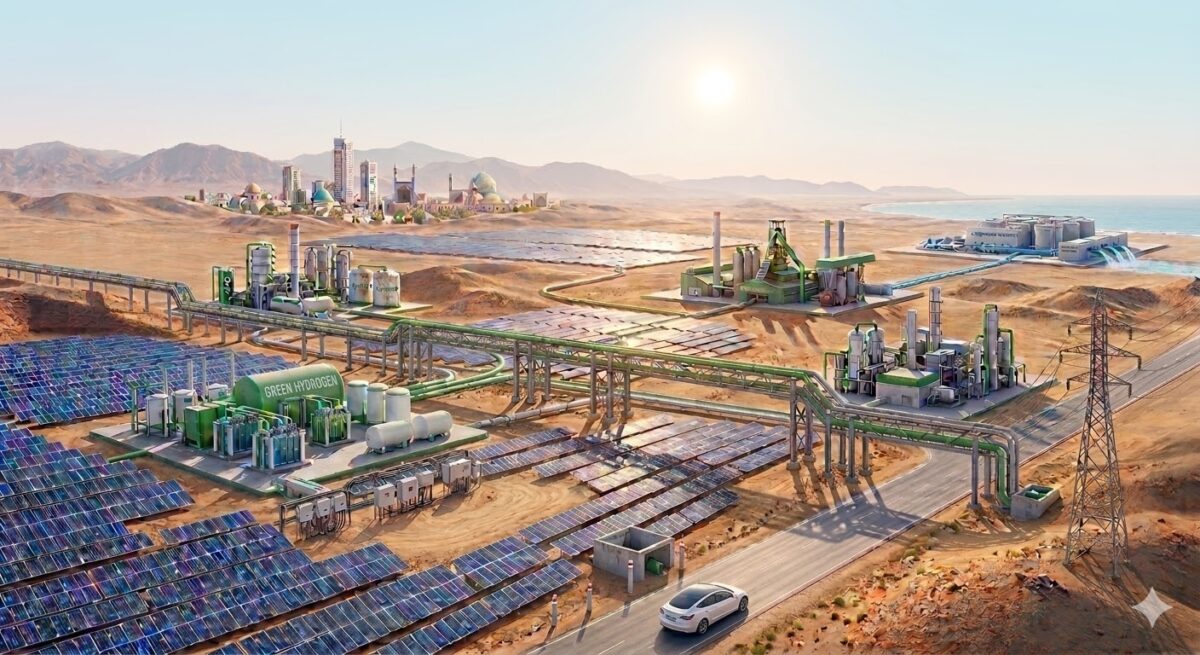





Although Iran is currently involved in a military conflict, it is still unknown to what extent the conflict will damage the country's energy infrastructure. The following analysis explores Iran’s long‑term energy transition prospects without assuming any specific outcomes of the ongoing situation. The focus remains on structural opportunities and challenges that will shape the country’s future energy landscape beyond the immediate context.
Iran is often seen through the lens of oil and gas. That image is understandable, but it is increasingly incomplete. In the energy system of the future, Iran’s most important strategic resource may not be underground at all. It may be the sun. With excellent solar conditions, vast land availability, and a strong industrial base, Iran has the potential to do far more than simply add renewable electricity to its existing system. It could build an entirely new economic model around low-cost solar PV and use that advantage across power, heat, transport, industry, and water supplies.
That is the key strength of a Solar-to-X Economy, as a PV-dominated case of the more general Power-to-X Economy. Solar PV is often still viewed too narrowly, as if its role begins and ends with electricity generation. In reality, once renewable electricity becomes abundant and cheap, it can do much more. It can be used to produce industrial heat, hydrogen, synthetic e-fuels, e-chemicals as feedstocks, and desalinated water. For Iran, this broader system perspective matters enormously. The country does not only need cleaner electricity, it also needs a long-term economic pathway that can gradually replace fossil fuel dependency with something equally strategic but much more future-oriented. Solar-to-X offers exactly that opportunity.
A recent study by LUT University on Pathways to a Fully Renewable Energy System in Iran shows that such a transition is technically possible and economically attractive. The study examines how Iran could move toward a fully renewable energy system by 2050 across five major sectors: power, heat, transport, industry, and desalination. The results point to something much bigger than a conventional power sector transition. They show the outline of a new energy economy in which solar PV becomes the backbone of the system and renewable electricity becomes the driver of change across the wider economy. Sunbelt countries are especially well placed to build low-cost, solar-led power systems with manageable balancing needs. Earlier research has already highlighted this advantage for the power sector, and the new modelling confirms that solar PV’s role could extend to the backbone of the entire energy-industry system.
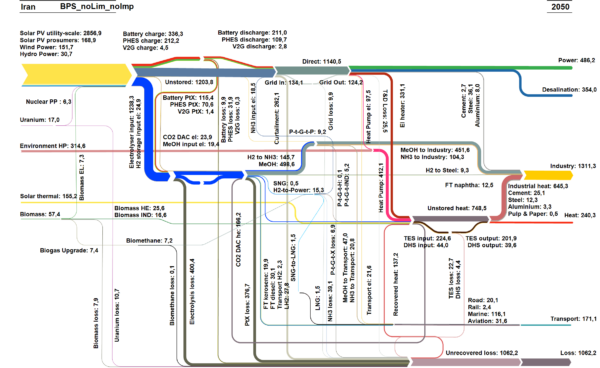
Image: LUT University
The power sector is where this transition begins. In the most ambitious pathway (Best Policy Scenario), the installed power capacity rises from around 81 GW in 2020 to more than 1660 GW by 2050. Solar PV becomes the dominant technology, accounting for around 81% of installed capacity and around 93% of electricity generation. Renewable electricity supply grows to more than 3200 TWh by 2050. These are large numbers, but the deeper point is even more important: solar PV electricity stops being just one generation source among others and becomes the central energy platform as a basis for the rest of the system. That is a very different way of thinking about the energy transition and is especially relevant for a country like Iran.
Once low-cost renewable electricity is available at scale, the benefits spread well beyond the grid. In the heat sector, direct electrification and heat pumps provide around 80% of heat demand by 2050, while solar thermal adds further support. In transport, direct electrification becomes the preferred route wherever possible, especially in road transport. For harder-to-electrify segments such as aviation and shipping, though, Solar-to-X fuels carry much of the transition. In the Best Policy Scenario by 2050, electricity supplies 13% of the transport sector’s final energy demand, while e-hydrogen provides 18%. The larger share comes from e-fuels: Fischer-Tropsch liquids account for 29%, e-methanol for 27%, and e-ammonia for 12%. This is where Solar-to-X becomes more than a useful phrase. It becomes a practical strategy for replacing oil-based fuels in the parts of transport where batteries alone are not enough.
The industrial implications may be even more important. Iran already has large energy-intensive industries, including steel and petrochemicals, and these sectors will play a major role in shaping the country’s economic future. If they remain tied to fossil fuels, they will become increasingly exposed in a world that is gradually moving toward lower-carbon production. If they are rebuilt around renewable electricity, hydrogen, and Power-to-X products, the story changes completely. In the study results, hydrogen output reaches nearly 1000 TWh by 2050, as e-ammonia, e-methanol, and e-fuels become increasingly important as energy carriers and industrial inputs. This is why solar PV should not be seen only as a climate solution. It could also become the foundation of a more competitive industrial model and can support cleaner production in steel, chemicals, cement, aluminium, and other energy-intensive industries.
This broader perspective is also important because it links the energy transition with other national challenges, especially water. Water scarcity is already a serious issue in many parts of Iran, and it is difficult to imagine any credible long-term development strategy that does not take this into account. PV-based electricity also avoids water consumption to cool thermal power plants. The study shows that desalination electricity demand reaches around 350 TWh by 2050. That matters because it shows how renewable electricity can support both defossilisation and water security. In a country where energy, industry, and water are all strategic issues, this kind of system integration is not a side benefit. It is one of the strongest arguments for change. Another concrete topic is the renewable energy integration in wastewater treatment plants, which can evolve to save water resources and even provide energy.
Of course, none of this works without flexibility. A highly solar PV-based system must be able to balance supply and demand across time and across sectors. That is why storage plays such a central role in the transition. Iran can use different types of storage options, such as pumped hydro energy storage in addition to the fast emerging battery storage. By 2050, electricity storage output reaches around 511 TWh, installed electricity storage capacity rises to around 1450 GWh, while heat and gas storage together add more than 4000 GWh of capacity. These are not technical details for specialists to worry about later. They are a reminder that the renewable transition is not just about replacing fossil supply with clean electricity generation. It is about redesigning the system so that low-cost solar PV electricity can serve many functions reliably and efficiently.
The climate benefit of such a transition is substantial. In the Current Policy Scenario, as a business-as-usual case, annual greenhouse gas emissions in Iran remain high, reaching around 446 million tons of CO2 in 2050. In the fully renewable pathway, emissions fall to net-zero by mid-century. Yet the economic story is just as important. The levelized cost of electricity of the entire system falls to around €24.7 /MWh by 2050 in the main transition scenario. That is a powerful signal. It suggests that a solar-led transition is not simply a costly environmental project. It is a rational and cost-competitive development pathway for the country.
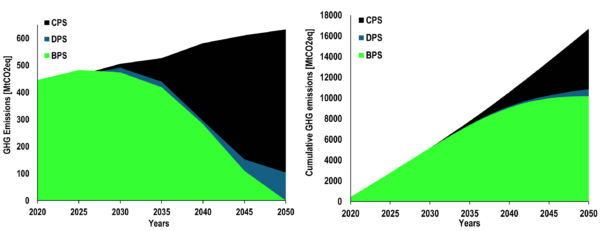
Image: LUT University
This is why Iran’s energy transition should be discussed less as a burden and more as an opportunity, as for the entire Middle East and North Africa region. Too often, countries with major fossil fuel resources are described as if they face an impossible choice between protecting the old fossil fuel economy and embracing the new renewable energy one. In reality, the more strategic question is how to use today’s energy strengths to build tomorrow’s energy system. In principle, Iran could enormously benefit from global export of e-fuels, e-chemicals, and e-materials. Export via pipelines and shipping, in particular of e-ammonia and e-methanol would be quite attractive due to relatively low transport cost, especially compared to hydrogen. e-Methanol may be the most valuable chemical, as the bedrock of a broader e-methanol-to-X value chain, serving the maritime sector, aviation, and chemical industry. The comparison with Norway is useful in that sense. Norway is often cited as an example of how a fossil fuel-rich country can pursue domestic defossilisation while using energy wealth to support its long-term economic transition. Iran can follow this path, but the broader lesson still stands: resource wealth can be used either to delay change or to shape the next economic model. The wiser choice is to invest in the future before the future arrives without oneself.
Iran’s long-term energy future does not have to be defined only by oil and gas. It can also be shaped by solar PV, green hydrogen, synthetic e-fuels, electrified industry, and renewable desalination. That is why Solar-to-X deserves serious attention. It offers a way to connect renewable electricity with industrial strategy, export potential, energy security which increases with renewable energy, and water solutions in a single framework. Few countries combine such strong solar resources with such large-scale energy demand and industrial capability. If Iran chooses to build on those advantages, it could move from being known mainly as a fossil energy power to becoming a solar-based energy economy. In the long run, that may prove to be the much more valuable identity.
Authors: Mehdi Khatibi, Gabriel Lopez, Dominik Keiner, and Christian Breyer
This article is part of a monthly column by the LUT University.
Research at LUT University encompasses various analyses related to power, heat, transport, industry, desalination, and carbon dioxide removal options. Power-to-X research is a core topic at the university, integrated into the focus areas of Planetary Resources, Business and Society, Digital Revolution, and Energy Transition. Solar energy plays a key role in all research aspects.
The views and opinions expressed in this article are the author’s own, and do not necessarily reflect those held by pv magazine.
This content is protected by copyright and may not be reused. If you want to cooperate with us and would like to reuse some of our content, please contact: editors@pv-magazine.com.


A most interesting report but it does not mention agrivoltaics, the combined production of electricity and food crops with mutual benefits to both, and more efficient use of water. Agrivoltaics looks well suited to Iran but also to the Middle East, Afghanistan, Pakistan and all of Central Asia. It is being extensively applied in NW China and in other arid areas and is gaining strength here In Australia. It has the potential to revolutionise the economics of rural areas, especially in arid zones.