Blathnaid O'Dea

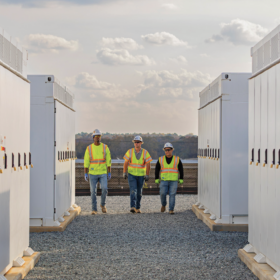
On-site batteries accelerate grid access for data center developers
Battery energy storage systems (BESS) are increasingly used in uninterruptible power supply (UPS) applications for data centers and to speed grid connections, offering services beyond what gas turbines can provide, including emerging approaches such as bring your own capacity (BYOC) and flexible grid connections (FGC).

Private wires legislation could slow Ireland’s residential rooftop PV progress
Solar Ireland told the Irish government that the Private Wires Bill’s proposed definition of private wires could bring rooftop solar installations within a full electricity licensing requirement, which would place significant additional demand on the energy regulator and slow down installations.

Iraq slashes solar import tariffs to 5%
The Iraqi Customs Authority has cut customs duties on solar energy systems from 33% to 5% – covering PV panels, inverters, cables, and lithium batteries – to accelerate solar adoption, following financing support from the Central Bank of Iraq.

UK government issues open call for experts to shape AI energy policy
The United Kingdom is inviting AI and energy specialists to identify datasets that could make its energy system more efficient, secure and digitized.

Ireland adds 1 GW of solar in 2025
Ireland reached 2,345 MW of installed solar capacity by December 2025, more than tripling installed capacity since 2023, according to Solar Ireland data. The country’s development pipeline has currently reached 1.7 GW.

Malaysia restricts non-AI data centers, citing energy concerns
Malaysia’s prime minister Anwar Ibrahim said future policy will ensure domestic consumers and the electricity grid are protected amid the country’s data center expansion. This could include leveraging the ASEAN Power Grid project to cover any supply shortfalls.
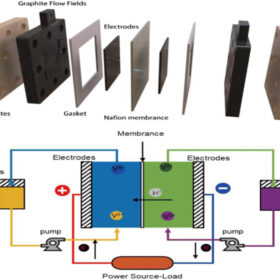
De-risking redox flow batteries for grid-scale storage
Following their review of redox flow battery research, Norway-based scientists told pv magazine that despite its high upfront capital costs and lower energy density relative to metal-ion, the technology can offer safety, reliability, and scalability advantages for standalone, large-scale applications.

Octopus Energy invests $1 billion in California clean technology
Octopus Energy will acquire a solar and storage project in California that is expected to be operational by July as part of its investment. The UK-based company, active across major markets in Europe, Australia, China and the United States, says California’s clean technology sector will “bring innovation, growth and returns to the UK.”
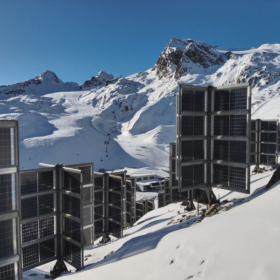
SolarEdge, Helioplant build 6.3 MW ‘cross-shaped’ bifacial PV system for Alpine regions
Helioplant will leverage SolarEdge’s inverter and power optimization technology to power its cross-shaped bifacial solar system specially designed for snowy Alpine regions with high elevation. They anticipate ski resorts will be a big market for the solution which uses SolarEdge’s technology to overcome shading issues caused by the cross-structure.
Nissan wheels out solar-powered vehicle
The Ariya demonstration vehicle features 3.8 m² of Lightyear’s custom solar panels integrated across the hood, roof, and tailgate. Testing showed that the car could generate 0.5 kWh of solar energy during a 2‑hour, 80 kilometer trip, delivering up to 3 kilometers of range at no extra cost or charging time.
