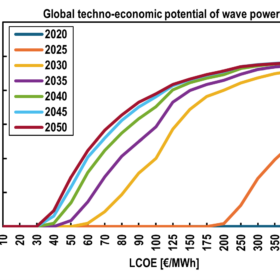
Wave power poised to complement solar PV in future global energy mix
Wave power may emerge as a valuable renewable energy source given recent economic and technical projections indicating a substantial potential of wave energy, particularly in coastal and island regions. Wave and solar resources are complementary around the world and thus may lead to energy systems combining solar PV with wave power. Islands may benefit most from wave power added to solar PV.

The urgent call to transform leadership in the face of solar slowdown
This week, WiSEu Network – Women in Solar+ Europe reflects on SolarPower Europe’s forecast of a 1.4% drop in EU solar growth for 2025, the first decline since 2015, and why this signals more than just a market slowdown. To meet 2030 targets, we don’t just need better strategies; we need a transformation in leadership itself. That means dismantling centuries-old biases that equate leadership with dominance and detachment, and embracing a fuller spectrum of qualities: empathy, collaboration, and emotional intelligence, now recognised as essential for navigating complexity and driving the energy transition.
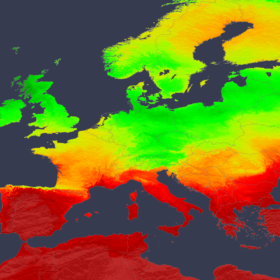
Record-warm July boosts solar in North, dampens South and East
In a new weekly update for pv magazine, Solcast, a DNV company, reports that persistent high‑pressure over Scandinavia delivered significantly elevated irradiance up to 30 % above normalin July, while central and eastern Europe faced reduced solar generation under increased cloud cover and rainfall.
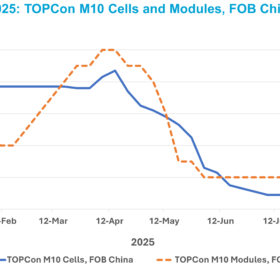
China solar cell rally stalls amid worsening margin squeeze
In a new weekly update for pv magazine, OPIS, a Dow Jones company, provides a quick look at the main price trends in the global PV industry.
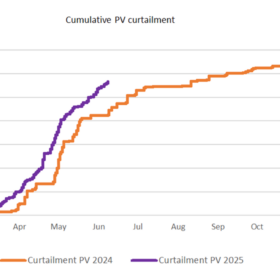
Remedies for PV curtailment in Poland
Solar curtailment is on the rise in Poland, with around 600 GWh of PV capacity reduced during the first six months of 2025. The Warsaw-based Institute for Renewable Energy (IEO) suggests one solution is to support the electrification of Poland’s heating sector with the surplus of PV power.

‘Once people recognize your expertise, respect tends to follow’
This week Women in Solar+ Europe gives voice to Ksenia Dray, Global Solar Leader at France’s RES. She says she witnessed a significant shift in gender inclusion across the renewable energy industry over the years. “I also see a new wave of purpose-driven professionals entering the sector, and many of them are women drawn by the opportunity to make a difference,” she states.
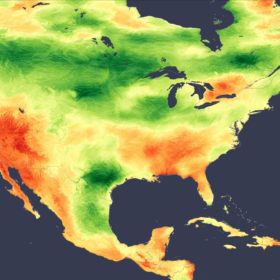
Tropical storms, record heat shape North America’s July solar production
In a new weekly update for pv magazine, Solcast, a DNV company, reports that while southwestern United States enjoyed increased solar irradiance in July, extreme weather events further north complicated solar operations during the holiday season.
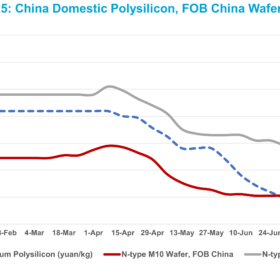
China wafer, polysilicon prices climb 33% since early July
In a new weekly update for pv magazine, OPIS, a Dow Jones company, provides a quick look at the main price trends in the global PV industry.
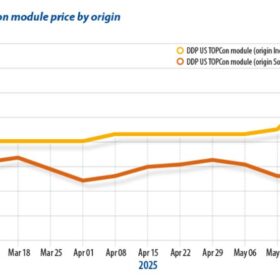
Trade headwinds fragment PV prices
Tempestuous trade conditions and policy uncertainty have led to module price fragmentation in the United States. Ahead of an expected reduction in manufacturing capacity utilization, leading manufacturers in China produced a high volume of cells in the spring. OPIS editorial director Hanwei Wu explains the latest market developments.

Double materiality assessment: Why rigorous ESG risk mapping isn’t optional anymore
Double Materiality Assessment (DMA) has become a central concept in Environmental, Social, and Governance (ESG) frameworks, especially under recent regulatory initiatives like the EU Corporate Sustainability Reporting Directive (CSRD). While implementation of DMA will only become mandatory for many companies over the next few years, there are already discussions at the EU commission in Brussels about simplifying the process to ease adoption. As an early adopter, Trinasolar shares insights on the purpose and benefits of DMA, makes a strong case for full-scope transparency, and reflects on key learnings from the 2024 DMA matrix rollout.
