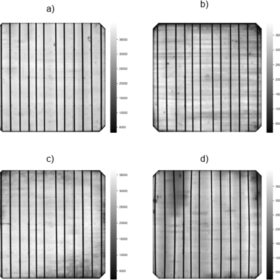
Copper-metalized heterojunction solar cells close to achieve same efficiency as silver-based counterparts
Researchers in Germany have shown that heterojunction solar cells screen printed with silver-copper on the front side and silver paste on the rear side can achieve a 0.13% efficiency gain over reference screen-printed bifacial cells based on silver alone. The research group worked specifically on dispensing and screen printing as printing methods.

Swiss startup offers timber-framed solar carport
Urbanpv has developed a timber-framed 46 kW parking lot design for ten parking spaces including the access lane.
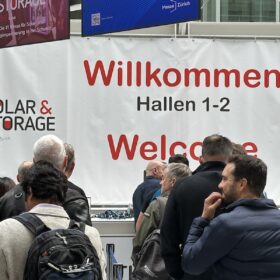
Solar & Storage Live Zurich 2025 reflects growth of Swiss PV sector
At the Solar & Storage Live trade fair, Swiss and European wholesalers were represented with products from manufacturers in Germany, Lithuania, Norway, Switzerland, and, of course, China. Some manufacturers also had their own booths, and there was also a new area for installers.

Xpanner launches robotic automation kit to retrofit solar pile drivers
The U.S. startup offers a new kit to integrate robotic automation with existing equipment.
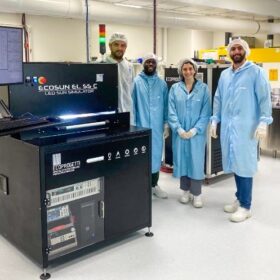
IPVF testing new perovskite solar PV testing platform from Ecoprogetti
The French research institute has added to its perovskite solar cell and module pilot line an Ecoprogetti integrated testing platform that combines a solar simulator with advanced electroluminescence (EL) analysis.
Encapsulant delamination behavior in PV glass recycling
Researchers in Spain investigated effective separation of encapsulants from PV glass with a focus on melting behavior and resistance to the hot knife-method of delamination. The results indicated that thermoplastic polyolefin encapsulants were the easiest to remove from the PV glass.
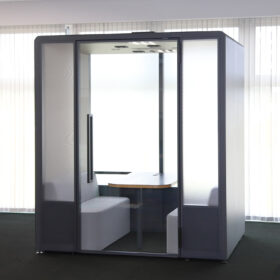
Itoki, Hitachi, Tokuyama recycle solar glass for office furniture
The Japanese companies have used their unique technologies to demonstrate how glass from end-of-life PV panels can be used in office furniture components, specifically in an office privacy cabin.

Vehicle integrated PV potential measured over a million km in Netherlands, Germany
Researchers have collected data from solar sensor-equipped vehicles, racking up over a million km mainly in the Benelux and German region, to be able to make more accurate efficiency and yield predictions. The research project is part of an ongoing three-year European assessment of VIPV.

Rable offers mounting system for east-west PV systems on low-load flat roofs
The Dutch startup said it is developing markets in France, Sweden, and Belgium after completing more than 50 solar rooftop projects in its home market based on its east-west oriented, self-supported mounting system.
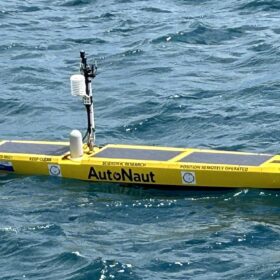
Solar, wave-powered uncrewed vehicle for marine monitoring
UK-based Autonaut offers wave-propelled and solar PV-powered drones capable of data collection at sea for several months at a time.
