
Swedish government backs Northvolt battery plant to tune of €15m
The Swedish Energy Agency has granted SEK 146 million to support Northvolt Labs’ large-scale battery manufacturing plant in Västerås, Sweden. Project already secured financial backing from ABB, Vestas and Scania.

The weekend read: Taking batteries from lab to market
The conversation around battery cell production may be heated, but it is largely confined to the advanced industrial economies of China, Japan, South Korea and the U.S. Although also a high-tech hub of innovation and manufacturing expertise, Europe has been on the outside looking in for some time. But that could all be about to change as two exciting storage production programs take flight.

Solar Philippines bids $0.058/kWh in Meralco price challenge
Solar Philippines has offered to provide continuous PV-generated electricity to power distributor Manila Electric Co. (Meralco) at a rate of PHP 2.99 ($0.058)/kWh.
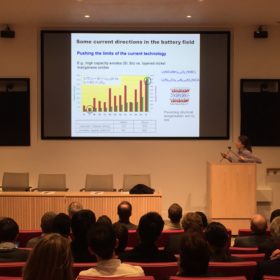
Battery storage challenges: Materials, longevity and project management
An academic event held last week in the U.K. presenting the results of two major research projects on energy storage provided an update on the current and future directions of battery storage technology and development.
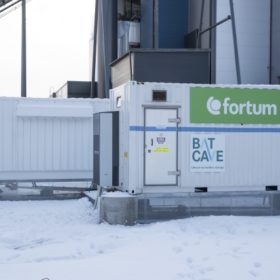
Battery, smart grid and efficiency companies raise $1.5 bn in VC funding in 2017 – Mercom
In 2017, battery storage, smart grid and energy efficiency companies saw a YoY increase in venture capital funding, garnering a combined US$1.5 billion, up from the $1.3 billion raised in 2016, finds the latest Mercom Capital report.
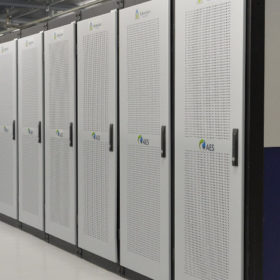
US C&I storage rankings place Stem, Green Charge and AMS at top
In the increasingly competitive commercial-and-industrial storage market, IHS Markit expects the segment to grow 10-fold over the next five years – and ranks the companies that will lead the charge.
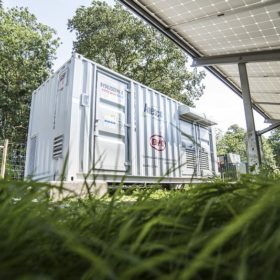
UK could reach 12 GW storage capacity within five years, report finds
Lessons learned from solar failures could propel battery storage market to 12 GW by 2021, argues report by All-Party Parliamentary Group on Energy Storage, which implores government to be “on the front foot” when it comes to seizing ways to ensure energy security for the nation.

Mali: Africa GreenTec issues €10 million corporate bond for solar containers
Up to 250,000 people are set to benefit from the containers, with communities revived by opportunities electricity can offer them.
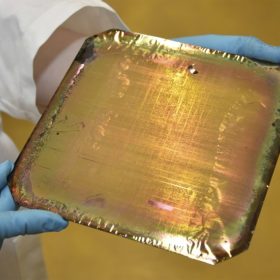
RENA leans on solar knowledge to develop mass etching process for lithium-ion batteries
German PV equipment manufacturer to team with Kiel University to develop scalable production of silicon anodes to boost lithium-ion battery performance.

UK government backs national battery facility to tune of £80m
Partnership between Coventry City Council, University of Warwick’s WMG and Warwickshire Local Enterprise Partnership to receive sizable investment from British government to build and maintain world-leading storage research and production facility.
