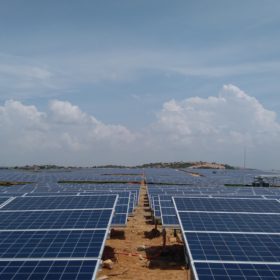
Solar is turbocharging Karnataka state to renewables leadership of India
The remarkable 4 GW of solar capacity added last year has seen Karnataka displace Tamil Nadu as the India’s renewables number one. And there is more to come, according to a new report, with PV set to account for a third of rising energy demand over the next decade.

Italy: Glass to Power crowdfunds €2.25 million, plans solar window fab
Italy-based Glass to Power has raised €2.25 million via crowdfunding to advance its plans for the roll out of an industrial production line for its transparent solar PV windows. The product is expected to be marketed in 2019.
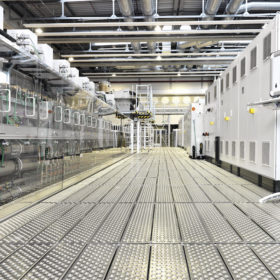
The weekend read: CIGS is back, back again
Stability and reliability, partial transparency, monolithic deposition onto flexible substrates, aesthetically pleasing appearance, applicability in roll-to-roll production, superior temperature coefficient, potential in tandem applications, and suitability for BIPV: The list of advantages that CIGS technology offers is well established and lengthy.
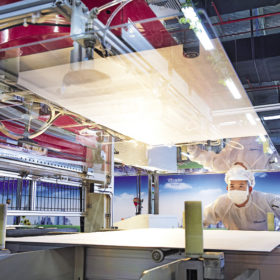
Top 10 crystalline PV module manufacturer ranking
With production and capacity figures provided by industry analyst IHS Markit, pv magazine provides a rundown of the top 10 crystalline silicon module manufacturers based on 2017 production data, followed by a look at the market forces and technology trends that have shaped the supply landscape.

Meyer Burger expects return to profit in H1 2018
In a preview of its half year financial results, Swiss equipment supplier, Meyer Burger has announced it is expecting a return to profit in the first half of 2018, recovering from a lengthy period of losses, including a major restructuring and the closure of multiple production sites.
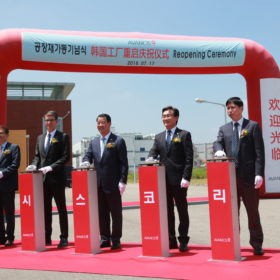
Avancis to restart Korean CIGS fab
The German thin film solar PV manufacturer has said it will restart production at its CIGS facility in South Korea. Annual production, scheduled for H1 2019, will be 100 MW.

REC Silicon hit by falling demand in Q2
Norway headquartered polysilicon producer, REC Silicon posted a loss of US$9.6 million for the second quarter of 2018, amid reduced production and increasing inventory. The company’s Solar Materials segment was responsible for much of these losses, with decreased demand and ongoing trade wars cited as the cause.

JA Solar exits NASDAQ exchange
Chinese module giant JA Solar has announced the completion of a merger that makes it the latest in a line of solar manufacturers to voluntarily de-list from a major stock exchange.

Indian government body recommends 25% tariff on Chinese and Malaysian cells, modules
Phased import tariff would fall to 20% 12 months after introduction and 15% for final six months of a proposed two-year period. Industry watchers say the cost of Indian solar energy could rise by up to 30%.
Daqo New Energy lowers Q2 forecast
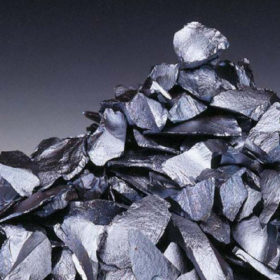
Chinese polysilicon giant Daqo New Energy has revised down its guidance for both polysilicon and wafer sales in the second quarter of 2018. The company states, however, that it remains confident in long-term prospects for the solar industry; and is proceeding as planned with capacity expansions.
