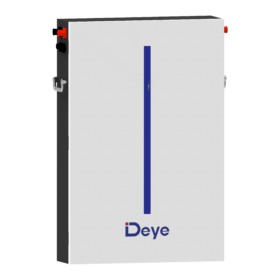
Deye unveils lithium iron phosphate battery for rooftop applications
China’s Deye has developed a new lithium iron phosphate battery system with a nominal voltage of 51.2 V. It says that up to 32 modules with a capacity of 6.14 kWh can be stacked and connected in parallel for a total capacity of 196.48 kWh.
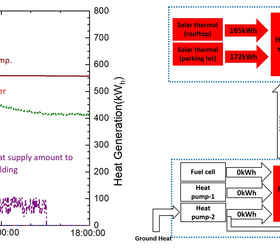
Renewables-powered heat pump for district heating
South Korean researchers have developed a heat trading system including a ground-source heat pump, solar thermal collectors, a fuel-cell system, and two heat storage tanks for district heating at hours of peak solar production.
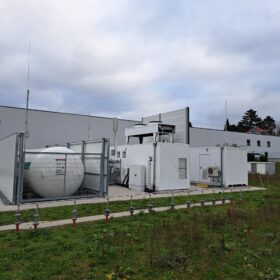
The Hydrogen Stream: German grid operator increases hydrogen blend in regional gas network
Netze BW has increased the amount of hydrogen it is injecting into the regional grid of Oehringen, in the southwest of Germany, from 20% to 30%. pv magazine spoke with the project leader, Heike Grüner, about the next phases of the project.
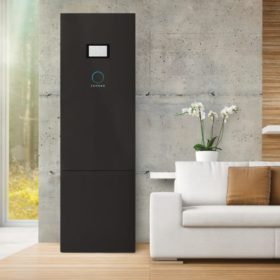
Italy deployed 1,121 MW/2,032 MWh of distributed storage capacity in 2022
Italy hit 959 MW/1,826 MWh of distributed storage capacity at the end of 2022. The segment continues to grow in the country, led by the regions of Lombardy and Veneto.
State of the (European) union
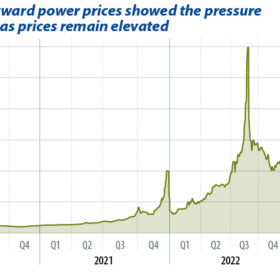
Gerard Reid, co-founder of corporate finance advisory Alexa Capital, considers whether the EU is up to the task of dealing with the twin threats of the energy crisis and the pull of a revitalized US clean power industry.
Study shows symbiotic effect of heat pumps and residential solar
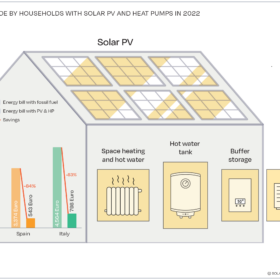
SolarPower Europe says in a new report that households in Germany, Spain, and Italy can more than triple their savings by pairing PV with heat pumps. It said this combination helped families to save between 62% and 84% on their annual energy bills in 2022.
EU wants European PV sector to make 40% of required components by 2030
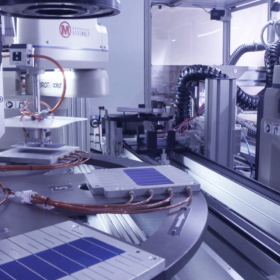
The European Union is working on a draft proposal, which pv magazine has seen, that would require 85% of the components used in European wind farms – along with 60% of heat pumps, 85% of batteries, and 85% of electrolyzers – to be manufactured on the continent.
Fraunhofer ISE, Viessmann develop multi-source residential heat pump
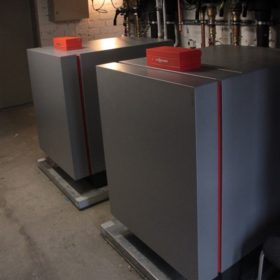
Fraunhofer ISE has presented the results of retrofit heat pump installations in multi-family homes in Germany. One demonstrator featured rooftop solar PV and a multi-source heat pump developed in partnership with Viessmann. It uses air and geothermal as heat sources.
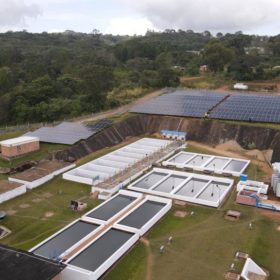
Solar, storage system for water treatment in Malawi
RIC Energy has built a 1.3 MW PV array and a 4.5 MWh battery system for two water treatment plants and five water pumping stations in Malawi. The hybrid system will treat enough water to supply more than 200,000 people.

The Hydrogen Stream: Japan finances Australia’s plan to produce H2 from coal
A Japanese state innovation fund has agreed to finance a coal-to-hydrogen project in Australia, while Honda says it has taken another step toward the commercialization of zero-emission backup power generation.
