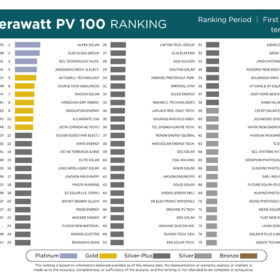
Who are the Top 100 PV manufacturers today?
The Terawatt PV 100 ranks the top 100 solar manufacturing companies using a new methodology based on production scale, financial strength, and corporate transparency, with Tongwei leading the Q1 2026 list and most top firms headquartered in China. The analysis highlights increasing global supply-chain scrutiny driven by tariffs and ESG mandates, while also showing rising influence from Indian companies and strong positions for key materials and equipment suppliers.

Global-warming-induced degradation could raise rooftop solar LCOE by up to 20%
A global study finds climate change will sharply increase high-temperature risks, accelerate degradation, and raise costs for rooftop PV, with economically disadvantaged regions hit hardest. Researchers warn current IEC standards underestimate future risks, urging urgent updates to avoid stranded assets and rising electricity costs.

What happens when type-C cracks strike photovoltaic modules
An international research team used high-resolution electroluminescence imaging to quantify type-C cracks in 100 PV modules after 11 years of operation, linking crack distribution to real-world power loss. Concentrated cracks within individual cells were found to cause disproportionately high losses, highlighting the importance of cell-level crack analysis for effective PV maintenance.
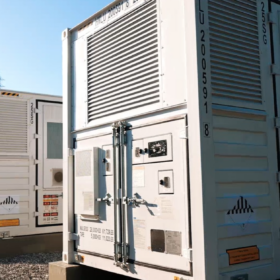
Brazil reserve battery auction rules near finalization with 20 GW lined up
Brazil’s electricity regulator has approved March reserve capacity auctions for thermal and hydro plants with more than 125 GW registered, while guidelines for a separate battery storage auction remain pending even as over 20 GW of projects are under development.
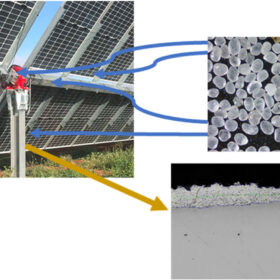
The impact of sand erosion on mounting structures in large-scale PV plants
Researchers in Spain have tested the erosion resistance of common galvanized coatings using both free-falling sand and forced-air sand-impingement methods. The study found that continuously galvanized steel coatings showed the lowest erosion rates, outperforming HDG and Zn-Al-Mg coatings.
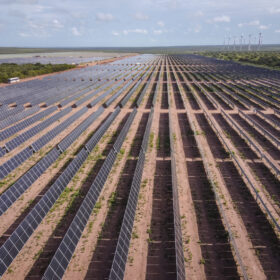
Capex-driven strategies can reduce solar LCOE by 20%
An international research group has conducted a literature review of capital expenditure-driven levelized cost of electricity optimization strategies for utility-scale PV systems. Tracking optimization, system voltage escalation, and advanced system design are identified as the most promising cost reduction areas. “The next wave of PV research must be LCOE-native, system-level, and deployment-validated,” a member of the research group said.

New multi‑hotspot detection tech based on Lab* feature descriptor
A Husqvarna researcher developed a fast, interpretable PV hotspot-detection method using IR thermography and Lab* color-space features instead of heavy neural networks, achieving up to 95.2% accuracy with shallow classifiers. The lightweight system works in real time on drones or edge devices and could save 17,620 kWh and 8.9 tons of CO₂ annually by improving fault detection in solar panels.
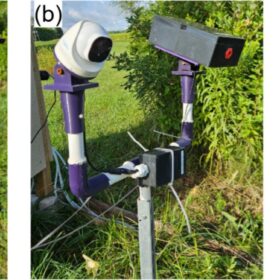
Open-access, modular monitoring platform for multi-year outdoor PV testing
A team of researchers in Canada has developed the Jericho Open Resistive Data Logger—an open-access photovoltaic (PV) monitoring platform that integrates data acquisition and processing hardware, a software framework, and a comprehensive sensor array. Designed primarily for agrivoltaic applications, the system has a total estimated cost of around $2,000.

Detecting PV module defects at a single glance
Scientists in China have developed a new deep learning model based on the so-called “You Only Look Once” algorithm, which requires only one forward propagation pass through the neural network to make predictions,
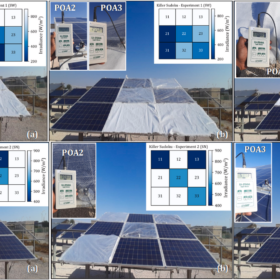
Using Asterisk Sudoku for PV system reconfiguration under shading conditions
Researchers in Qatar have used an algorithm relying on a variant of the popular logic-based puzzle to determine the optimal way to eliminate cluster shading. They have tested the new approach under fixed and moving shadows.
