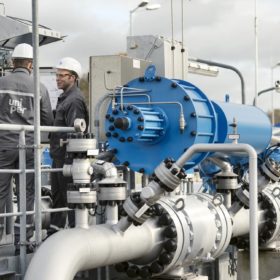
Incentives crucial to avoid green, blue, and even purple hydrogen fading to grey
An Anglo-German report has suggested the environmentally-friendly desire to use only clean power to produce hydrogen, outlined by nations such as Germany, could end up being more emissions-heavy than the more pragmatic embrace of blue hydrogen under consideration in the U.K.

DuPont Teijin: Solar is at a crossroads, the PV value chain must come together
Rivalry is an integral part of the global business landscape, particularly in an industry like solar where products have become commodities. However, as Steven Davies, EMEA market manager for DuPont Teijin Films underlines, when it comes to sustainability, cross-industry partnerships are increasingly necessary to overcome the challenges companies are facing, including changing consumer demands and supply chain risks posed from climate change disruptions.
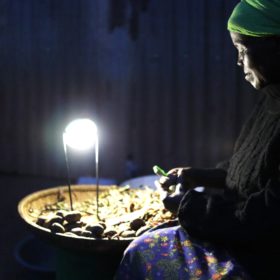
Entire village in Malawi to receive solar in pilot project
It is hoped 100% solar home system installation–with householders able to buy, or lease on a PAYG basis–will offer a template for installation in remote communities across Africa.
Chinese utility pitches energy transformation credentials
The fossil fuel assets belonging to the state-owned parent of China Power International Development might overshadow the latter’s green claims but the Hong Kong-listed utility said it reached full operation at 940 MW of solar farms in 2020–more than half of it unsubsidized.

Indonesian government has vastly underestimated solar potential
A Jakarta thinktank says the authorities need to significantly raise their clean energy ambitions as even the most conservative estimates of the volume of solar capacity the nation could host far outstrip the 207 GW the energy ministry has suggested.
India’s $122bn energy stimulus spending may benefit fossil fuels most
A report says India’s energy investment commitments over the last 14 months largely feature measures for power transmission and distribution that could benefit greenhouse-gas-producing fuels more than renewables.
‘Solar can energize the East African recovery’
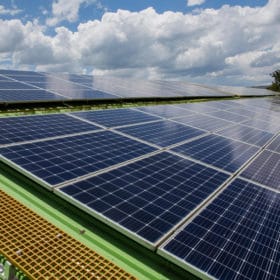
Patrik Huber, co-founder and managing director for East Africa at renewables leasing company Solarise Africa, has spoken to pv magazine about the company’s take on how the region can prime for a green recovery. Huber explained Solarise’s contribution to the recovery includes recent expansion into three new countries.
Global temperature goal of 1.5C needs 14 TW of solar by mid century
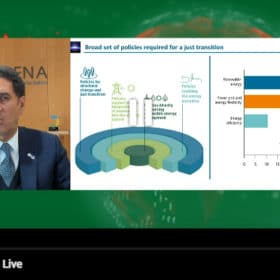
Renewable electricity will be linked to 90% of the actions needed to remove carbon emissions in 2050, according to the International Renewable Energy Agency, and the biggest volume of generation capacity will be provided by solar.
Household solar holds key to climate-neutral Japan
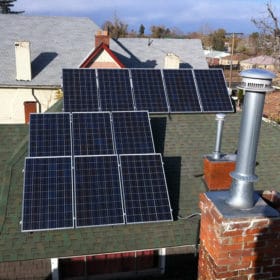
Rooftops will have to supply a third of the 524 GW of solar generation capacity needed by 2045 to reach a zero-carbon economy by mid century, according to an academic paper. The researchers also suggested green hydrogen should not play a central role in the nation’s energy transition.

Solar-led renewable energy system could free up 10% of Caribbean nation’s GDP
A mix of solar and wind power can help Antigua and Barbuda to an almost-90% renewable energy system, and green hydrogen could then show the path to hitting the national ambition of 100% green power by 2030, and net zero by 2050.
