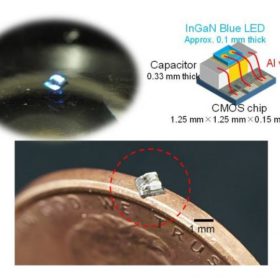
Japanese scientists develop wireless optical neural stimulator based on PV
A very small implantable device that can be used to control brain patterns has been developed by Japanese researchers using photovoltaic technology. The device is both the smallest and the lightest wireless optical biodevice to have ever been developed.
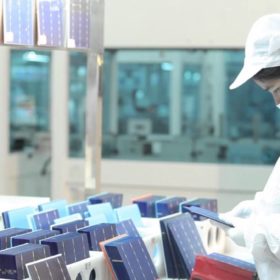
JinkoSolar achieves 23.95% efficiency for p-type mono cell
Chinese module manufacturing heavyweight JinkoSolar has announced the achievement of a new world record efficiency for a p-type monocrystalline silicon cell, at 23.95%. The record has been confirmed in testing by the Chinese Academy of Sciences.
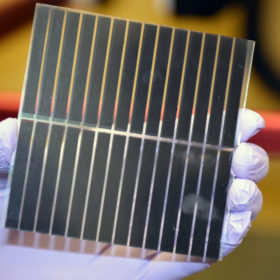
Japanese scientists use manganese to boost perovskite cell performance
Researchers working on inorganic perovskites at the Energy Materials and Surface Sciences Unit at the Okinawa Institute of Science and Technology Graduate University (OIST) in Japan have found that doping with manganese can significantly improve the performance of wholly inorganic perovskite solar cells.

AT Solar builds innovative storage project based on hydrogen in Sweden
The goal of the project, RE 8760 is to show how the storage of renewable energies can make them usable all year round. The generated solar power is stored and converted into hydrogen. It can also be conserved over long periods and used to recharge fuel cell vehicles during the dark winter months.
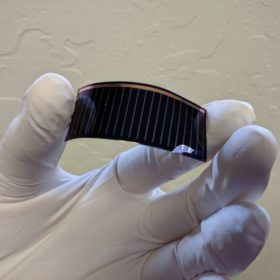
Alta Devices launches new solar cell for vehicle integration
U.S. technology company, Alta Devices has launched a new gallium-arsenide based solar cell, which it says improves on the power to weight ratio of its previous cell by 160%. The cell is designed to provide lightweight, high efficiency generation for integration with cars, drones and other vehicles.

Berkeley Lab scientists discover coating to capture near infrared light
A team of researchers the United States Department of Energy’s Lawrence Berkeley National Laboratory has discovered a method of coating particles with organic dye, which can capture near infrared light, a breakthrough which, according to the researchers, could greatly boost solar cell efficiency by capturing a larger section of the light spectrum.

US scientists claim new efficiency record for organic tandem solar cells
A team from the University of Michigan in the U.S. has developed an organic tandem solar cell with 15% efficiency, a new record for an organic solar cell. The scientists utilized a novel method for stacking the two layers on top of each other without damaging either layer.

Longi half cut PERC module exceeds 360 W
Longi is progressing at breakneck speed, having announced yet another world record. This time, the Chinese manufacturer says its 120-cell half-cut monocrystalline PERC module has exceeded 360 W.

European researchers discover new effect of light on perovskites
Scientists led by Germany’s Max Planck Institute for Solid State Research have demonstrated for the first time that, as well as electrons, light also releases charged particles in a perovskite solar cell material. The researchers state that this groundbreaking discovery could make possible new solar power applications, such as batteries directly charged by light.

UK researcher’s discovery could push PV into shape
A team of scientists at Warwick University in the U.K. has discovered a method for altering the structure of a semiconductor at the nano level which, it says, could push cell efficiencies of several materials beyond their theoretical limits.
