





The timing is hard to miss. In the white paper, Sungrow notes that mainstream cell capacity has risen from around 280 Ah in 2021 to over 500 Ah by 2024, while single-container capacity has moved from roughly 3 MWh to more than 6 MWh, and individual plant scale has crossed into the GWh range. The same document cites BloombergNEF’s expectation that global cumulative installed energy storage capacity will rise twelvefold by 2035 (to 7.3 TWh).
Scale, however, has arrived with sharper risks. The paper cites 125 recorded energy storage fire incidents globally as of H1 2025 and argues that the industry has been too ready to treat “cell safety” as a proxy for “system safety”.
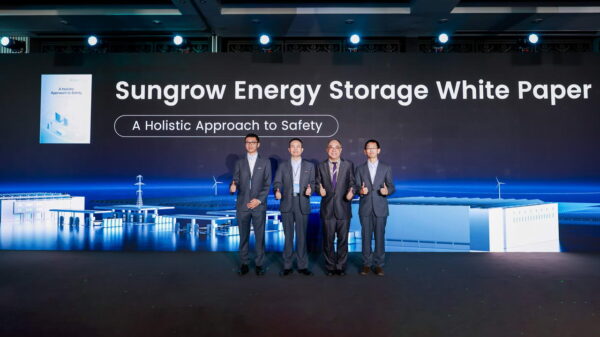
That gap—between component-level engineering and system-level outcomes—is the central target of the new report, titled Sungrow Energy Storage White Paper: A Holistic Approach to Safety. In TÜV Rheinland’s foreword, Weichun Li, Senior Vice President for Solar and Commercial Products in Greater China, frames the shift as structural: “Traditional single-layer protections… are no longer sufficient” for system-level risks, and the industry is moving towards “system-level, full-lifecycle” safety expectations.
Sungrow’s answer is what it calls an “all-dimensional” architecture: protection across space—from cell to grid—and across time—from R&D and verification through operation and end-of-life. The paper positions this as a “safety-by-design” discipline that integrates electrochemistry, power electronics and grid-forming technologies, rejecting “tiered safety standards” in favor of a single high baseline for all customers.
The practical content is detailed, and, crucially for a safety document, heavy on measurable claims.
At the battery layer, the paper argues that higher-capacity cells raise new mechanical and thermal challenges, and that “managing cells effectively” becomes as important as selecting them. It describes a battery monitoring and management technology (BM²T) and cites performance targets including cell-level SOH estimation error <2%, rack-level SOH <3%, and SOC estimation error ≤3%. It also cites lithium plating early-warning accuracy ≥95% and claims thermal runaway early warning five minutes in advance with ≥99% accuracy (and ten minutes with ≥95%), aiming to reduce false alarms and unplanned shutdowns.
At the electrical layer, the statistics show that short circuit and arcing are major triggers in past incidents. Among comprehensive electrical safety technologies, its DC arcing suppression technology ArcDefender is highlighted. In one summary, the system is described as covering arc currents from “mA level to 500 A” and identifying and extinguishing arcs within 0.1 seconds.
At the system layer, the paper leans on standards as much as engineering. It describes an integrated fire suppression system designed to ensure “extreme thermal runaway does not result in fire”, aligned with tests and frameworks including UL 9540A and NFPA 855/69/68/13.
Where the document becomes most persuasive is at plant scale, where laboratory confidence often meets the messier reality of installation geometry, weather, and imperfect commissioning. The white paper describes a 20 MWh “real-world” scenario using four PowerTitan 2.0 systems, with containers arranged back-to-back and separated by just 15 cm, and with fire protection systems deliberately disabled. It says 52 cells in one container were destructively heated and ignited to induce thermal runaway.
The reported outcome is stark: the fire peaked with the affected container reaching 1,385°C, while the adjacent container reached 42°C—and the paper says there was no thermal runaway propagation to neighboring containers. After 26 hours of continuous combustion, it says there was no re-ignition and no burn-through, and that adjacent containers remained undamaged.
The grid layer, meanwhile, is treated as more than a marketing add-on. With inertia declining and volatility rising in high-renewables systems, the paper argues that storage safety must include grid forming services—particularly in weak-grid conditions. It cites a specific event on December 23, 2023, when a high-voltage transmission line between the UK and France tripped, causing an instantaneous loss of 1 GW and a frequency drop from 50 Hz to 49.3 Hz. The paper says a Sungrow energy storage plant in Minety, the UK, responded within 1 second, helping restore frequency within 5 minutes.
This is where the corporate narrative aligns most neatly with an investor’s or operator’s view: safety is not merely the absence of fire, but the ability to keep assets controllable, insurable and grid-compliant as their scale grows.
Roger Li, General Manager, Utility-Scale Product Line, Sungrow Energy Storage Business Unit, puts it more bluntly in the company’s own framing: “Safety is designed… verification comes before manufacturing.” He argues the goal is not “cost-blind stacking” of safety features, but “just-right design” that turns risk management from reactive handling to proactive pre-emption—so storage is not only usable, but “safe to use, durable to use, and dependable to use”.
The white paper's underlying proposition is a practical one: as storage moves towards larger cells, denser containers and gigawatt-class plants, the industry will either build safety into architecture—or pay for it later in downtime, retrofits, higher insurance premiums and slower permitting.
Sungrow and TÜV Rheinland’s joint release is a bid to make “all-dimensional safety” the new baseline—and to make safety-by-design a competitive advantage rather than a cost line.
