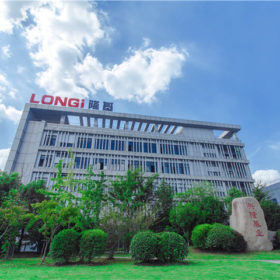
Longi claims 23.6% efficiency for its PERC monocrystalline cells
Just one month after announcing a PERC module efficiency of 20.41%, the Chinese solar manufacturer announced it has now achieved a 23.6% efficiency for its PERC monocrystalline cells, thus beating its own previous records.

Roth: US steel, aluminum tariffs to add at least 1-3c per watt to solar projects
While President Trump has a range of options, all likely scenarios seem likely to result in a modest increase in the cost of solar installations.

Elkem plans IPO on Norway’s stock exchange to expand silicon business in China
Through the IPO, the Norwegian polysilicon maker and silicon product provider will raise the funds to acquire two Chinese manufacturing facilities from its parent company.
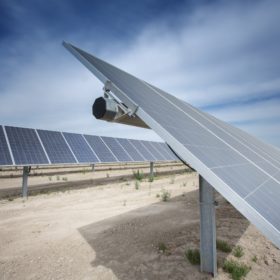
Solar to lead global renewables growth for next five years — KPMG
Investors throughout the world made 406 investments in large-scale renewables in 2017, collectively valued at roughly €40.1 billion (US$49.5 billion), but solar is set to grow more in terms of capacity than any other clean-energy technology over the next half decade, according to a new report. Battery storage will play a crucial role in this, it found.
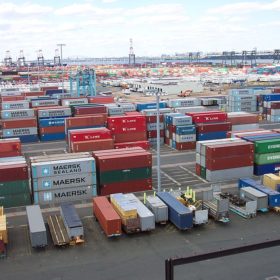
US imports of Chinese solar climbed sharply in Q4
1,200%. According to Bloomberg New Energy Finance, that’s how high imports of Chinese modules rose in the fourth quarter last year, in a desperate attempt to stockpile sufficient numbers before tariffs choked off international supplies.
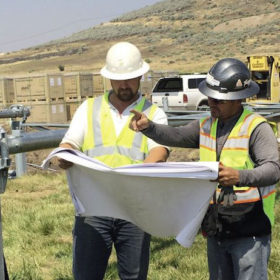
Chinese companies lead global solar developer rankings
State Power Investment Corporation (SPIC) and GCL New Energy have taken the top spots for installed capacity, but Canadian Solar and First Solar are showing impressive pipelines.
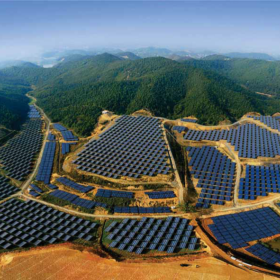
AECEA: Solar to overtake wind in China
A new report from the Asia Europe Clean Energy Associates (AECEA) expects solar to overtake wind energy in 2018 as China’s third largest source of power generation. AECEA is calling 2018 a ‘transition year’ for PV in China, as new regulations reshape the market, which is still expected to reach 250 GW installed capacity by the end of 2020.
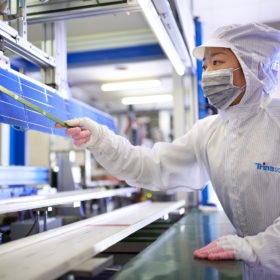
Trina Solar hits new efficiency record for IBC cell
Trina Solar has set a new record of 25.04% total area efficiency for an n-type interdigitated back contact (IBC) solar cell. The record has been independently verified by Japan Electric Safety and Environmental Technology Laboratory.
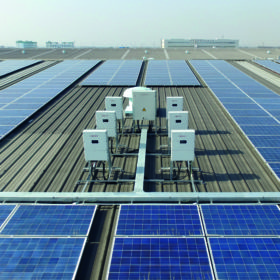
France’s EDF enters China’s rooftop solar market
Creation of joint venture with Asia Clean Capital sees the French energy giant announce plans to build, own and operate distributed rooftop solar projects across China.
Longi to triple wafer capacity to 45 GW by 2020
The Chinese vertically integrated solar manufacturer has set out a three-year roadmap, aiming for 28 GW monocrystalline wafer capacity by end of this year, 36 GW by the end of 2019, and 45 GW by 2020.
