From niche to mainstream: the keys to making BIPV happen today
This pv magazine Webinar will investigate how BIPV companies and stakeholders such as architects, the construction sector, smart city initiatives and regulations, and more, can work together, to create generating assets from large buildings in urban environments and commercial applications, to residential environments.

The Hydrogen Stream: Italy’s Eni lays out plans in Algeria and Egypt, UAE joins race with help from Japan
Italian energy company Eni is partnering with local companies in Algeria and Egypt to explore the possibility of producing green and blue hydrogen in the North African countries. The United Arab Emirates is also collaborating with Japanese partners to develop the country’s hydrogen sector, while in New York, hydrogen has arrived in Long Island.
A wave of big African solar is set to break
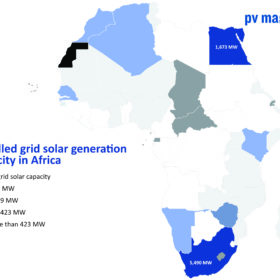
The Africa Solar Industry Association has recorded almost 2 GW of large scale project announcements since the start of last month with 18 countries planning new clean power infrastructure and including energy storage in the plants.
Universal electricity access by 2030 remains a distant dream
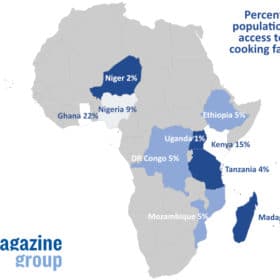
Energy efficiency, electrification of heating and transport, and the provision of clean cooking facilities are all going in the wrong direction as the Covid crisis deprived millions in sub-Saharan Africa of electricity use, according to a report by the IEA, IRENA, WHO, World Bank and UN Statistics Division.
Battery storage – a key resource in the MEA energy transition
Solar and other renewable energy sources are rapidly growing their share in the energy mix all over the world. And as this grows, so too does the importance of energy storage in balancing the intermittent output of solar and wind and ensuring electricity is available wherever its needed. In this pv magazine Webinar, we’ll focus in on the role of storage across the Middle East and Africa regions, where we not only see batteries being deployed to support regional grids, but to provide backup power to commercial operations, form microgrids, and firm up the supply to off grid and rural electrification projects.

Assessment of floating PV potential at African hydropower reservoirs
European researchers have estimated the potential of floating PV deployment at Africa’s existing hydropower reservoirs which exceed 5 MW in size, by using satellite images and hydropower reservoir data. Under the most likely scenario presented in the study, utility scale floating solar may reach a capacity of more than 20 GW by using less than 1% of the water surface area at 108 hydropower plants spread across the continent, assuming a capex of €0.40/W.
C&I sector in Sub-Saharan Africa embraces captive solar solutions
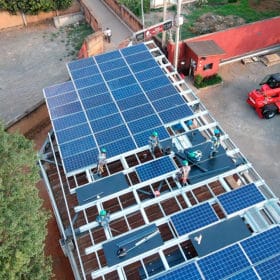
The Commercial and Industrial (C&I) solar sector currently accounts for 75% of power demand in Sub-Saharan Africa. However, due to the unreliable nature of energy supply from the grid, consumers under this segment have been forced to invest in alternative sources of energy, which they consider to be more reliable and less expensive, such as the use of captive solar solutions.
Solar dried up in North Africa during 2020
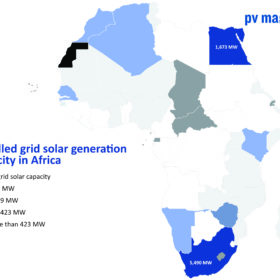
Politicians across the continent will have to decide between their heavily-indebted state utilities or embracing the energy transition, according to one energy analyst.
Solar Data Is Power: Maximizing Solar PV Value Through the Entire Lifecycle with Optimized Solar Datasets
Join this pv magazine Webinar to learn what factors to consider when selecting a solar data service to support the lifecycle of your solar projects.
Cutting out the cracks: Advantages of thermal stress cutting
Since their introduction midway through the last decade, half cut cells have grown to become an industry standard technology adopted by virtually every module manufacturer. And as we see larger formats and other innovations that require cells to be cut into three or more pieces, the trend is only set to grow further; and this places the processes used to cut the cells at the heart of PV manufacturing. In this pv magazine Webinar we’ll take a closer look at the innovative thermal laser separation developed by 3D-Micromac, comparing this to the traditional ‘scribe and break’ processes still widely used in PV manufacturing, and taking a look at Voltec Solar’s production line in France where the TLS tool is in operation.
