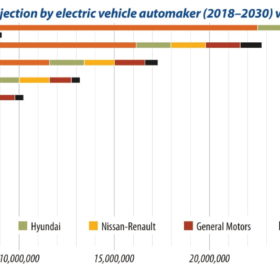
Electric vehicle race heats up
The race to electrify passenger cars is picking up pace, writes Prachi Mehta, senior research analyst for Wood Mackenzie. Competition among leading EV automakers is fierce, as 2024 looms as a watershed year when auto battery-pack prices cross a key consumer threshold.
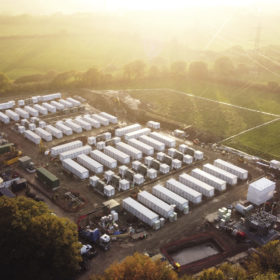
The weekend read: Energy storage potential
As solar and wind make up larger portions of the energy mix, energy storage is becoming an increasingly important piece of the puzzle in keeping electricity networks running smoothly. And as battery costs fall, new business models are emerging to increase the value of battery energy storage projects for both grid operators and project owners. Focusing on two leading countries – the United Kingdom and Australia – pv magazine looks at what’s in store for large-scale energy storage.

The Hydrogen Stream: New push from Oman, a guide to produce hydrogen from aluminum and more blue hydrogen projects
Oman is expanding its network to become a hydrogen hub and the Massachusetts Institute of Technology (MIT) has published a practical guide for generating hydrogen using scrap aluminum. Furthermore, BP and Mitsui have separately announced more blue hydrogen projects.

Can $100 billion in green finance be raised annually to help emerging economies fight climate change?
Project finance for infrastructure in emerging economies is one of the central issues of the upcoming COP26 agenda. For the Emerging Africa Infrastructure Fund (EAIF) and its parent organization, the Private Infrastructure Development Group (PIDG), the event is likely to bring considerable global focus on what it does and how it does it. In the following Op-ed Martijn Proos from Ninety One, the EAIF’s managers, discusses the role of EAIF and how it is helping to fund new renewable energy capacity across Africa.
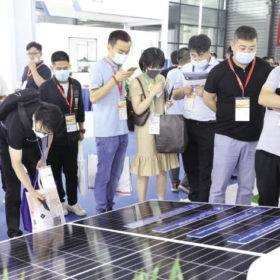
Current affairs
A new white paper published by Chinese module giant JA Solar examines the performance of new large format modules, and compares products based on the two different wafer sizes, 182mm and 210mm, that are set to dominate the market for the coming years. Thanks largely to the impact of very high currents present in the larger of the two options, JA Solar finds that the 182mm products offer a slight advantage in performance. Further, JA notes that any further increases in size would come with more risk than reward, and calls on the industry to return its focus to reaching higher cell efficiencies and yields through new materials and innovations.

The Hydrogen Stream: Russia unveils hydrogen strategy, Germany provides more funds for power-to-X
ThyssenKrupp has also said it is working on a green hydrogen and ammonia project in the Emirates and three U.S. companies are planning to develop low-cost renewable hydrogen generation for use in transportation and distributed energy applications.

Harnessing heat loss with thermionics
Scientists in Canada evaluated the potential of a lesser-known approach to boosting solar generation efficiency. Thermionics uses heat from the sun to generate electricity, and could be combined with photovoltaics to create devices with better than 40% efficiency from a single junction. In their evaluation, the scientists find promising pathways for further research, despite a mountain of challenges that will need to be overcome.
Vehicle-to-grid outlook
Multiple drivers are combining to allow battery capacity in electric vehicles to be used as a grid asset through vehicle-to-grid technology, writes George Hilton, senior analyst for energy storage at IHS Markit. Vehicle-to-grid tech could offer low-cost energy storage at a huge scale, but there are many barriers to overcome.

The weekend read: ‘Hydrogen is the flagship of the energy transition’
Ankica Kovač is an assistant professor at the University of Zagreb and the head of the Power Engineering Laboratory. She is also a member of the Council of the President of the Republic of Croatia for Energy Transition, along with numerous energy transition bodies and working groups.
Module wind load resistance: Standards vs. reality
With extreme weather events becoming all too common, and a growing list of PV projects that have been damaged or destroyed by strong winds, ensuring that mounting structures are able to withstand the pressures they’ll face in the field is a vital concern for all involved. In this pv magazine Webinar, we’ll examine where current testing standards may fall short, and what this means for suppliers of trackers and mounting structures. And we’ll also be treated to a closer look at Gamechange Solar’s testing program, which takes into account the different pressure gradients across a module’s surface in a high wind environment; and ensures ample wind resistance.
