China could be preparing to settle unpaid subsidies mountain
In-country analyst the AECEA has speculated the authorities could be ready to wipe the slate clean for the start of the nation’s 14th five-year plan on January 1. The analyst has raised its solar expectations for the year but noted the sky-high price of polysilicon remains a concern for developers.
The steeplechase of transparent PV
A South Korean research team has claimed that transparent PV technologies need to improve in terms of efficiency, stability and aesthetics before they can reach commercial maturity.
Solar tile with passive cooling
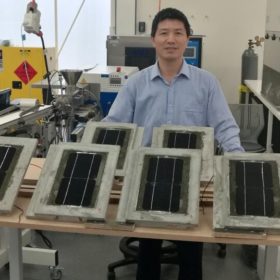
Researchers built the device by attaching 17%-efficient monocrystalline PV cells to a mortar roof tile that was doped with a phase-change material (PCM). The PCM solar tile provided 4.1% more power than the PV tile with no cooling agent in the winter, and 2.2% to 4.3% more during the summer.
How much vertical BIPV is too much?
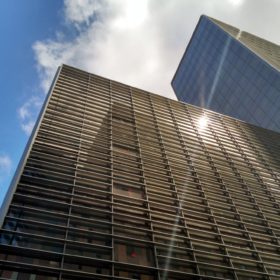
A French-Italian research group has shown that BIPV facades on buildings can cause a ‘darkening’ effect by reducing light reflectance on nearby installations, dragging down energy production by 11%. The ‘urban heat island effect’ can also weigh on PV system performance, the researchers said.
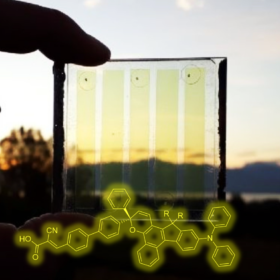
Semi-transparent mini BIPV panels for solar windows
European scientists have developed mini modules with an active area of 14 cm² and a 3.68% efficiency rating. The panels also have a self-adjusting feature that can help to mitigate the amount of light when they are exposed to full sunlight, or to the temperatures of buildings with large windows and/or glass facades.
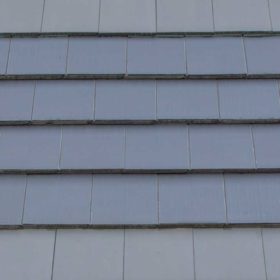
A 17.5%-efficient dark grey solar tile
U.K. business Roof Tiles Technology Ltd has developed a solar tile with a claimed efficiency of 17.5% and power output of 175 W per square meter. The company’s founder, Antonio Lanzoni, said a PV system featuring the product would cost 25-30% more than a standard solar rooftop.
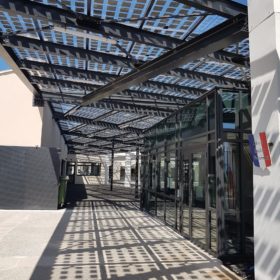
BIPV solar modules with varying transparency
German panel maker Sonnenstromfabrik has developed a glass-glass monocrystalline PV module in three versions offering different levels of transparency. The company says the transparency feature makes the panels suitable for verandas, pergolas, awnings, carports, swimming pools, halls and facades. Their power output varies from 160 W to 280 W, while their efficiency ranges from 9.5% to 16.7%.

New PV system for facades, windows in Japan
Japan’s Kaneka and Taisei have designed their T-Green Multi Solar system to be integrated into walls and window surfaces. The system is available in two different versions – a solid type in which PV laminates are turned into vertical exterior panels or walls, and a variant that achieves transparency through striped solar cells that are integrated into window glass.
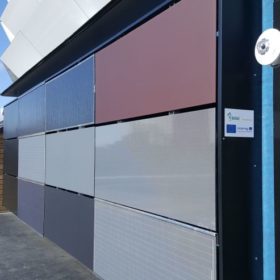
Colored PV module performance is underestimated
In a recent conversation with pv magazine Roland Valckenborg, business developer and project manager at the Netherlands Organisation for Applied Scientific Research (TNO), has described the results of a multi-year testing program for colored BIPV modules. Just a few years ago, it it was thought that power yield could be up to 50% lower than conventional panels, but tests have shown a difference of just 10%. Valckenborg says that losses can vary depending on the color of a panel.
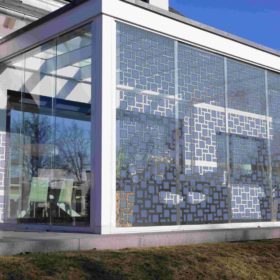
‘Free-form’ organic PV
French organic PV module manufacturer Armor said it began manufacturing free-form PV modules in early April. The new technology will allow the company’s ASCA PV film to be produced in a range of different shapes.
