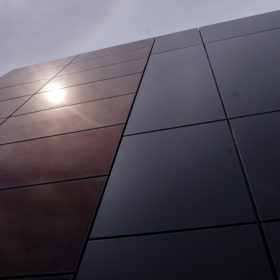
CdTe facade solar panel with 18.2% efficiency
New cadmium telluride solar panels are now available for applications on tall buildings in urban environments. Their efficiency ranges from 15.3% to 18.2%, with 110 W to 450 W of power output.
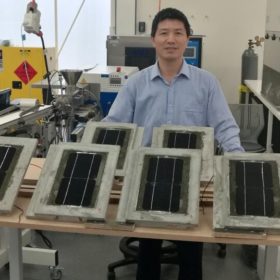
Solar tile with passive cooling
Researchers built the device by attaching 17%-efficient monocrystalline PV cells to a mortar roof tile that was doped with a phase-change material (PCM). The PCM solar tile provided 4.1% more power than the PV tile with no cooling agent in the winter, and 2.2% to 4.3% more during the summer.
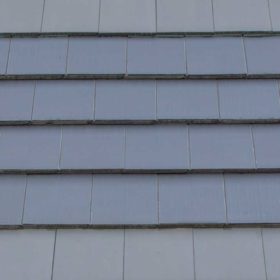
A 17.5%-efficient dark grey solar tile
U.K. business Roof Tiles Technology Ltd has developed a solar tile with a claimed efficiency of 17.5% and power output of 175 W per square meter. The company’s founder, Antonio Lanzoni, said a PV system featuring the product would cost 25-30% more than a standard solar rooftop.
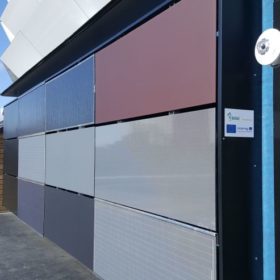
Colored PV module performance is underestimated
In a recent conversation with pv magazine Roland Valckenborg, business developer and project manager at the Netherlands Organisation for Applied Scientific Research (TNO), has described the results of a multi-year testing program for colored BIPV modules. Just a few years ago, it it was thought that power yield could be up to 50% lower than conventional panels, but tests have shown a difference of just 10%. Valckenborg says that losses can vary depending on the color of a panel.
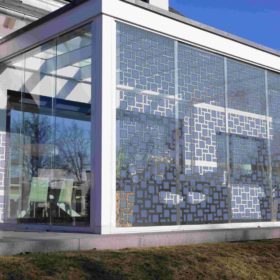
‘Free-form’ organic PV
French organic PV module manufacturer Armor said it began manufacturing free-form PV modules in early April. The new technology will allow the company’s ASCA PV film to be produced in a range of different shapes.
