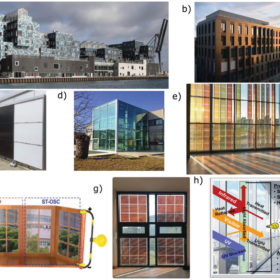
Tunable solar cells with customized design capabilities
German scientists have reviewed all solar cell technologies with tuning capabilities and have identified all of their possible applications.
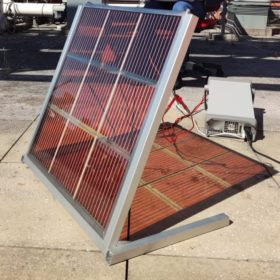
Semitransparent dye-sensitized solar module for BIPV applications
Scientists in Italy have developed a module with an area of 0.2 sm and an efficiency of 2.7% in outdoor conditions, with a tilt angle of 60 C. They designed it by considering the trade-off between low losses and device sturdiness.
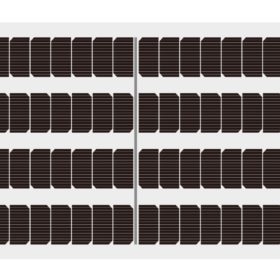
JinkoSolar showcases 13.08%-efficient transparent TOPCon solar module for BIPV, agrivoltaics
The new solar module can be purchased with different levels of transparency, depending on the project, with light transmittance ranging between 30% and 40%. It has a power output of 245 W to 300 W and a temperature coefficient of -0.30% per C.
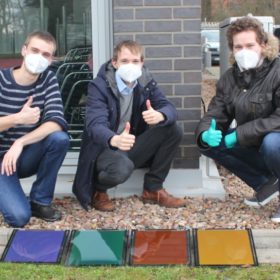
Novel way to turn semi-finished thin-film solar modules into colored BIPV panels
German scientists have developed a way to cut semi-fabricates into desired shapes and then apply a conductive oxide-metal-oxide electrode with the preferred color. They can structure the elements into modules via the backend interconnection process.

BIPV facade for new exhibition space in Switzerland
Switzerland-based Novartis has deployed a 36 kW building-integrated PV facade on its new exhibition center in Basel. The system features 10,680 organic PV modules from France’s Asca.
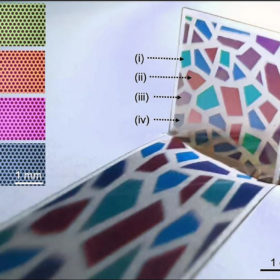
Perovskite microcells for solar windows
Developed by Korean scientists through a novel lift-off-based patterning approach based on swelling-induced crack propagation, the perovskite PV device achieved an open-circuit voltage of 1.16 V, a short-circuit current density of 22.5 mA/cm2, and a fill factor of 77%. With the microcells, the researchers also built a first prototype of a solar window which they claim has vivid colors and high color purity.
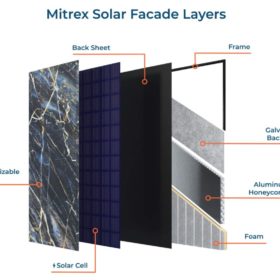
Canadian university to be equipped with a stealthy solar façade/microgrid
Building-integrated photovoltaics provider Mitrex said its system will provide St. Mary’s University student residence with a power-producing microgrid.
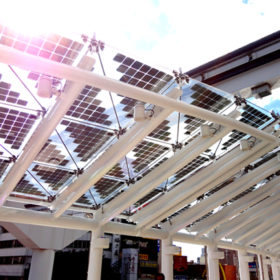
Glass-integrated BIPV module from Japan
Japanese glass manufacturer AGC has developed a building-integrated PV (BIPV) panel for different building requirements. It can be installed on facades, canopies, and curtain walls where normal glass can be placed.
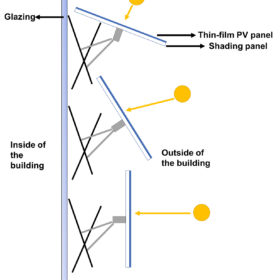
Designs, control strategies for PV-integrated shading devices
Photovoltaic shades in buildings offer energy efficiency and electricity generation, but an international research group says their commercial viability will depend on the control strategies used to optimize performance.
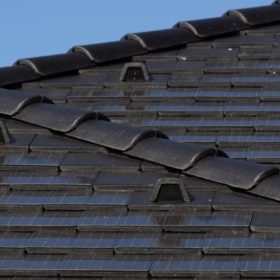
Hungarian start-up launches solar tile with output of 167W per m²
Developed by Hungarian manufacturer Terràn, the Generon solar tile is based on concrete support and weighs is in at 5.7kg.
