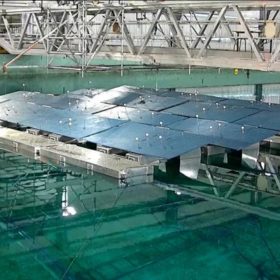
New tech to reduce mechanical stress in floating PV arrays
French start-up HelioRec has developed a new floater that can contain water to add more weight and increase its stability on the water. According to its creators, the new product can be 3.5 times more stable than conventional blow-molded floaters.

Mozambique’s first floating solar project
The floating array is planned for a water reservoir in Chicamba, in Manica province. Consultants are now being sought for the feasibility studies.
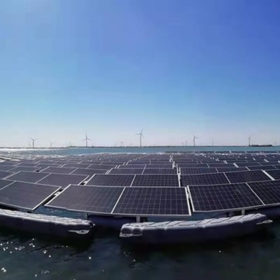
World’s largest floating PV plant goes online in China
Huaneng Power International has switched on a 320 MW floating PV array in China’s Shandong province. It deployed the plant in two phases on a reservoir near its 2.65 GW Dezhou thermal power station.
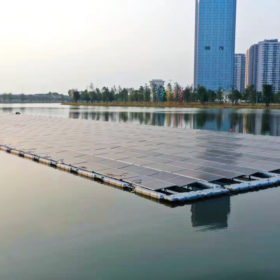
Floating solar array powering recreational park in Vietnam
The 600 kW array was built by Sungrow with 540 W solar panels and its own floating structures.
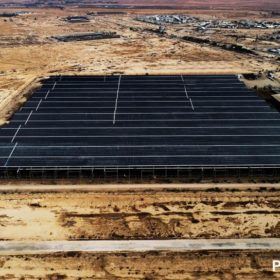
Israel allocates 1.14 GW of PV across two tenders, lowest price comes in at $0.02751/kWh
The Israeli authorities allocated more than 1.14 GW of PV capacity and 210 MWh of storage across two different tenders. In a first procurement exercise for the 330 MW/210 MWh Dimona solar-plus-storage project the winner was Israeli company Shikun & Binui Holdings Ltd. In another tender for innovative PV projects local developer Prime Energy secured 475 MW with the final average price of $0.0541/kWh.

Floating PV mounting structure for harsh climatic conditions
Developed by Chinese specialist Mibet, the floating PV structure can reportedly endure wind and snow loads of up to 42m/s and 1KN/㎡, respectively, in all water environments. It was recently deployed in Poland, at a location where temperatures may reach as low as 40 degrees Celsius.
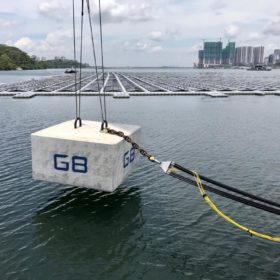
Singapore floating PV company targeting offshore expansion
Floating PV is a growing niche in the solar sector, but its offshore segment has proven more difficult to activate, largely because of the difficulty of open-water energy generation. Nevertheless, one company in Singapore, G8 Subsea, aims to leave the safety of harbors and reservoirs.
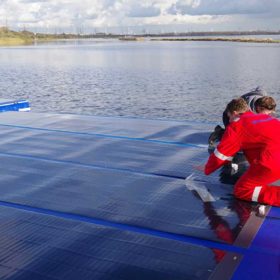
CIGS solar panels for offshore PV
A Dutch consortium is testing a 20 kW pilot floating PV installation for offshore applications with CIGS solar modules developed by Swedish manufacturer Midsummer. The panels consist of 144 solar cells and measure 4 m X 1 m, with up to 485 W of capacity.

Portugal launches auction for 263 MW of floating PV
Through the procurement exercise, the Portuguese authorities want to select floating PV projects between 8 to 10 MW in size. Six water reservoirs have already been identified for their deployment.

South Korea’s largest floating PV plant now online
The 41 MW facility was built by Korean developer Scotra with solar modules provided by South Korea-based manufacturer Hanwha Q-Cells. It was deployed on a water reservoir at the Hapcheon dam, in the South Gyeongsang province.
