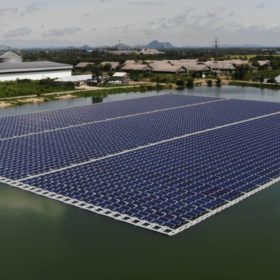
German government study to evaluate potential of floating solar on lakes at former mines
Around 500 open-pit lakes left behind as a legacy of Germany’s open-cast lignite mining industry could potentially host more than 50 GW of solar generation capacity. With that in mind, the Federal Ministry for Economic Affairs and Energy is financing a three-year study into the technology’s revenue potential.
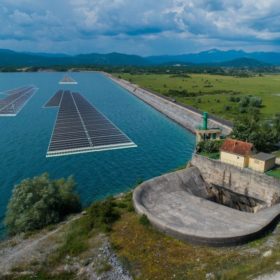
Montenegro’s first floating PV project
Montenegro’s power utility, EPCG, is planning to build the facility on a salt lake in the western part of the country. Some undisclosed Danish companies are interested in developing the project.
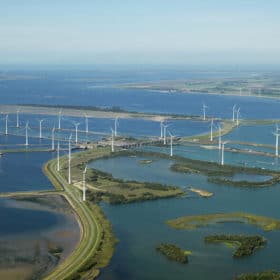
Large-scale PV to join wind power complex at Dutch dam
The project is expected to have a capacity of up to 50 MW and is set to be commissioned in 2023.
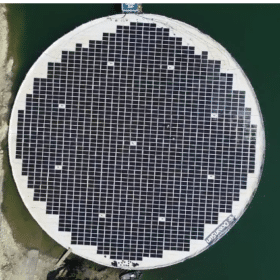
Albania’s first floating PV plant is now operational
The 500 kW floating array was built with floating membranes supplied by Norwegian specialist Ocean Sun. The project is expected to continue its second implementation phase during the second half of 2021, when three more 500 kW floating units will be installed.
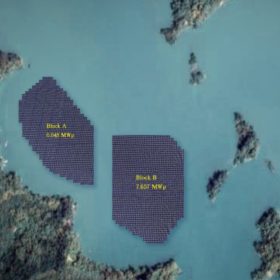
Taiwan’s Wushantou Dam to host 13.7 MW floating PV array
The floating plant will be deployed at the 20 MW Wushantou hydroelectric power dam operated by Taiwanese state-owned utility Taiwan Power Corp, in Tainan city.

Assessment of floating PV potential at African hydropower reservoirs
European researchers have estimated the potential of floating PV deployment at Africa’s existing hydropower reservoirs which exceed 5 MW in size, by using satellite images and hydropower reservoir data. Under the most likely scenario presented in the study, utility scale floating solar may reach a capacity of more than 20 GW by using less than 1% of the water surface area at 108 hydropower plants spread across the continent, assuming a capex of €0.40/W.
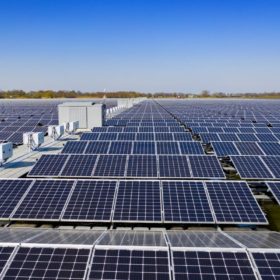
Construction begins on Europe’s largest floating PV plant
The plant is being built by Dutch developer Groenleven on a former sand extraction lake in the northern Netherlands. The company’s project manager for floating PV, Willem Biesheuvel, told pv magazine about its approach to deploying floating arrays always with a west-east orientation, which he claims ensures more stability and resistance to wind and waves.
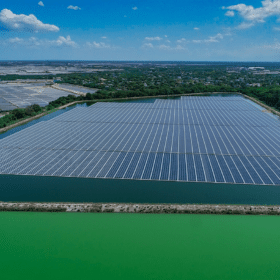
India’s largest floating PV project comes online
The 14.7 MW project, developed for Southern Petrochemical Industries Corporation (SPIC) Limited, relies on 37,632 390W PV panels occupies an area of 15.6 hectares.
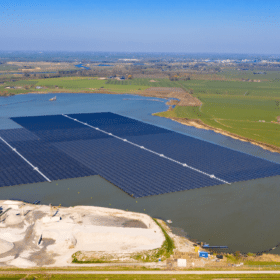
Water quality untouched by floating PV
Baywa re and Dutch researchers have evaluated the first positive effects of floating PV on the flora and fauna in water. They have also ascertained that the erosion of a lake’s banks has decreased.
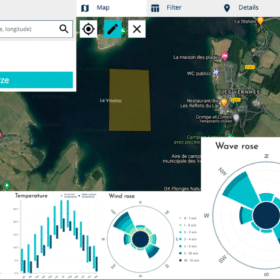
New tech to identify best locations for floating PV
Norway’s Glint Solar and the Norwegian Geotechnical Institute have developed an algorithm that is able to automatically calculate wave heights and wind directions at potential locations for floating PV arrays. It considers the geometry of the water surface as well as 40 years of data on wind conditions.
