
Offshore solar could achieve LCOE of less than $0.06/kWh in Thailand, Malaysia
An international team of researchers completed a preliminary techno-economic study on the global potential for offshore floating PV (OFPV). The results provide project cost benchmarking, country-specific economic assumptions, and a global assessement of offshore solar’s levelized cost of electricity (LCOE).

Scientists develop new floating box array for offshore PV
Researchers have tested a 9 x 11 floating box array for offshore photovoltaics in a large wave flume, under regular and irregular wave sequences. They have placed wireless gyroscopes on three of the boxes, representing the front, middle, and rear positions.
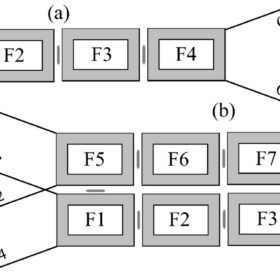
Floating PV system with ring-like floater geometry
Scientists in China have investigated the hydrodynamic performance of a novel modular floating photovoltaic system. They did so using a novel hybrid approach, which integrates viscous-flow effects from computational fluid dynamics into a potential-flow solver. They analyzed the new system with varying numbers of panels, either in a single chain or a parallel configuration.

Hydrogen can mitigate curtailment in floating PV-pumped hydro energy storage systems
Scientists at Italy’s University of Cagliari explored the integration of a water electrolyzer with a floating PV-pumped hydro energy storage system. They found that under high curtailment conditions, hydrogen production helped to stabilize system efficiency and lower the levelized cost of electricity when compared to a system without the electrolyzer.

Powering ferries with floating PV, hydrogen
Scientists in Malaysia have conducted a techno-economic-environmental study of a green fueling system for a ferry that runs between islands in their home country. Using 40,000 solar panels, they were able to power two round trips round-trips per day. Annual CO₂ reduction was measured at 23.75 million kg.

High-frequency monitoring of floating PV
Researchers in Brazil have installed a vertical thermistor chain with six temperature loggers beneath a floating PV plant and at a nearby reference site. The system also recorded dissolved oxygen and photosynthetically active radiation to assess environmental impacts.
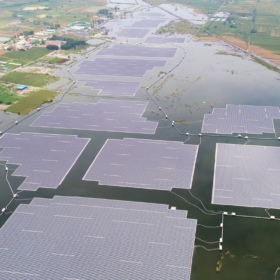
Water-based photovoltaics reach global capacity of 21.18 GW
An international research team has developed an index-based remote sensing method to see trends in the global development of water-based PV. It has found that China currently accounts for 80% of the global total deployed capacity.

Deploying floating PV on mine pit lakes, tailings ponds
Researchers in South Korea have conducted a literature review on recorded cases of floating PV plants placed on mine pit lakes and tailings ponds, both of which are byproducts of the mining industry. Looking at more than dozens of cases, they have concluded that mine pit lakes generally provide more stable environments for deployment.

Supercharging pumped-hydro stations with floating PV
Scientists have simulated the addition of floating solar panels to Switzerland’s Etzelwerk, an open-loop pumped-storage hydropower plant. Using 10% of the upper reservoir for the solar panels, the research team was able to add about 20% of the energy output.

Offshore vs. ground-mounted PV
Researchers in Saudi Arabia have compared the performance of ground-mounted PV plants with that of off-shore solar facilities and have found that floating installations benefit from the cooling effect of the seawater.
