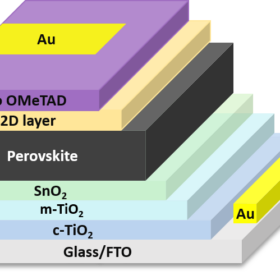
3D/2D perovskite solar cell treated with substituted PEAI hits 23.08% efficiency
An international research team has fabricated a quasi-2D perovskite solar cell with a special kind of phenethylammonium iodide (PEAI) salt to enhance hole extraction. The result is a 23.08%-efficient device that is also able to retain 95% of its initial efficiency after 900 hours.
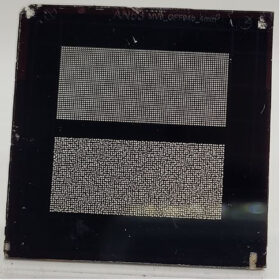
Translucent tandem perovskite-perovskite solar cells for BIPV
An international research group has made translucent perovskite solar cells to maintain decent levels of average visible transmittance (AVT) while offering higher efficiency. They tested different module and cell configurations and produced a two-terminal, perovskite-perovskite tandem device with an efficiency of 17.7% at 12% AVT.

Only5mins! – Self-healing properties of perovskite solar
The Viperlab project is a European initiative that brings together organizations that are working on perovskite solar. pv magazine speaks with Eva Unger, Viperlab’s scientific coordinator, about the infrastructure needed to facilitate the transfer of information and technology to the industry, as well as the huge database that needs to be created to serve this purpose.
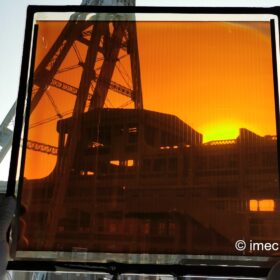
Imec unveils 781 cm2 bifacial perovskite solar panel with 11.9% efficiency
Scientists in Belgium have developed perovskite solar panels with a thermally stable device stack. The encapsulated bifacial panels they created with this configuration were able to retain around 92% of their initial efficiency after 1,000 hours.

Copper thiocyanate to eliminate moisture leaks in perovskite PV cells
Indian scientists have replaced Spiro-OMeTAD with copper thiocyanate (CuSCN) as a hole-transporting material in a perovskite solar cell. They say that the new precursor can offer the same efficiency levels, while reducing moisture leakage.
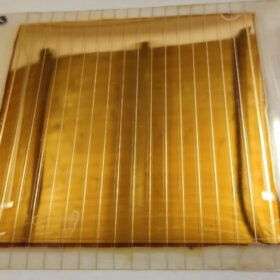
Blade-coated flexible perovskite solar cell achieves 14.08% efficiency
Researchers in Italy have used blade coating to develop a flexible solar cell that does not contain toxic dimethyl sulfoxide. They used the cell to fabricate small solar modules with efficiencies of up to 6.58%.
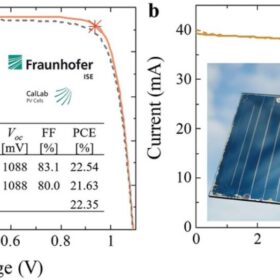
Slot-die coated perovskite PV cell with precursor ink hits 22.54% efficiency
German researchers claim to have reduced ribbing effects in using slot-die coating for the production of perovskite solar cells. The results are reportedly the most efficient solar cell built with this technique to date.
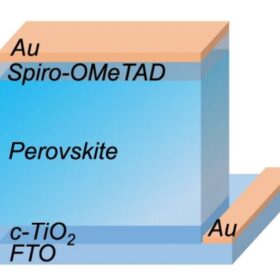
Perovskite solar cell with 25.3% efficiency via new ligand
A research group in China has designed a perovskite solar cell with a new ligand known as 3-amidinopyridine. These molecules are reportedly able to efficiently reduce anion vacancy defects, thus ensuring higher power conversion efficiency and remarkable stability.
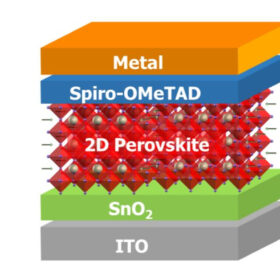
Ruddlesden-Popper perovskite solar cell with 18.73% efficiency
Scientists in China have fabricated a Ruddlesden-Popper perovskite solar cell based on γ-aminobutyric acid (GABA) as the organic spacer cation. They claim this innovation offers higher power conversion efficiency and outstanding stability.
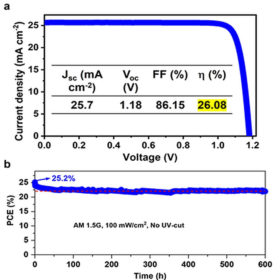
Perovskite alkylammonium chloride solar cell achieves 26.08% efficiency
The US National Renewable Energy Laboratory (NREL) has certified that a South Korean research team has achieved a 25.73% efficiency rating with a perovskite PV cell based on alkylammonium chlorides. The champion device built by the scientists reached an efficiency of 26.08%.
