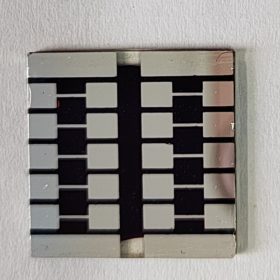
Inverted perovskite solar cell with 22.15% efficiency, 83.92% fill factor
Chinese scientists have used daminozide as an interlayer and additive to make a perovskite solar cell with a p-i-n structure. It has the highest efficiency and highest fill factor for a polycrystalline, MAPbI 3-based inverted perovskite solar cell to date.
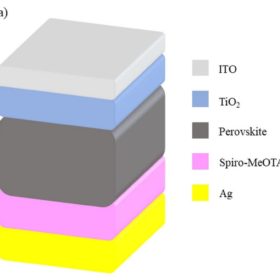
Natural-born p-doped material for pervoskite solar cells
Researchers in South Korea have found that molybdenum ditelluride could increase carrier generation in perovskite solar cells. They simulated a cell with a perovskite absorber and a layer made of the new material, and determined that its efficiency could exceed 20%.
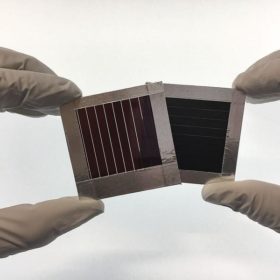
CIGS-perovskite tandem solar module with 21.1% efficiency
German scientists have built a tandem perovskite-CIGS panel measuring 9 square centimeters, with organometallic perovskites for the top module.

All-perovskite tandem solar cell with 27.4% efficiency, high voltage
A US-Canadian research group has built an all-perovskite tandem PV device with a record-breaking open-circuit voltage of 2.19 eV, which they achieved by reducing recombination at the electron transport layer.

Floating ‘artificial leaf’ for solar-to-hydrogen production
University of Cambridge scientists have developed lightweight floating photocatalyst devices that produce green hydrogen and syngas. The leaf-like photoelectrochemical devices show potential for scalability.
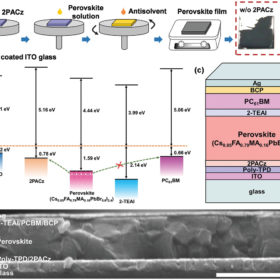
Inverted perovskite solar cell with 21.85% efficiency via surface modulator
A UK research group has used surface modulators to reduce non-radiative recombination in perovskite solar cells. They used 2-TEAI organic halide salt to build a cell with high power conversion efficiency and stability.
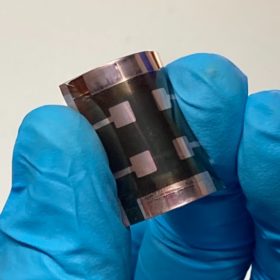
Flexible all-perovskite tandem solar cell with 23.8% efficiency, improved voltage
A Chinese-Swiss research group claims to have overcome two major challenges for the development of flexible all-perovskite tandem solar cells – voltage losses and the deposition process for the cell’s functional layers. They built a device with a high open-circuit voltage of 2.1 V.
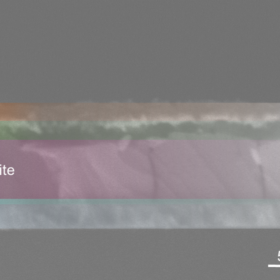
Perovskite solar cell with copper electrode hits 20.1% efficiency
Chinese researchers have developed a new solar cell with a planar n-i-p structure and an indium tin oxide (ITO) substrate. It also has a tin(IV) oxide (SnO2) buffer layer, a perovskite layer, a hole transport layer (HTL), and a layer made of copper. It was able to retain around 92% of its initial efficiency after 1,000 hours.
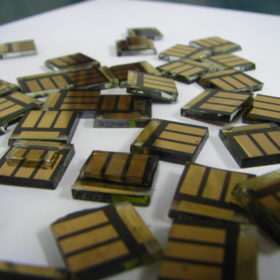
Reliance New Energy invests in US perovskite solar startup Caelux
The new energy unit of Reliance Industries has signed an agreement to acquire a 20% stake in California-based perovskite solar startup Caelux for $12 million.
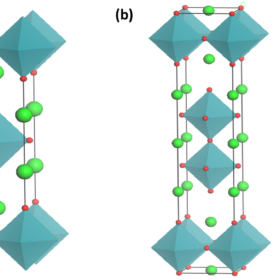
Prospects for Ruddlesden–Popper perovskite solar cells
A research group in the Netherlands has analyzed different manufacturing techniques for two-dimensional Ruddlesden–Popper perovskite solar cells. These cells offer improved photostability and environmental stability compared with their three-dimensional counterparts.
