Silicon and perovskites should stick together, say Korean scientists
Researchers from the Ulsan Institute of Science and Technology have demonstrated a new method of fabricating perovskite-on-silicon tandem devices, using a transparent conductive adhesive to combine the two cells. The scientists have developed devices with demonstrated efficiencies of 19.4%, and propose strategies to bring that above 24% using existing technology.

Solar pioneer Pierre Verlinden: The big problem is apathy
On the first day of this year’s EU PVSEC conference, veteran solar researcher Pierre J Verlinden won the Becquerel Prize for Outstanding Merits in Photovoltaics. The award recognized more than 40 years as a leading PV researcher in academia and at leading companies including Sunpower and Trina Solar. Its recipient spoke to pv magazine about what is needed from solar to stave off catastrophic climate change.

German scientists team up for perovskite tandem cells
Two of Germany’s leading research institutes and a CIGS module maker have announced plans to work on the development of perovskite-CIGS tandem cells with a target of producing thin film modules with better than 30% efficiency.
French scientists try to uncover the secrets of black perovskite
X-ray analysis is said to have solved the mystery of how to preserve optical absorption in perovskite layers. Researchers say the discovery could help stabilize the material and speed up the launch of a new ingredient for PV research.
Oxford PV orders 100 MW production line from Meyer Burger
The British-German perovskite startup has ordered a turnkey 100 MW silicon heterojunction solar cell line from the Swiss PV equipment supplier. The terms of the deal were not disclosed.
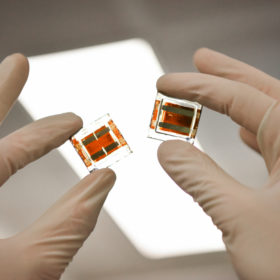
Copper iodide, another option to stabilize perovskite cells
A research team from Russia’s institutes NUST MISIS and IPCE RAS, and Italy’s University of Rome Tor Vergata, have applied an additional layer of p-type copper iodide semiconductor between perovskite and the hole-transport NiO layer of the cell. According to the scientists, this inorganic material is more accessible and easy-to-use.

MIT works to refine the flow of promising perovskites
Scientists at the Massachusetts Institute of Technology have developed an accelerated process for screening new perovskite compounds as they search for those with the potential to be used in high efficiency solar cells. According to MIT, the process speeds up the synthesis and analysis of new compounds by a factor of ten and has already highlighted two sets of materials worthy of further study.
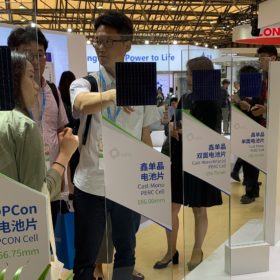
Innovation and uncertainty mark SNEC 2019
There was plenty of innovation on display at this year’s SNEC, which closed yesterday afternoon at the Shanghai New International Expo Center. The three-day exhibition ran from Tuesday to Thursday, was well attended and still ranks as the world’s largest solar energy trade show.

Scientists cast light on how potassium can fix perovskite cells
Doping perovksite solar cells with potassium is said to eliminate interface trapping defects and mobile ion migration. ‘Hysteresis suppression’ is key for more efficient cells based on the promising material.
Europe bets on perovskite
Europe’s most important scientific research institutes have joined forces to make perovskite solar applications more than just a dream. The European Perovskite Initiative consortium is planning to draw up a perovskite white paper.
