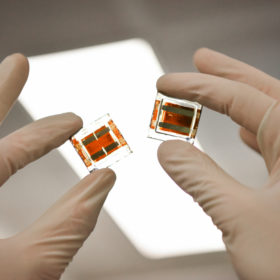
Copper iodide, another option to stabilize perovskite cells
A research team from Russia’s institutes NUST MISIS and IPCE RAS, and Italy’s University of Rome Tor Vergata, have applied an additional layer of p-type copper iodide semiconductor between perovskite and the hole-transport NiO layer of the cell. According to the scientists, this inorganic material is more accessible and easy-to-use.

MIT works to refine the flow of promising perovskites
Scientists at the Massachusetts Institute of Technology have developed an accelerated process for screening new perovskite compounds as they search for those with the potential to be used in high efficiency solar cells. According to MIT, the process speeds up the synthesis and analysis of new compounds by a factor of ten and has already highlighted two sets of materials worthy of further study.
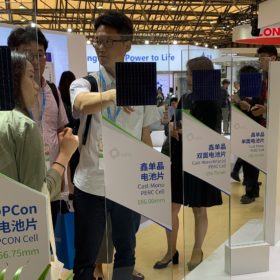
Innovation and uncertainty mark SNEC 2019
There was plenty of innovation on display at this year’s SNEC, which closed yesterday afternoon at the Shanghai New International Expo Center. The three-day exhibition ran from Tuesday to Thursday, was well attended and still ranks as the world’s largest solar energy trade show.

Scientists cast light on how potassium can fix perovskite cells
Doping perovksite solar cells with potassium is said to eliminate interface trapping defects and mobile ion migration. ‘Hysteresis suppression’ is key for more efficient cells based on the promising material.
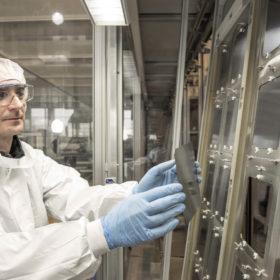
Europe bets on perovskite
Europe’s most important scientific research institutes have joined forces to make perovskite solar applications more than just a dream. The European Perovskite Initiative consortium is planning to draw up a perovskite white paper.

Dutch scientists use fluoride to make perovskite solar cells more stable
Researchers claim the cell they have developed is able to retain 90% of its efficiency after 1,000 hours under extreme light and heat conditions.

UK researchers seek to use perovskite solar cells for hydrogen production
A research team has applied a waterproof coating obtained from graphite to a perovskite cell intended to power the production of hydrogen underwater. The cell is said to have worked underwater longer than expected.
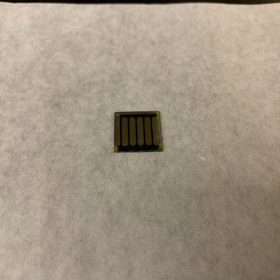
Enhancing perovskite cell performance with coffee
A U.S.-Chinese research team has discovered that carbonyl groups in caffeine can increase the efficiency of perovskite solar cells from 17% to 20%. The peculiar molecular structure of caffeine is said to be a good match for the precursors of perovskite material compounds.
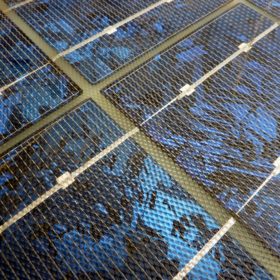
Taiwan’s PVEVL expands performance tests to perovskite, quantum dot and organic solar cells
Despite the difficulties its solar manufacturing industry faces, the Taiwanese government is ramping up its R&D efforts to measure the efficiency of what it calls “new-generation light-driven photovoltaics”.
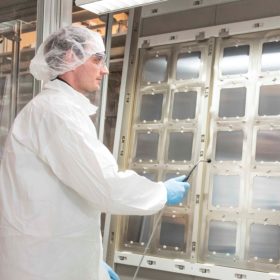
Meyer Burger, Oxford PV sign perovskite cooperation deal
Meyer Burger has struck a strategic partnership with Oxford PV to expedite the mass production of perovskite on silicon heterojunction (HJT) tandem cells.
