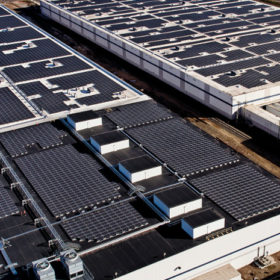
Amazon to install up to 41 MW of on-site solar in the U.S. by the end of 2017
The company’s solar installations planned for 15 fulfillment centers this year will be followed by another 35 by 2020

Extension of EU duties on Chinese solar products is now official
On Friday, the EU published in its Official Journal the 18-month extension of antidumping and anti-subsidy duties on Chinese solar products, including notification of a partial interim review of the measures. The review could lead to the gradual reduction of duties and minimum import prices. The EU will also consider if the Minimum Price Undertaking agreement is still of relevance.
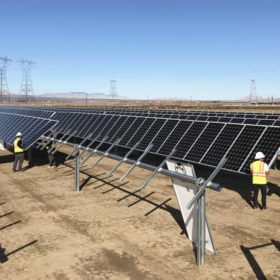
Solar reached 1.4% of U.S. electricity in 2016
The latest figures from the U.S. Department of Energy show that all renewables together made up 15.3% of U.S. generation.
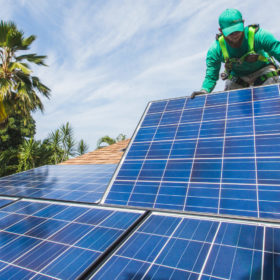
North American and European utilities invested around $297 million in distributed solar to date, GTM Research
Investments in distributed solar made by North American and European utilities have reached an aggregate value of $297 million to date. North American power providers seem to be more confident on distributed solar, but European companies are investing more heavily in all distributed energy segments.

Chint signs framework agreement to build solar factory in Brazil
The Chinese module maker has signed an agreement to set up a solar module manufacturing facility in Brazil. The local government hopes the new factory will attract more investments.

Mixed reactions to 18-month extension of antidumping and anti-subsidy duties on Chinese manufacturers
The 18-month extension to antidumping (AD) and anti-subsidy duties applied to Chinese solar exports has caused mixed reactions within the industry. The measure should be published on the EU Official Journal by the end of this week.

World Bank approves $480 million guarantee to promote solar and renewables in Argentina
The World Bank will promote the development of large-scale renewable energy and solar projects across Argentina with a $ 480 million guarantee. The funds will be used to support projects being implemented under the country’s RenovAr program for renewable energies.

Meyer Burger to shut-down U.S. diamond wire production
The Swiss equipment provider has announced a plan to close production for its diamond wire platform in Colorado. The company blames global pressure on prices and margins. Meanwhile, its preliminary financial results for 2016 show a 40% increase in sales.

Italy installed 369 MW of new PV systems in 2016
The Italian solar market grew by 22% in 2016. The country added 369 MW of new PV systems last year. This growth was mainly driven by tax breaks for the residential sector and the regulation for self-consumption. Most of these systems have a power of up to 100 kW.
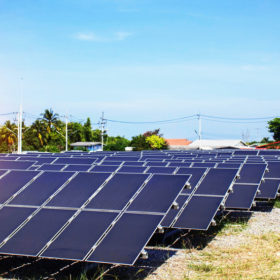
Spain installed PV systems totaling 55 MW in 2016
In 2016, Spain’s solar development was driven by grid-connected PV systems for self-consumption and stand-alone systems for agricultural use.
