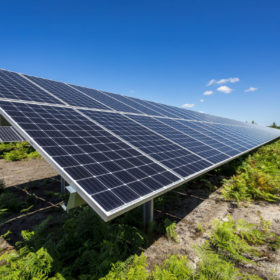
Engie secures solar PPA in France, vows to shut 1 GW of coal in Latin America
At the ongoing COP25 summit in Madrid, the French energy group announced the closure of nearly 1 GW of coal assets in Chile and Peru between 2019 and 2024. It also secured a PPA for an 18 MW solar park that will come online in southern France in June 2021.

New transparent solar cell for window applications
South Korean scientists have transformed an opaque crystalline silicon solar cell into a transparent one by punching holes into it measuring around 100 μm in diameter. A neutral-colored, transparent c-Si substrate was used to develop the new cell, which is said to have an efficiency of up to 12.2%.

100% renewables means 95% less water consumption for conventional power generation
According to a new study by Finland’s LUT University, solar PV consumes between 2% and 15% of the water that coal and nuclear power plants use to produce just 1 MWh of output; for wind, this percentage ranges from 0.1% to 14%. Under the researchers’ best policy scenario, water consumption could be reduced by 75.1% by 2030, compared to 2015 levels.
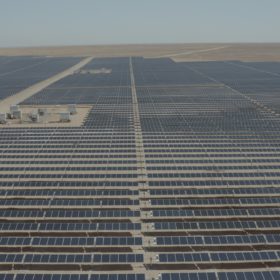
ACWA Power switches on 50 MW solar park in Jordan
The PV project, which was tendered by Jordanian utility NEPCO in 2017, will sell power at $0.059/kWh. The plant is located in Jordan’s Risha region, which is roughly 300 km northeast of Amman.
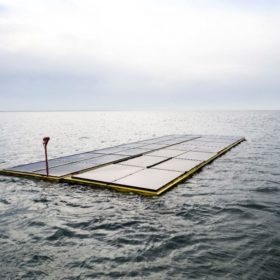
Offshore PV system goes online in North Sea
The 8.5 kW pilot project, which was launched in February 2018, will soon be expanded to 50 kW. The Dutch consortium behind the installation eventually plans to expand it to 1 MW and then up to 100 MW at a later stage. The Netherlands Enterprise Agency (RVO) provided financial backing for the project.

2.2 MW/1.5MWh of storage linked to 5 MW off-grid PV plant in Tunisia
Italian gas and oil producer Eni has followed the recent commissioning of a 10 MW solar+storage project in Pakistan with the completion of a similar off-grid installation at an oil field in Tunisia. The power plant was built in partnership with Tunisian state-owned oil company Entreprise Tunisienne d’Activités Pétrolières

Neural networks improving solar power forecasting
An international research team has developed a new approach for solar power forecasting that combines neural networks and pattern sequences for the first time. The performance of the new Pattern Sequence Neural Network (PSNN) was tested on an Australian data set that includes information from two years of forecasts. It can be used with different clustering and cluster-sequence extraction algorithms, and can be applied to multiple related time sequences

Winners do not always win
As part of a series of interviews on renewable energy and geopolitics, Indra Overland – head of the Center for Energy Research at the Norwegian Institute for International Affairs – explains why some countries will take the lead in the energy transition. All of the countries in Africa, with the exception of a few oil exporters, will be part of the solar revolution, he said, noting the recent release of the GeGaLo Index. He also looks at why big economies such as the United States, Germany, China and Australia are not geopolitically well-situated for the energy transition, and why others, such as Japan, France and Spain, are positioned more favorably. In addition, Overland discusses why it is particularly important that nations under strong political pressure grasp the benefits of clean energy.

Another one fights the dust
Scientists from Israel have used nanowires to detach particles from the surfaces of solar panels. The proposed microscopic self-cleaning technology is said to raise the efficiency of particle removal with hydrophobicity.
Liten research institute claims 24.25% efficiency for heterojunction cell
The French institute said the result has been certified by ISFH CalTeC, in Germany. The manufacturers claim they were able to increase cell performance by improving the plasma-enhanced chemical vapor deposition of amorphous silicon nanolayers and the conductive and anti-reflective transparent oxide layers.
