
Solar had no chance against wind in Spain’s renewable energy auction
Spanish solar association UNEF claims PV was discriminated against in the auction and announced it will appeal to the European Commission.
Italy opens ancillary services market to pilot renewable energy and storage projects
The project is the initial stage of an organic reform of the Italian ancillary services market, which is expected to be implemented in accordance with the European balancing code.
Report: Near-total renewable energy systems cheaper than gas in 2030 (w/ chart)
A report released last week by Climate Policy Initiative stresses flexibility and shows how energy storage and limited gas generation can support a power system dominated by renewables at a lower cost than conventional generation.
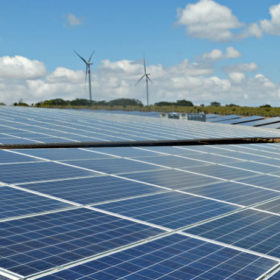
Brazil assesses potential of hybrid solar-wind power plants
The assessment was conducted by Brazil’s energy agency Empresa de Pesquisa Energética (EPE). These projects are expected to be particularly suitable to regions with a low degree of grid integration.

Jamaica targets $300 million renewable energy investments
The Caribbean country is seeking to accelerate its transition to clean energies, and to benefit from funds from the Green Climate Fund. Meanwhile, the government is also seeking to improve net metering for residential and commercial PV.
Denmark’s Energy Commission says incentives for renewables should be phased-out
A recently created Energy Commission has advised the Danish government to phase-out incentives for renewables, at the same rate as the technology becomes competitive with other energy sources. Meanwhile, Denmark has added only 3.7 MW of PV so far this year.

Kosovo must do more for renewables, EU says
The European Commission has said that Kosovo’s government needs to increase efforts to improve its energy system, and to provide more support for renewables, although it has recently revised its energy (and renewable energy) strategy up to 2020.
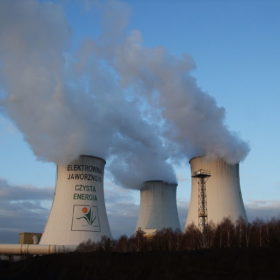
Poland to miss 2020 EU renewable energy target, Ecofys
Poland is set to miss its target of covering up to 15% of energy demand with renewables by 2020. Under the most favorable scenario provided by a report released by local consultancy Ecofys, new additions for solar may reach 695 GWh, while the country is expected to reach a target of only 13.8% by the end of the decade.

French presidential election: what to expect for solar from the winners of the first round?
Both winners of the first round have said they want more solar during their electoral campaigns. While Macron promises to double installed PV capacity by 2022, Le Pen claims she will push for a massive deployment of solar and biomass (not wind), although under an “intelligent protectionism”.
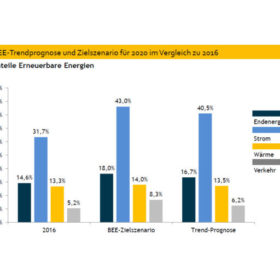
Germany could miss 2020 renewable energy target, report says
According to German renewable energy association BEE, the country could fail to reach its 2020 EU target for renewables covering 18% of its total energy consumption. The association claims that if Germany aims to achieve this target, an additional 22 TWh of electricity from renewables per year must come from the power, heat and transport sectors.
