
Recycling lead-acid batteries for perovskite solar cell manufacturing
Researchers from China are proposing to use spent battery lead for creating a perovskite that can be used in the production of solar cells that are based on this promising material. The proposed one-step process, which was tested in the production of a 17.38% efficient perovskite heterojunction cell, is said to be cheaper and less energy-intensive than other recycling processes for waste lead from lead-acid batteries.
How do solar cells work underwater?
Although cells lose much of their power yield when submerged, they may not be useless. Researchers in India say submerged cells could be used in monitoring sensors and for other commercial and defense applications. An amorphous silicon cell from Panasonic was tested in their study.

A multi-level inverter for solar water pumps
Scientists in India have tested a new inverter topology with a single-phase, induction-motor water pump. The seven-level inverter, with five power semiconductor switches, is said to be particularly efficient at reducing switching losses thanks to a pulse width modulation technique.
A graphene-doped tandem perovskite cell with 26.3% efficiency
Italian researchers have added graphene to the titanium dioxide electron selective layer used in a perovskite cell to increase chemical stability. The two-terminal cell was made by stacking two sub-cells which were fabricated and optimized separately.
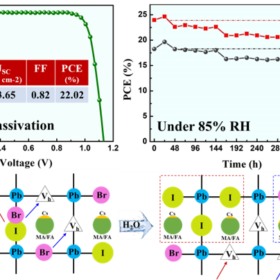
Moisture-resistant perovskite cell with 22.02% efficiency
Scientists in China have used a fluorine-containing Lewis acid treatment to develop a perovskite cell that is said to retain between 63% and 80% of its initial efficiency after 14 days under 75% and 85% relative humidity.

Is thin-film best for offshore PV?
Superior hydrodynamic properties, more robustness in high seas and a much reduced logistics requirement support the case for thin-film over crystalline silicon, pontoon-mounted alternatives, according to an Indo-Italian research group.
Preventing lead leakage in perovskite cells
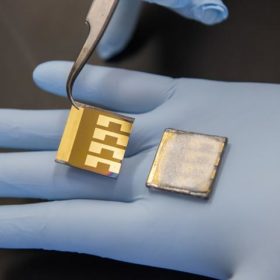
A U.S. research group has used a lead-absorbing material to coat the front and rear of a perovskite solar cell stack. The researchers claim the films captured 96% of lead leakage when the cells were damaged.

New layer raises efficiency of heterojunction solar cells
A Dutch research team has used highly transparent, hydrogenated nanocrystalline silicon oxide layers to improve the optoelectrical performance of contact stacks in a silicon heterojunction device. The material is said to offer superior electrical as well as favorable optical properties.

A nanoparticle-sensitized solar cell with 8.5% efficiency
The record feat compares to usual figures of 2-3% for such devices. The Taiwanese scientists who developed the cell said it was prepared with the Silar method and is based on a ternary metal sulfide-alloyed semiconductor. They claim performance could be further boosted.
Assessing the impact of micro-cracks in solar glass
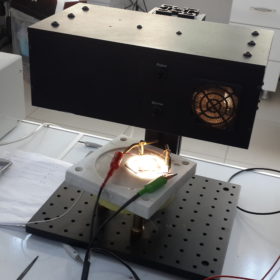
A Turkish research team has analyzed how big changes in temperature can affect absorbance, light transmittance and reflectivity in two types of solar glass. The scientists demonstrated lower efficiency in solar cells and the glass itself were attributable to a large number of micro-cracks and deformations on the glass surface.
