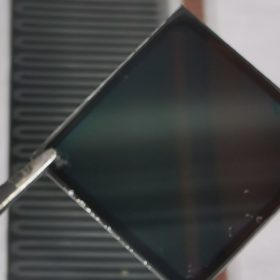
International consortium claims 25% efficiency for perovskite CIGS solar cell
Researchers led by Belgian institute imec claim to have achieved the result with a 1cm² perovskite tandem solar cell. The result tops the 24.6% efficiency the consortium announced in September 2018. The cell’s developers are now aiming for 30%.
Why go solar? We can think of at least 333 reasons
Australian researchers have compiled data from 173 studies which examined homeowner behavior when buying rooftop PV and identified 333 predictors related to the attitude, knowledge, tendency, awareness, willingness and intent of householders.
Wireless sensing for remote operation of off-grid tracker solar
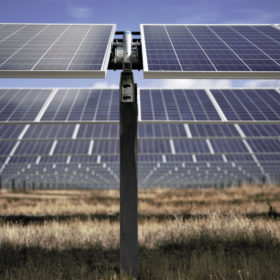
Researchers in Thailand are proposing a wireless monitoring solution for PV in remote locations. The system, based on global standard ZigBee 2.4 GHz wireless technology, can read data and tilt solar panels in auto and manual modes.
Agrivoltaics in New Caledonia
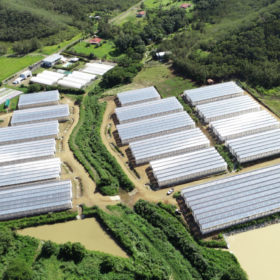
The 16-greenhouse Focola project has been developed by French renewables developer Akuo and local utility company Enercal Energies Nouvelles on the Pacific Ocean territory.
Self-healing polymeric coating for organic PV
A new polymer developed by Indian researchers can mend its own cracks when exposed to ultraviolet light. The unique ability makes it an ideal candidate as a smart coating for photovoltaic solar devices to prevent damages and increase performances.

Recycling lead-acid batteries for perovskite solar cell manufacturing
Researchers from China are proposing to use spent battery lead for creating a perovskite that can be used in the production of solar cells that are based on this promising material. The proposed one-step process, which was tested in the production of a 17.38% efficient perovskite heterojunction cell, is said to be cheaper and less energy-intensive than other recycling processes for waste lead from lead-acid batteries.
How do solar cells work underwater?
Although cells lose much of their power yield when submerged, they may not be useless. Researchers in India say submerged cells could be used in monitoring sensors and for other commercial and defense applications. An amorphous silicon cell from Panasonic was tested in their study.

A multi-level inverter for solar water pumps
Scientists in India have tested a new inverter topology with a single-phase, induction-motor water pump. The seven-level inverter, with five power semiconductor switches, is said to be particularly efficient at reducing switching losses thanks to a pulse width modulation technique.
A graphene-doped tandem perovskite cell with 26.3% efficiency
Italian researchers have added graphene to the titanium dioxide electron selective layer used in a perovskite cell to increase chemical stability. The two-terminal cell was made by stacking two sub-cells which were fabricated and optimized separately.
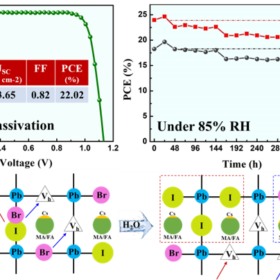
Moisture-resistant perovskite cell with 22.02% efficiency
Scientists in China have used a fluorine-containing Lewis acid treatment to develop a perovskite cell that is said to retain between 63% and 80% of its initial efficiency after 14 days under 75% and 85% relative humidity.
