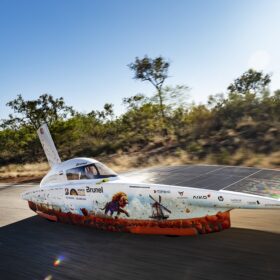
Bridgestone World Solar Challenge leaderboard: what’s on deck
This edition of the 3,000 km solar car race across Australia from Darwin to Adelaide has the same teams in the lead in the Challenger class since early on. Each has a 6 m2 solar deck but no two are exactly the same.

Mito Solar launches new range of colored modules for yachts, cars
Dutch specialty module manufacturer Mito Solar now offers PV modules in a wide range of colors for yachting and mobility applications. The colors are enabled by a front-side encapsulant made of thermoplastic polyolefin (TPO).
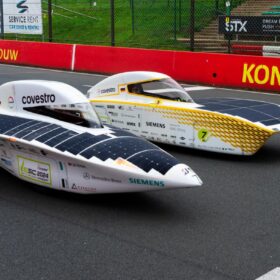
Germany’s Sonnenwagen Aachen team finishes second, third in solar race
Sonnenwagen Aachen, a student team from RWTH Aachen University in Germany, secured second and third place at the iLumen European Solar Challenge 2024, sharing the podium with Belgium’s KU Leuven team, which took first place.
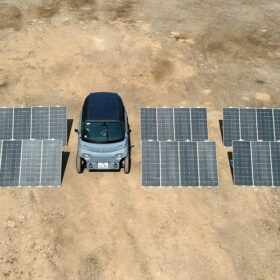
Citroën lightweight compact EV equipped with solar kits
La Croisière Verte is the name of a 13,500 km expedition from the north to south of Africa in a fleet of four Citroën AMI vehicles, each carrying 5,600 W of lightweight PV panels in foldable packs.
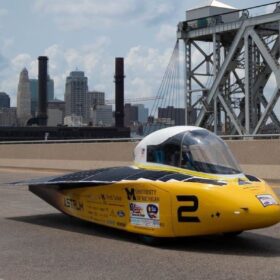
Students from University of Michigan win solar car race
The eight-day Electrek American Solar Challenge 2024 created three new champion solar car teams with the student-run University of Michigan team coming in first, followed by Canada’s École de technologie supérieure and the Illinois State University solar car team.
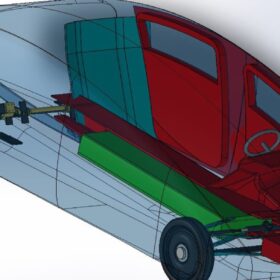
Crash test for lightweight 4-seater solar cars
Researchers at the University of Bologna carried out crash simulations to qualify a novel solar powered 350 kg passenger vehicle for the next edition of the 3,000 km Bridgestone World Solar Challenge (BWSC) across the Australian continent.
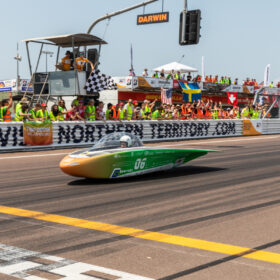
New dates, rules for 2025 Bridgestone World Solar Challenge
The Bridgestone World Solar Challenge has announced a new set of dates for for the 2025 edition of its unique 3,000 km solar car race across the Australian continent, along with some regulation changes.
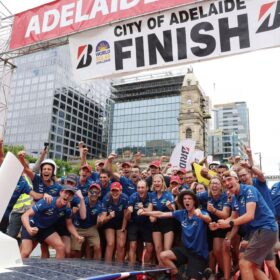
Belgian students win Australian solar race with PV-powered car
Belgium’s Innoptus Solar Team was the first car to cross the finish line this week in the 3,000 km Bridgestone World Solar Challenge. The team beat its 2019 winning time by 48 minutes.
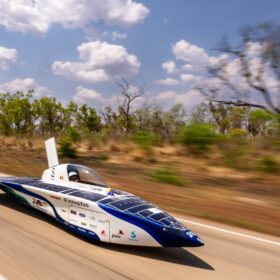
Belgian student solar car takes an early lead in Bridgestone World Solar Challenge
On the journey from Darwin to Adelaide, the Innoptus Solar Team, a non-profit project of students from the University of Leuven, is in a leading position amongst dozens of competitors from around the world in the Bridgestone World Solar Challenge. It tapped European research labs for PV equipment and know-how.
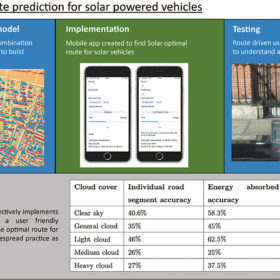
Mobile application to predict optimal energy efficient route for solar vehicles
Irish researchers have created a mobile app that calculates the best route for solar-powered vehicles based on user preferences for time and energy efficiency. The app’s experiment predicted the most energy-absorbing route with 51.65% accuracy and chose the most energy-consuming route with 86.65% accuracy.
