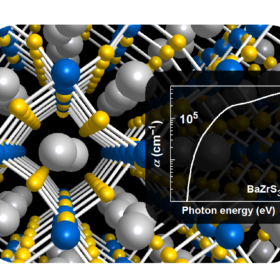
New perovskite promises 38.7% efficient tandem cells
Japanese researchers have identified a perovskite material with a strong band edge gap and high stability which they say could offer 38.7% efficiency if used in the correct tandem cell architecture.

German coal mines could host 3 GW of floating PV
Research institute the Fraunhofer ISE has estimated the technical potential of floating PV at mining sites in Germany at around 56 GW. With floating projects 10-15% more costly than land-based alternatives, researchers have called for further incentives, such as the staging of ‘innovation tenders’.
Eskom seeks modules and mounting structures for off-grid project
The South African utility is seeking offers for the supply of 1,383 320 W polycrystalline modules and mounting structures, to be used for the construction of four off-grid PV projects at its research center.
Preventing LID in a 23.83% efficient Longi PERC cell
Australian researchers have unveiled hydrogenation technology to reduce light and elevated temperature-induced degradation in Czochralski silicon PERC solar cells. The developers say the process can minimize degradation without sacrificing performance in cells and modules.
French solar institute and Enel announce 24.63% efficiency for heterojunction solar cell
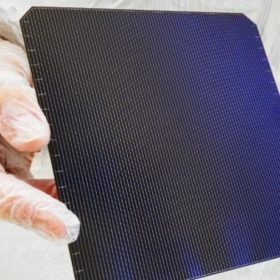
The efficiency of the cell, made with a standard M2 wafer, was raised around 0.7% by using an improved busbar-free screen printing metallization process based on heterojunction processes developed with manufacturing equipment provided by Swiss specialist Meyer Burger.

Uzbekistan opens tendering process for 200 MW solar park
The project is part of the 1 GW solar program developed by the government with the support of the Asian Development Bank. The solar park will be in the Surkhandarya province, in the far southeast of the country.

A mathematical method for choosing the best PV technology in hot, dry areas
The proposed model is said to perform better at energy prediction than software tools such as PVWatts, PVSyst or RetScreen. The approach was validated on two 5 MW PV plants in the same district of the Indian state of Rajasthan.

Morocco kicks off tender for 400 MW solar park
The Moroccan Agency for Sustainable Energy has started to pre-qualify developers for the first phase of the Noor PV II solar project.

Germany added almost 4 GW of PV in 2019
The German network operator reported around 339 MW of new solar in December. New installations for 2019 exceeded new capacity additions for the preceding year by more than 1 GW.

Republika Srpska to tender 100 MW PV project
Bosnia and Herzegovina’s second-largest utility, Elektroprivreda Republike Srpske (ERS), is planning the $75.7 million project. The region’s first solar park will be built near Trebinje, in Republika Srpska.
