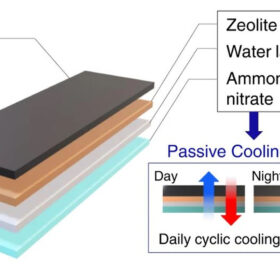
Passive solar module cooling tech based on water sorption
South Korean scientists have developed a WD-ER cooling system that can lower the operating temperature of a PV panel by up to 14.9 C, with an average heat transfer coefficient of 64.1 W/m2.
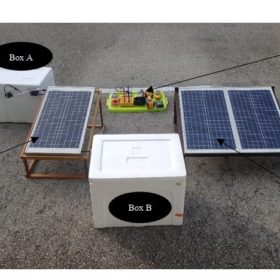
Cooling solar panels with bio-inspired coconut fiber
Malaysian scientists have tested bio-inspired coconut fiber to cool down solar modules. The cooling system features a moist coconut pith encapsulated with a polyurethane sheet. It is placed on the back of a PV module’s surface and acts as a heat sink.
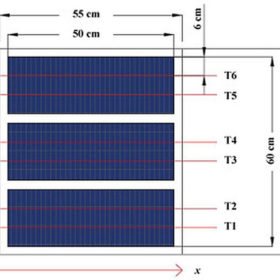
Passive solar module cooling tech based on paraffin wax
Egyptian researchers have used paraffin wax as a phase-change material (PCM) to reduce the operating temperatures of PV modules. They have found that the material improves power yield by more than 15%, compared to a reference module without cooling.
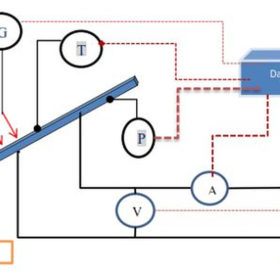
Cooling solar modules with vacuum pressure
Scientists in Indonesia have developed a vacuum technique to lower the temperature of PV modules below the ambient air temperature. They applied it to a solar module in a casing that is resistant to negative pressure.

Cooling down photovoltaic panels with concrete
Scientists in Italy have proposed the use of radiative coolers made of cementitious materials to reduce the operating temperature of solar panels. The novel system configuration consists of a stack made by a reflector, a cement-based radiative cooler, and a bifacial solar cell.
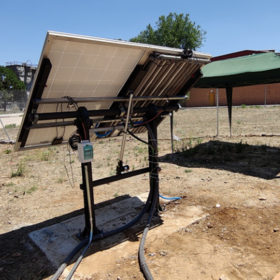
Underground heat exchanger to cool down solar panels
Spanish scientists have built a cooling system featuring heat exchangers on solar panels and U-shape heat exchangers installed in a borehole at a depth of 15 meters. The researchers claim that this reduces panel temperatures by up to 17%, while improving performance by about 11%.
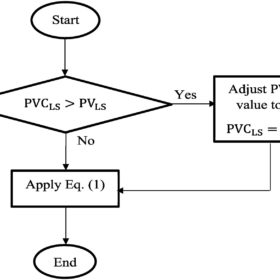
The PV cooler lifespan effectiveness factor
Researchers in Malaysia have defined a new parameter to evaluate solar module cooling techniques based on their lifespan effectiveness. They warned that the proposed methodology should be utilized only with standard test conditions, a temperature of 25 C, and a reference PV system without the cooling system.
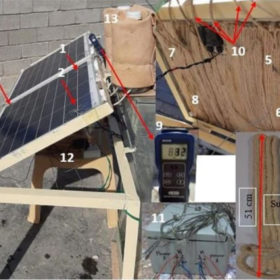
Cooling down solar modules with cotton wicks immersed in water
The novel technique consists of attaching cotton wicks immersed in the water (CWIWs) to the backside photovoltaic module. The water is supplied to cotton wicks from top to bottom by gravity which the scientists said helps the effective absorption of cotton and reduces water consumption.
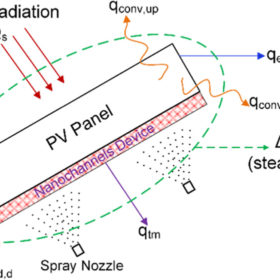
New solar module cooling tech based on porous nanochannels
US scientists have utilized a nanochannels device to cool down the operating temperature of a commercial PV module and have found that the proposed technique is able to improve power yield by up to 32.8%. Spray droplets are dispersed over the nanochannels device in order to eliminate the need for a continuous supply of a coolant.
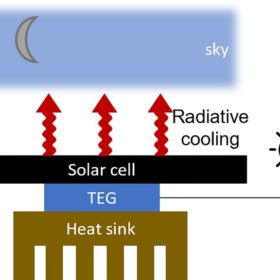
Radiative cooling-based solar cell with 50 mW/m2 of generation at night
Stanford University scientists have developed a solar cell with 24 hours of power generation via an embedded thermoelectric generator, which extracts power from the radiative cooler at night. Extra daytime power from excess heating comes from the cell itself.
