
Conical-shaped solar panels cooled by forced airflow
A group of international scientists has compared the hypothetical performance of three novel shapes of solar modules – pyramidal, hexagonal and conical – and has found the latter has the strongest potential in terms of thermal behavior. According to their findings, a cooling technique based on forced airflow is key to making these solar module shapes into a feasible solution.
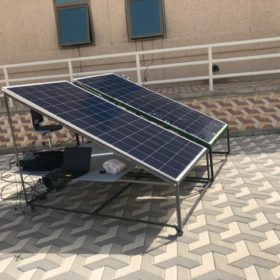
Solar module cooling techniques for the desert
Saudi scientists have tested several cooling technologies for solar panels and have found that active techniques work better than passive ones under harsh climatic conditions. The most effective one consists of a system based on four heat pipes immersed in a box of liquid, as liquid bulk, integrated with the back of the solar panel.
Solar module cooling technique based on multiple phase-change materials
Academics have utilized three PCMs, known as RT26, RT35, and RT42, and decided to pack them ascendingly depending on their melting points and heat-flow direction. The system is claimed to allow lower melting rates and longer thermal management of the modules.
Nano-micro-scale cooler for solar modules
The proposed technique is based on radiative cooling and consists of a glass coating made with a two-dimensional subwavelength nanostructured grating, which is imprinted in soda-lime glass and has enhanced mid-infrared emissivity, and a micro-structured grating. The temperature decrease provided by the nano-micro-grating coating was found to be approximately up to 5.8 degrees Celsius.
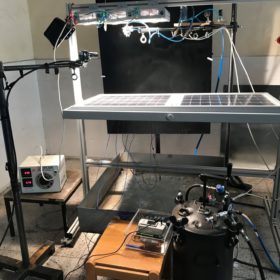
Air-assisted water spray for PV module cooling
Turkish researchers have developed a cooling technique in which water is sprayed via an air-assisted external mixing flat fan nozzle. The system can produce smaller droplet sizes to ensure the even distribution of water on panels.
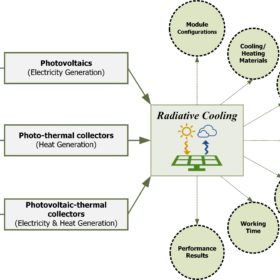
The best radiative cooling tech for PV arrays
Scientists in China have analyzed the radiative cooling techniques used in combination with solar energy systems such as PV arrays, solar thermal collectors, and concentrated PV installations. They identified five major system typologies based on functionality and working time.

Vortex generators and glass texturing for solar module cooling
New research from Australia has shown that vortex generators and glass texturing have so far proved to be the most effective solutions among the novel methods explored for lowering the temperature of solar panels.
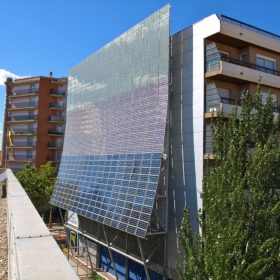
PCM-based passive cooling for BIPV systems
Indian scientists tested four kinds of phase change materials (PCMs) for solar module cooling in building-integrated photovoltaics. The PCMs were encapsulated with the PV system and the building envelopes and were also found to be beneficial to the thermal comfort inside the buildings.
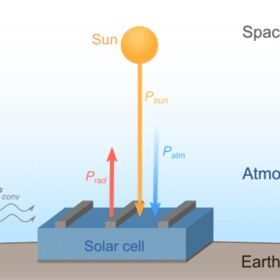
Cooling PV modules with radiative sky cooling
French scientists have proposed the use of radiative sky cooling as a passive cooling technique to cut PV module temperatures by 10 C. They claim the method could improve performance by more than 5 W/m2.
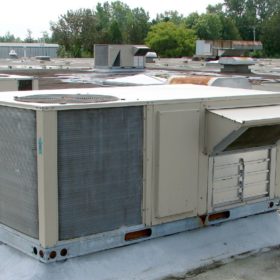
Cooling PV panels with HVAC system exhaust
A French-Lebanese research group has proposed a way to cool down PV modules by using air exhausted from heating, ventilation, and air conditioning (HVAC) systems. They showed that array performance improves when the cooling load rises.
