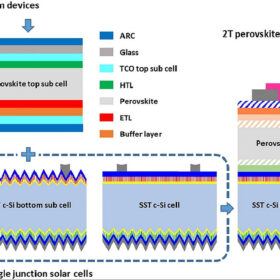
Poly-SiOx solar cell for 4T, 2T perovskite-silicon tandem devices
Scientists in the Netherlands have developed a new crystalline solar cell based on poly-SiOx passivating contacts. The poly-SiOx tech results in a 20% efficiency rating, but 4T tandem perovskite-silicon solar cells based on the poly-SiOx cell can reach an efficiency of 28.1%, and 2T tandem perovskite-silicon devices can hit 23.2%.

Only5mins! – Pushing the boundaries of tandem perovskite-silicon solar
pv magazine speaks to Gianluca Coletti, program manager of tandem photovoltaic tech at Dutch research institute TNO, about initial attempts to bring tandem perovskite-silicon solar cells to market. He says the first PV products based on the highly efficient technology could make an appearance sooner than expected.

Tandem perovskite-silicon solar cells retained 80% of efficiency after 1 year
Saudi Arabia researchers claim to have improved the outdoor stability of a tandem perovskite-silicon solar cell by using proper encapsulation. By the end of the first year of operation, the cell’s fill factor remained above 70%.

Perovskite-silicon tandem PV cell with textured wafers hits 28.1% efficiency
Researchers in Saudi Arabia have built a perovskite-silicon tandem cell with textured silicon wafers to offer superior light trapping. The device has an open-circuit voltage of 1,851 mV, a short-circuit current of 18.9 mA/cm2, and a fill factor of 80.1%.
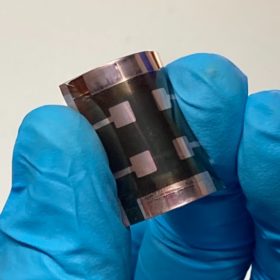
Flexible all-perovskite tandem solar cell with 23.8% efficiency, improved voltage
A Chinese-Swiss research group claims to have overcome two major challenges for the development of flexible all-perovskite tandem solar cells – voltage losses and the deposition process for the cell’s functional layers. They built a device with a high open-circuit voltage of 2.1 V.
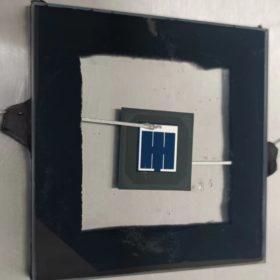
Perovskite-silicon tandem single-cell solar module with 26.2% efficiency
Researchers in Saudi Arabia claim to have reduced cell-to-module losses in tandem perovskite silicon photovoltaic devices through an optical redesign of the module through refractive-index engineering. They built a monolithic perovskite-silicon tandem mini-module with a power conversion efficiency of 26.2%.
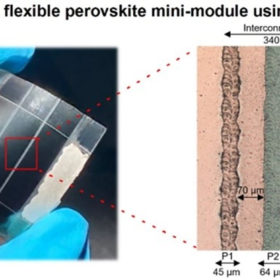
Four-terminal flexible perovskite-CIGS tandem mini-module with 18.4% efficiency
Swiss scientists have built a 4T tandem perovskite/CIGS mini-panel with a geometric fill factor of over 93%. It combines a 10.8%-efficient mini perovskite module and a 15.1%-efficient CIGS device.

CSEM, EPFL achieve 31.25% efficiency for tandem perovskite-silicon solar cell
The new world record was independently certified by the National Renewable Energy Laboratory (NREL) in the United States.
Ultra-thin perovskite-organic tandem solar cell with 24.0% efficiency
Researchers in Germany have built a perovskite-organic solar cell with low interfacial losses and a high open-circuit voltage. The device achieved an open-circuit voltage of 2.15 V, a short-circuit current of 14.0 mA cm−², and a fill factor of 80%.
Hanwha Q Cells, Helmholtz-Zentrum Berlin claim 28.7% efficiency for 2T perovskite-silicon tandem solar cell
The Korean manufacturer and the German research center were able to improve the performance of their jointly developed tandem solar cell by almost one percentage point.
