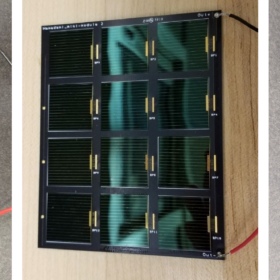
The best PV tech for Internet-of-Things devices
U.S. scientists have evaluated three different PV technologies – GaInP, GaAs, and silicon – for powering wireless temperature sensors. They found that the silicon solar module offers the lowest performance and also suggested its use may be applied to low-demand devices.
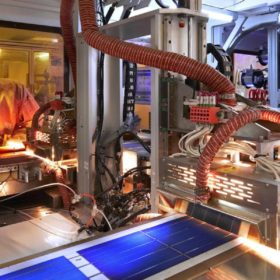
Trina Solar improves efficiency of 210 mm PERC solar cell by 0.5%
The cell has achieved a power conversion efficiency of 23.5%. The result was confirmed by China’s National Center of Supervision and Inspection on Solar Photovoltaic Product Quality (CPVT).
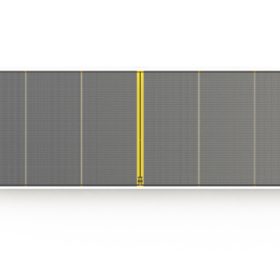
Ultra-lightweight CIGS solar module for high altitude airship applications
The 25 W solar panel has been designed to operate at air mass zero (AM0), which is the standard spectrum outside the Earth’s atmosphere. According to the PV manufacturer, the module has a weight of just 82 grams, while a small 300 W array comprised of these panels would weigh in at around 1 kg.
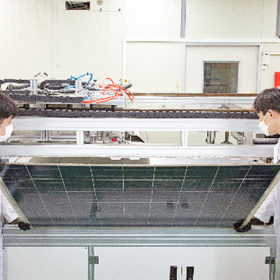
Novel PV module recycling tech from South Korea
Developed by the Korea Institute of Energy Research (KIER), the “non-destructive” technology is claimed to enable the recovery of 100% of a module’s glass and to allow the reuse of silicon for producing new solar cells with an efficiency of 20.05%.

The world’s hottest heat pump
A Norwegian consortium has built an industrial heat pump that can reach a temperature of up to 180 degrees Celsius. The machine can be used with different industrial processes that rely on steam as an energy carrier and can reduce a facility’s energy consumption by between 40% and 70%, as it enables the recovery of low-temperature waste heat.
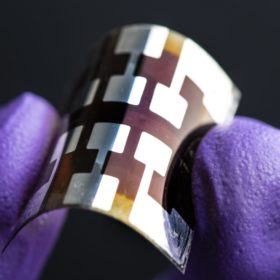
Perovskite-silicon tandems could rapidly scale solar
Halide perovskites combined with conventional silicon could help solar break the 26% efficiency barrier – disrupting the technology without disrupting business systems.
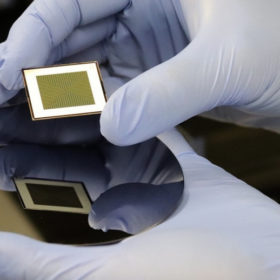
Australian researchers develop bifacial solar cell with 96.3% bifacial factor
Australian National University researchers claim to have set a world record for bifacial solar cell efficiency that they say could boost the energy output of solar farms by 30%.
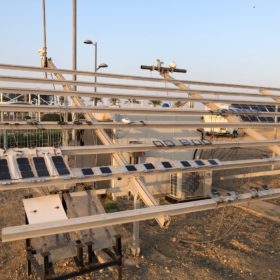
Tracing the roots of fill factor degradation in perovskite-silicon tandem solar cells
Scientists in Saudi Arabia have conducted one of the longest tests on the stability of perovskite-silicon tandem solar cells. According to their findings, the most affected parameter under the hot and humid climate of the region is the device fill factor, which dropped from 80% to 50% in just six months.
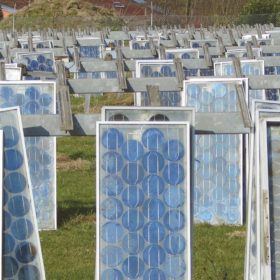
Blockchain for PV module recycling
Next Energy and Marubeni are developing a blockchain tech for PV module inspection – with the support of the Japanese government – which they claim is able to provide data on a panel’s traceability and components as well as verifying that the data were not modified or tampered with.
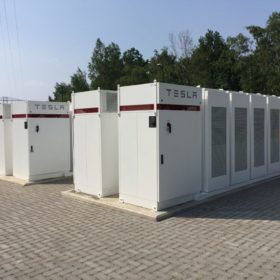
Novel salt solution for lithium-ion battery fires
Australian researchers have tested a novel lithium salt for high-voltage lithium batteries in electric vehicles and grid-scale storage systems. They claim the salt is less hazardous than conventional battery materials.
