A new concept for heat-recovery solar cells
Researchers in Japan have demonstrated a new concept for a ‘heat-recovery’ solar cell, which they claim has the potential to exceed the theoretical limit for cell efficiency. They say, however, that a suitable material for the energy filtering layers is yet to be identified. The cell is equipped with a 100-micron thick silicon absorber, two electrodes and carrier-energy filtering layers placed between the absorber and electrodes.

New PV system for facades, windows in Japan
Japan’s Kaneka and Taisei have designed their T-Green Multi Solar system to be integrated into walls and window surfaces. The system is available in two different versions – a solid type in which PV laminates are turned into vertical exterior panels or walls, and a variant that achieves transparency through striped solar cells that are integrated into window glass.
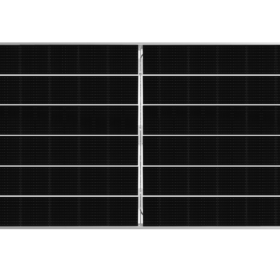
Jinko launches PV module with record output of 580 W
The panel is part of the company’s new Tiger Pro series, which includes two 530 W modules and a 430 W product for distributed-generation applications. It will begin production of the series in the fourth quarter, although it will start accepting first orders immediately.
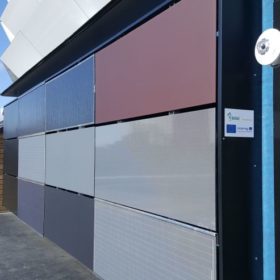
Colored PV module performance is underestimated
In a recent conversation with pv magazine Roland Valckenborg, business developer and project manager at the Netherlands Organisation for Applied Scientific Research (TNO), has described the results of a multi-year testing program for colored BIPV modules. Just a few years ago, it it was thought that power yield could be up to 50% lower than conventional panels, but tests have shown a difference of just 10%. Valckenborg says that losses can vary depending on the color of a panel.

Offshore vs land-based solar
A simulation by Utrecht University researchers indicated North Sea PV projects may perform better than a ground-mounted solar generator in the Netherlands. Offshore installations could generate 12.96% more power per year, according to the findings of the study, with the sea acting as a cooling system.

Fine-tuning plasmonic solar cells
Two different studies published this week show new advances in the use of plasmonic enhancement to improve performance and stability of perovskite solar cells.
Assessing impact of residual stress in solar cells
Scientists in China have analyzed the impact of residual stress in triple-junction solar cells used in aircraft and satellite applications. The group observed damages such as holes, fractures of grid lines, cracks at the cell level, and fractures of the PV materials.
Harvesting atmospheric water to cool down PV panels
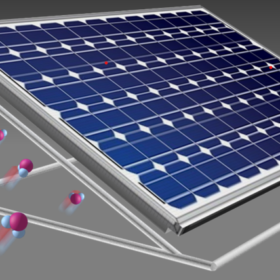
Scientists from Saudi Arabia have proposed a new PV panel cooling technique which employs an atmospheric water harvester. The device uses waste heat from the PV panel to collect atmospheric water at night and then releases it during the day to cool down the module. The researchers claim the device may also be improved to produce liquid water, which could be used for the cleaning of the modules.

Flexible, 22.6%-efficient perovskite cells for indoor use
The developers of a perovskite device designed for use under illumination of 100-500 lux say it could be manufactured for $78-108 per square meter.

Storing wind and solar with new gravity-based system
Scottish start-up Gravitricity is planning a project to store surplus power from renewables at Port of Leith. A 250 kW, grid-connected prototype facility will have its ability to stabilize the network tested. The system involves a 16m rig over a 150-1500m shaft.
