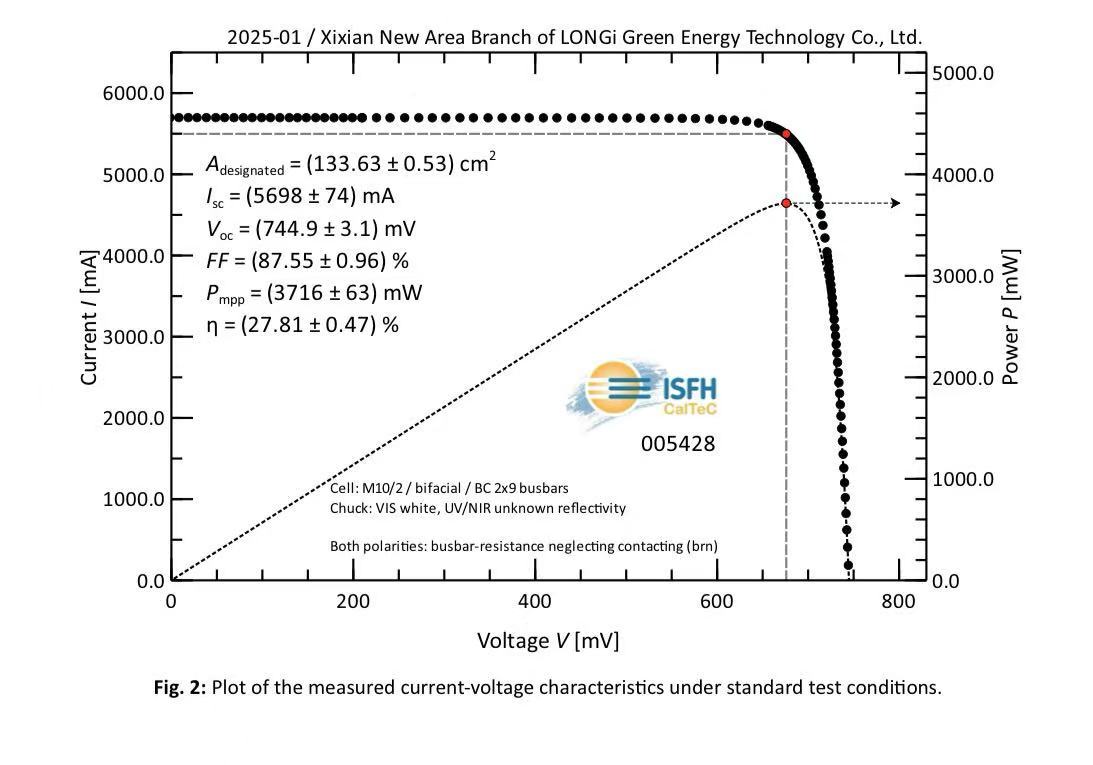





Chinese PV module maker Longi has revealed that its proprietary hybrid interdigitated back contact (HIBC) crystalline silicon solar cell based on a full-size silicon wafer has achieved a world record power conversion efficiency of 27.81%.
The result was confirmed by Germany’s Institute for Solar Energy Research Hamelin (ISFH).
The cell also achieved a short-circuit current of 5,698 mA, an open-circuit voltage of 744.9 mV, and a fill factor of 87.55%.
The performance improves the company's previous record of 27.3%, which was achieved in May 2024.
“In the solar industry, conversion efficiency is a defining metric,” said Li Zhenguo, founder and president of LONGi Green Energy. “Each one-point increase in cell efficiency translates into more than a 5% reduction in system costs.”
In a statement to pv magazine, a spokesperson from Longi explained that the record-setting HIBC cell was developed independently by its Central Research Institute.
“By redesigning both the cell architecture and material systems, we achieved simultaneous breakthroughs in optical management and carrier transport efficiency,” the spokesperson stated, without providing further details. “This opens a new frontier for enhancing module power density and sets a benchmark for the next generation of photovoltaic performance.”
Since SunPower set a record of 20.3% efficiency in 2007 using IBC technology, back contact (BC) solar cells have dominated the efficiency rankings. BC technology, known for its high efficiency and compatibility, has achieved eight consecutive world records in crystalline silicon module efficiency over the past 30 years.
This content is protected by copyright and may not be reused. If you want to cooperate with us and would like to reuse some of our content, please contact: editors@pv-magazine.com.

By submitting this form you agree to pv magazine using your data for the purposes of publishing your comment.
Your personal data will only be disclosed or otherwise transmitted to third parties for the purposes of spam filtering or if this is necessary for technical maintenance of the website. Any other transfer to third parties will not take place unless this is justified on the basis of applicable data protection regulations or if pv magazine is legally obliged to do so.
You may revoke this consent at any time with effect for the future, in which case your personal data will be deleted immediately. Otherwise, your data will be deleted if pv magazine has processed your request or the purpose of data storage is fulfilled.
Further information on data privacy can be found in our Data Protection Policy.