





The Solar World Congress (SWC) is the official scientific conference of the International Solar Energy Society (ISES). ISES is a United Nations-accredited membership-based NGO founded in 1954, the same year the first silicon solar cell was officially introduced. On top of this scientific event, which in 2025 will happen in Fortaleza-Brazil, ISES publishes the scientific journal Solar Energy. Initially named “The Journal of Solar Energy, Science and Engineering”, it was first published in 1957. The journal has since evolved, changing its name to “Solar Energy, The Journal of Solar Energy Science and Technology” in 1964, and is currently published by Elsevier on behalf of ISES. In 2021, ISES and Elsevier launched Solar Energy Advances, a new, full open access journal that aims to provide a forum for the presentation of fundamental scientific advancements in the understanding of any aspect of solar energy research, development, application, measurement of policy.
The ISES SWC 2025 is taking place for the first time in Brazil, on 4-7 November, and the number of accepted papers on PV applications in this traditionally solar-thermal event is noteworthy. As photovoltaics keeps adding capacity at a rapid pace everywhere, surpassing the worldwide installed capacity of both natural gas and coal in 2025, rooftop PV in Brazil is at the forefront of new installations of the more than 1 GW per month being added to the country’s 60 GW of PV. About 80% of the new PV installations in Brazil are happening on roofs, and there are more than 6.5 million consumer units (mostly single-family households) already benefiting from either on-site or remote generation with PV. This is less than 7% of the total amount of consumer units in the country, and there is still a lot of room to grow, as more financing mechanisms become available, based on and fueled by the growing perception that rooftop PV is the least-cost electricity generation technology for residential consumers. The Brazilian net metering law unleashed this growth in 2012, when residential PV electricity costs were still to reach parity with distribution utility tariffs and has reached exponential growth a few years later when PV grid parity was achieved.
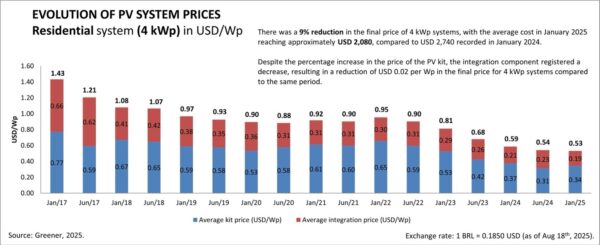
Some 50% of new rooftop PV installations in Brazil are financed, and even with the current high interest rates and the increase in import taxes for PV, the typical payback time ranges from 2.6 to 4.4 years for residential, and from 1.7 to 2.3 years for commercial PV systems, depending on the local solar resource availability and the distribution utility’s residential/commercial tariff. There are more than 150 thousand PV system integrators active in the country, most of them (64%) are very small (1-5 people workforce) and have a very local clientele. Small (4-12 kW), residential rooftop PV systems comprise 66% of new installations, and are escalating simply because PV is so cheap. The graph below brings figures from a recent survey by Brazilian PV market analysis advisory Greener, showing the steep price reductions for turn-key small-scale (4 kW) rooftop residential PV systems since 2017. The price breakdown also shows that installation costs in January 2025 were less than 30% of what they were in January 2017, while the PV system itself now costs only 44% of what it used to cost eight years ago.
The figure below shows a more detailed cost breakdown in PV system sizes from small-scale residential up to the large-scale commercial PV systems in Distributed Generation (DG) Brazilian Net Metering Legislation limit of 5 MW since 2023. It shows the continuing price reductions, the effect of PV system size and installation type, with rooftop PV being around 10 to 15% cheaper than ground-mounted PV.

As the news that rooftop PV is by far the least-cost electricity generation option becomes widespread, and distribution utilities keep increasing conventional residential tariffs, solar electricity will keep growing and by 2030 will dominate the energy generation market worldwide. The ISES SWC 2025 in Brazil will bring more insights into this trend.
Authors: Prof. Ricardo Rüther (UFSC), Prof. Andrew Blakers /ANU
ISES, the International Solar Energy Society is a UN-accredited membership NGO founded in 1954 working towards a world with 100% renewable energy for all, used efficiently and wisely.
The views and opinions expressed in this article are the author’s own, and do not necessarily reflect those held by pv magazine.
This content is protected by copyright and may not be reused. If you want to cooperate with us and would like to reuse some of our content, please contact: editors@pv-magazine.com.


By submitting this form you agree to pv magazine using your data for the purposes of publishing your comment.
Your personal data will only be disclosed or otherwise transmitted to third parties for the purposes of spam filtering or if this is necessary for technical maintenance of the website. Any other transfer to third parties will not take place unless this is justified on the basis of applicable data protection regulations or if pv magazine is legally obliged to do so.
You may revoke this consent at any time with effect for the future, in which case your personal data will be deleted immediately. Otherwise, your data will be deleted if pv magazine has processed your request or the purpose of data storage is fulfilled.
Further information on data privacy can be found in our Data Protection Policy.