




Scientists from the Multidisciplinary Core Institute for Future Energies (MCIFE) in South Korea have fabricated a polycrystalline solar cell using a semiconductor–water interface that reportedly improves light absorption, while reducing surface reflection and offering protection from environmental damage in underwater environments.
The cell was fabricated with a 2.3 nm-thin layer of gallium oxide (Ga2O3), which is a material with a large bandgap, high transparency, chemical robustness, and remarkable surface passivation properties. “When applied as an ultrathin layer, Ga2O3 can simultaneously serve as a passivation layer, protective barrier, and anti-reflective coating, thereby offering a pathway to enhance silicon solar cells beyond conventional designs,” the researchers explained.
“In addition to its optical advantages, Ga2O3 functions as a strong protective layer, especially in water-based environments. It helps to reduce degradation from chemical reactions, thereby improving the long-term stability, resistance to oxidation and resilience of the solar cells,” they added.
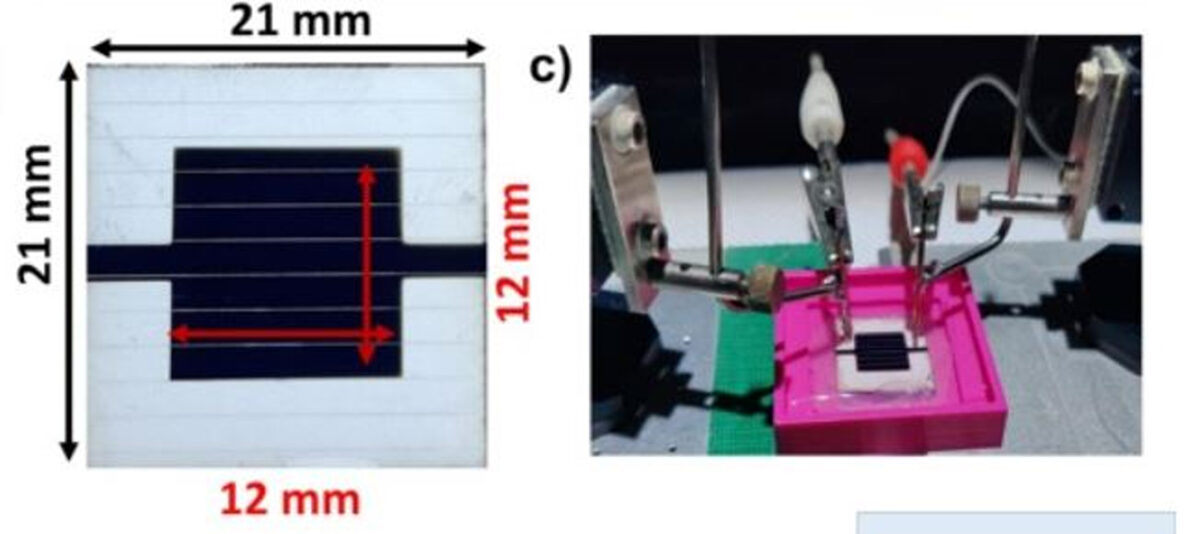
The 12 mm × 12 mm device also relies on a silver (Ag) busbar aimed at improving charge collection and silicon nitride (SiNx) anti-reflection coating. It was encapsulated within a watertight 3D-printed box to ensure impermeability.
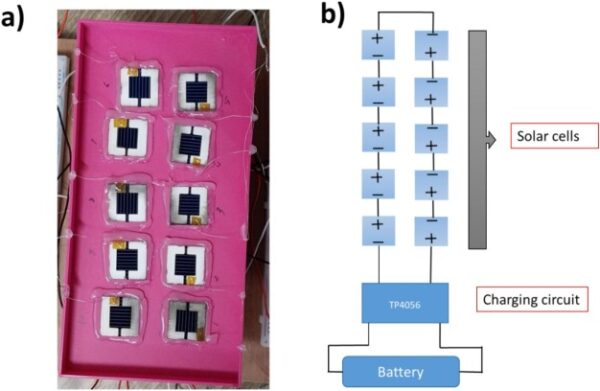
Image: Multidisciplinary Core Institute for Future Energies (MCIFE), Materials & Design, CC BY 4.0
The performance of the cell was measured and compared to that of a bare polycrystalline cell, a bare polycrystalline device for underwater environments, a gallium oxide deposited polycrystalline cell, and a gallium oxide deposited underwater polycrystalline cell.
All devices were tested by pulsed white light illumination under four different conditions: without Ga2O3 in air (W/O-Air); with Ga2O3 in air (W/G-Air); without Ga2O3 in water (W/O-Water); and with Ga2O3 in water (W/G-Water).
The measurements showed that the gallium oxide-deposited underwater polycrystalline cell is able to achieve the highest efficiency among all devices, with a percentage value of 21.56%, followed by the bare polycrystalline cell for underwater conditions with 19.36%, the gallium oxide-deposited polycrystalline cell with 19.04%, and the bare polycrystalline cell with just 17.87%.
“The results indicate that the presence of Ga2O3 significantly enhances the photocurrent in both air and water environments,” the academics emphasized. “Notably, the highest photocurrent is observed in the W/G-Water condition, suggesting that the combined effect of Ga2O3 and water improves charge transport efficiency.”
The “hybrid” solar cell was presented in the paper “Aqua-powered hybrid solar cell using amorphous conformal Ga2O3 thin-film,” published in Materials & Design.
The performance of underwater solar cells was investigated in 2020 by scientists from the Birla Institute of Technology and Science and the Indian Institute of Technology Kanpur and Defence Materials. According to their findings, submerged cells benefit from lower temperatures and an ideal environment for cleaning. “Although there are challenges and limitations, the results obtained show that there is an enormous potential for solar PV technology in underwater monitoring sensors or devices, and various other commercial and defense applications with modern-day power electronics,” the researchers stated at the time.
In 2022, researchers in China used commercially available solar cells to create an underwater-optimized lens-free system for high-speed optical detection and found that the PV devices enabled a much larger detection area than commonly used photodiodes.
In June of this year, researchers in Italy tested how perovskite solar cells could perform underwater and found that, at very shallow depths, they may even achieve higher power conversion efficiencies compared to reference devices operating under out-of-water conditions.
This content is protected by copyright and may not be reused. If you want to cooperate with us and would like to reuse some of our content, please contact: editors@pv-magazine.com.



By submitting this form you agree to pv magazine using your data for the purposes of publishing your comment.
Your personal data will only be disclosed or otherwise transmitted to third parties for the purposes of spam filtering or if this is necessary for technical maintenance of the website. Any other transfer to third parties will not take place unless this is justified on the basis of applicable data protection regulations or if pv magazine is legally obliged to do so.
You may revoke this consent at any time with effect for the future, in which case your personal data will be deleted immediately. Otherwise, your data will be deleted if pv magazine has processed your request or the purpose of data storage is fulfilled.
Further information on data privacy can be found in our Data Protection Policy.