





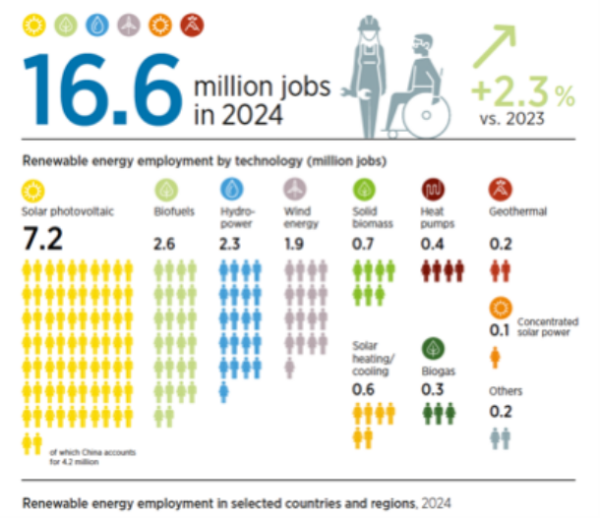
The 2025 edition of the Renewable Energy and Jobs report, released in early January 2026 (with 2024 data), brings the latest estimates for renewable energy jobs worldwide. The estimates are complemented by an analysis of progress in the industry and the public policy scenario, focusing on the need for inclusive policies for a truly successful energy transition. This edition of the report highlights the need to “expand training, job opportunities and career perspectives for population groups that are in danger of being left behind”, emphasizing that it is the workers, in a wide spectrum of occupations and skillsets, that will secure the success of the energy transition.
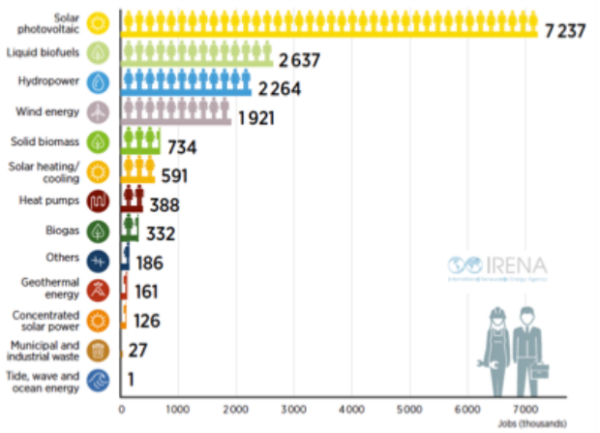
Solar photovoltaics accounted for over 43% of the renewable energy sector employment by technology. Biofuels accounted for 15.6%, hydropower for 13.8%, wind energy for 11.4%, solid biomass for 4.2%, solar heating and cooling for 3.6%, heat pumps for 2.4%, biogas for 1.8%, geothermal for 1.2%, and concentrated solar power (CSP) for 0.6%.
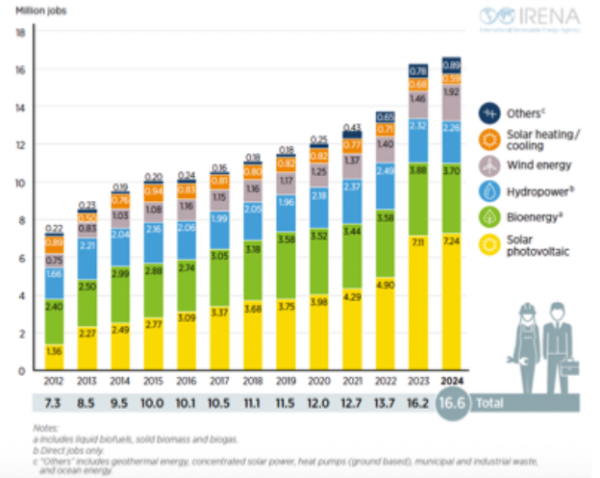
The annual growth in 2024 compared to 2023 was only nominal (2.5%), much smaller than the growth in any other year in the historical series since 2012, except for 2016. Even during the pandemics, job growth was larger (around 5%/year in the 2019-2021 period), having grown 14.2% from 2022 to 2023 and 18.2% from 2023 to 2024. This might be due to the industry hitting structural bottlenecks as it matures, rather than a lack of demand. Other reasons for the marginal growth in 2024 compared to 2023 include:
Grid Bottlenecks: A major and growing obstacle is that grid infrastructure in many countries (including the US, Brazil and Europe) is not growing fast enough to handle the surge in new renewable capacity. As a result, massive amounts of solar and wind projects are stuck in long queues waiting for connection. Curtailment is here to stay and overbuilding low-cost solar and wind should be put in the equation.
Intense Regional Concentration: The vast majority of global growth is concentrated in China. In 2024, China accounted for over 88% of the increase in Asia's renewable capacity. While this represents huge progress, it also reveals that global growth is heavily dependent on one market, and slower growth in other regions brings down the overall percentage increase.
Solar Manufacturing Oversupply: Global solar manufacturing capacity in 2024 more than doubled compared to 2023, causing an excessively abundant supply (manufacturing capacity utilization is currently below 50%). While this made solar modules incredibly cheap, it resulted in negative net margins for many manufacturers, forcing them to cancel or scale back new investment projects.
Lagging “Other” Renewables: While solar photovoltaics has surged, other renewable technologies like wind and geothermal are growing more slowly, and the growth of hydropower and biofuels in some regions has been inconsistent (negative growth in 2024 compared to 2023).
Permitting and Siting Delays: In addition to grid issues, lengthy permitting times and, in some countries, increased federal opposition and cancelling of projects have delayed new installations, particularly for wind power.
The graph below shows the evolution of global renewable energy employment by technology from 2012 to 2024.
Global renewable energy employment, by technology, in 2024.
When analyzing renewable energy jobs by region, China continues to stand out the most. The report highlights that imbalances around the world reflect not only diverging levels of commitment and investment, but also uneven capacity to act, given varying industrial and supply chain structures, technological dependences and availability of skilled labour.

Brazil and India are good examples of countries where solar photovoltaics deployment has grown considerably in recent years. India has consistently invested in local manufacturing (solar module capacity exceeding 110 GW annually by late 2025, driven by government support, while solar cell capacity is around 50 GW/year). In Brazil, while there is only negligible solar module production capacity (1 GW/year), PV modules imported from China at around 0.1 $/W and favourable legislation (Net Metering law), have resulted in thousands of small new companies that have installed over one million rooftop PV systems in 2024 alone. Despite not having a large solar PV manufacturing industry, the fast uptake of both rooftop and large-scale PV in Brazil is a good example to show that most jobs are in the country where the PV modules are deployed because that is where most of the costs are incurred (engineering, transport, land, fencing, land preparation, support structures, module installation and commissioning, operations and maintenance, transmission, grid connection).
Effective education and training strategies, upskilling and reskilling are essential in building a capable energy transition workforce with experience and expertise, as recognized by IRENA’s Call to Action in Skilling for the Energy Transition.
While much of the attention in the sector is paid to issues surrounding technology, costs and markets, it is the human side, the workers, that make it happen.
Authors: Prof. Ricardo Rüther (UFSC), Prof. Andrew Blakers /ANU
ISES, the International Solar Energy Society is a UN-accredited membership NGO founded in 1954 working towards a world with 100% renewable energy for all, used efficiently and wisely.
The views and opinions expressed in this article are the author’s own, and do not necessarily reflect those held by pv magazine.
This content is protected by copyright and may not be reused. If you want to cooperate with us and would like to reuse some of our content, please contact: editors@pv-magazine.com.


By submitting this form you agree to pv magazine using your data for the purposes of publishing your comment.
Your personal data will only be disclosed or otherwise transmitted to third parties for the purposes of spam filtering or if this is necessary for technical maintenance of the website. Any other transfer to third parties will not take place unless this is justified on the basis of applicable data protection regulations or if pv magazine is legally obliged to do so.
You may revoke this consent at any time with effect for the future, in which case your personal data will be deleted immediately. Otherwise, your data will be deleted if pv magazine has processed your request or the purpose of data storage is fulfilled.
Further information on data privacy can be found in our Data Protection Policy.