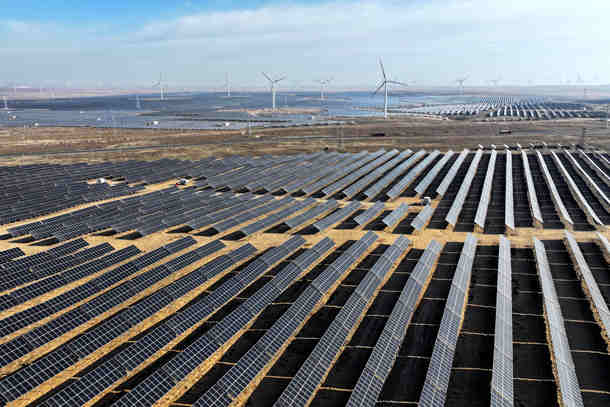





China Energy Investment Corp. (CHN Energy) has completed trial operations and formally commissioned the Phase II 2 GW photovoltaic (PV) project at its Lingwu mining-subsidence renewable base in Ningxia, bringing the full 4 GW Lingwu project online as of February 28.
The Lingwu project is part of the 6 GW Ningxia mining-subsidence PV base, which also includes an operational 2 GW section at Ningdong. Combined, the projects cover approximately 120 square kilometers and are expected to deliver around 10.8 TWh of clean electricity annually through the Ningxia–Zhejiang 800 kV Lingshao ultra-high-voltage direct current (UHVDC) line. This output is sufficient to meet the annual electricity demand of about 7.2 million households, according to the company.
CHN Energy said the base is a key component of China’s second batch of large-scale “desert, Gobi and wasteland” renewable projects. The company described the scheme as a way to repurpose coal mining subsidence zones, goaf areas, and other underutilized land, while strengthening west-to-east clean power transmission. The project is operated by CHN Energy Ningxia Electric Power and Guohua Energy Investment.
A notable feature of the Lingwu base is its hybrid grid architecture. The project includes a planned 600 MW/1,200 MWh energy storage system, of which 400 MW/800 MWh has already been completed. It uses grid-forming storage together with supporting coal-fired assets to form what CHN Energy describes as an integrated “solar-coal-storage-hydrogen” export base. For the Lingwu Phase II 2 GW section, the company adopted a “solar-plus-coal” bundled transmission model, leveraging the flexibility of existing thermal assets on the Lingshao corridor to smooth PV variability and improve stability.
CHN Energy also highlighted a domestic-first transmission approach, in which new renewable generation is exported by expanding the existing 750 kV substation of a nearby coal plant, rather than building a fully separate outlet. Overall, the base includes one 750 kV substation, six 330 kV substations, and around 200 km of transmission lines.
On the engineering side, the developer pointed to adaptations for unstable mining-subsidence terrain, including mixed mounting structures, geological monitoring and warning systems, drone inspections, and automated cleaning. The project also integrates a “PV + ecology” model designed to support vegetation recovery, grazing, and other land uses beneath and between module rows.
According to state media, the full 6 GW base is expected to save roughly 3.24 million tons of standard coal annually while helping transition the Lingshao corridor from a predominantly coal-based export route toward a more diversified, renewable-led model. For China’s utility-scale PV sector, the project is significant less for module technology than for its approach to land reuse, grid integration, and long-distance transmission – three factors expected to shape the next wave of large solar bases in western China.
This content is protected by copyright and may not be reused. If you want to cooperate with us and would like to reuse some of our content, please contact: editors@pv-magazine.com.

By submitting this form you agree to pv magazine using your data for the purposes of publishing your comment.
Your personal data will only be disclosed or otherwise transmitted to third parties for the purposes of spam filtering or if this is necessary for technical maintenance of the website. Any other transfer to third parties will not take place unless this is justified on the basis of applicable data protection regulations or if pv magazine is legally obliged to do so.
You may revoke this consent at any time with effect for the future, in which case your personal data will be deleted immediately. Otherwise, your data will be deleted if pv magazine has processed your request or the purpose of data storage is fulfilled.
Further information on data privacy can be found in our Data Protection Policy.