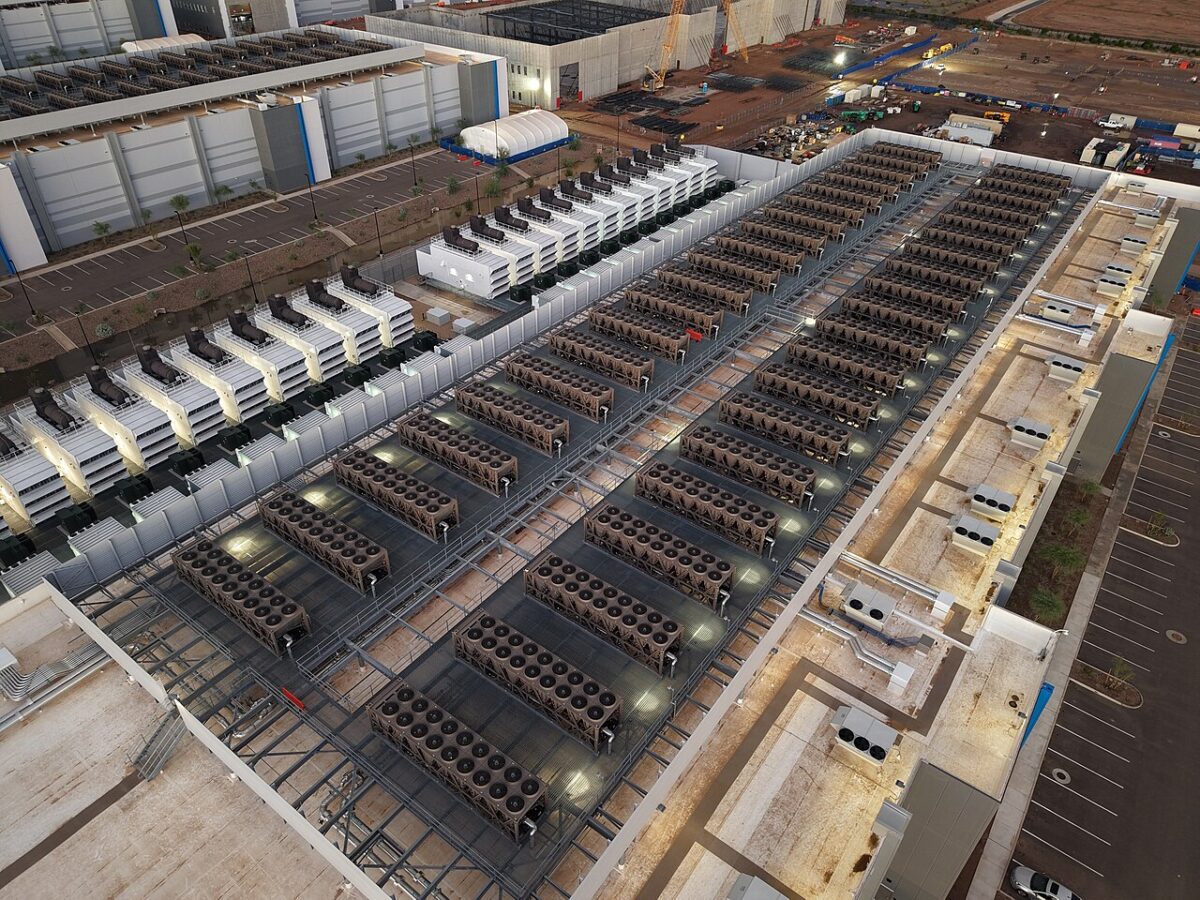





Malaysia’s power sector is poised for demand growth, with industrial expansion, digitalisation, and most notably, the development of data centres. As Malaysia has been becoming a hotspot for new data centres in Southeast Asia, physical bottlenecks have started to appear. On 24 February 2026, Prime Minister Anwar Ibrahim announced that the government has been limiting non-AI data centre developments for the past one and a half to two years, citing concerns for security of supply of power and water. Therefore, delivering reliable supply to data centres requires more than incremental generation additions. It requires coordinated investment across the system, such as adequate dispatchable capacity to meet rising peak demand and reinforcement of the grid to maintain system stability as solar penetration increases.
These system developments carry cost implications that are addressed within Malaysia’s Incentive-Based Regulation (IBR) framework. Under the IBR, network revenues and regulated returns are determined for fixed regulatory periods, balancing core principles of efficiency, cost reflectivity, and affordability. Recent tariff reforms, including the introduction of a dedicated ultra-high voltage (UHV) category specifically for data centres, reflect a clearer application of the “causer pays” principle. These large consumers whose demand drives network expansion and system balancing requirements are increasingly expected to bear a proportionate share of those costs.
At the same time, corporate sustainability commitments are accelerating demand for renewable energy. Data centres face mounting pressure from global clients and investors to secure long-term green electricity supply. Solar power purchase agreements (PPAs) offer a pathway to meet decarbonisation targets while aligning cost management.
The Corporate Renewable Energy Supply Scheme (CRESS) was introduced in this context, to facilitate direct renewable procurement while preserving grid integrity and regulatory coherence. As stakeholders move from policy ambition to commercial execution, attention has increasingly turned to a critical variable shaping project economics—the System Access Charge (SAC).
For developers, banks and corporate offtakers, understanding the structure and potential evolution of the SAC is now central to evaluating the financial robustness of CRESS-linked investments.
How CRESS works: commercial structure and cost allocation
CRESS represents the next step in corporate power procurement in Peninsular Malaysia, moving beyond utility-owned green programmes following the retirement of the Corporate Green Power Programme (CGPP). As of the start of 2026, publicly announced plans for CRESS projects total ~4 GW, with developers including TNB Renewables, UEM Lestra, Gentari, Gamuda, and Solarvest announcing participation.
Under CRESS, an eligible corporate offtaker enters a long-term PPA with a renewable energy developer. Planned PPA tenors typically go up to 21 years, aligning with common project financing horizons.
For the regulator to ensure that overall system costs remain appropriately allocated, CRESS participants are subject to the System Access Charge (SAC). While the solar developer contracts bilaterally with the offtaker, the developer is liable for paying the SAC. Depending on risk appetite and bargaining power, this cost is factored into PPA negotiations, together with the developer’s project cost, thus influencing the all-in delivered price of renewable electricity.
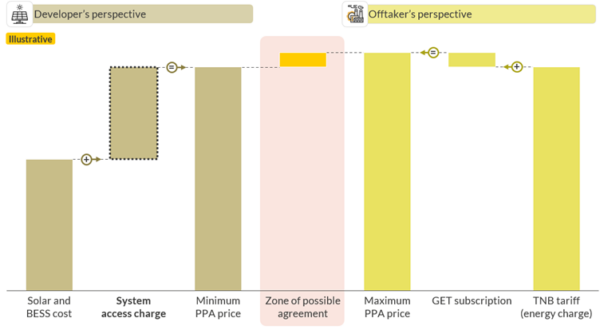
Image: Aurora Energy Research
For context, Malaysia has mandated a coal exit and cheap domestic gas reserves are expected to dwindle. Based on a recent non-representative poll of power industry experts, two thirds expect the TNB base tariff to increase from today’s 46 sen/kWh to a range of 50-60 sen/kWh within 10 years. Thus, CRESS offers corporate offtakers the potential to secure long-term renewable supply and hedge against exposure to retail tariff structures. For developers and financiers, the commercial attractiveness of a project depends not only on solar resource and capital costs, but also on the trajectory and risk profile of the SAC over the life of the PPA. It is this intersection between policy design, system cost allocation and long-term price risk that makes the SAC central to CRESS bankability.
System Access Charge: from regulatory instrument to investment variable
At its core, the SAC is a regulatory instrument designed to ensure that corporate renewable procurement remains consistent with system cost recovery principles. As CRESS projects utilise the national grid for electricity dispatch and increase complexity of operations due to the intermittency of solar, the Energy Commission applies its causer pays principle when subjecting CRESS developers to the SAC.
However, while the policy rationale is clear, the trajectory of the SAC is less so and the Energy Commission has provided little forward guidance for developers and financiers entering 15–21 year PPAs. The SAC thus represents a regulated cost component whose evolution depends entirely on future regulatory determinations, likely linked to system expansion needs, and capacity payments to dispatchable power plants.
The Energy Commission has indicated that the SAC may be revised every three years, with provisions allowing increases of up to 15% per instance. While such mechanisms provide regulatory flexibility, they introduce an asymmetry in long-term contracting. Solar developers and corporate offtakers must negotiate on how potential SAC adjustments are allocated, despite the limited visibility on the SAC’s cost drivers.
Although the Energy Commission has not formally itemised the components of the SAC, its underlying intent can be derived from regulatory principles. In practical terms, it represents the system operator’s cost recovery for grid expansion and enhancement, as well as for ensuring system reliability and security of supply.
This can be fundamentally linked to measurable system variables: demand growth, generation mix evolution, peak capacity requirements, fuel prices, and capital expenditure cycles. Yet in commercial discussions, the SAC could be treated as an administrative parameter rather than an outcome of underlying system economics.
This perception gap matters. Uncertainty over SAC escalation can widen bid-ask spreads in PPA negotiations, delay financial close, or require risk-sharing mechanisms that complicate contract structuring. In a market where UHV tariff rates in the Regulatory Period 4 are already ~30% higher than the base tariff, even moderate SAC adjustments can materially influence negotiations.
Aurora Energy Research approaches the SAC not as an opaque charge, but as a derivable outcome of power system fundamentals. Through a model that solves for the least-cost power system operation and long-term capacity expansion, it is possible to forecast the underlying drivers. By linking these outputs to regulatory principles embedded within IBR, the SAC can be framed within a scenario-based forecasting methodology. This results in the firm SAC ranging from 200-220 RM/MWh (20-22 sen/kWh), in real 2024 terms, in Aurora’s base case. In the event higher solar penetration happens, this range could increase by 10-20%, rising above the previously set 250 RM/MWh (25 sen/kWh).
Instead of viewing the SAC as an external and unpredictable input, stakeholders can assess it through scenario-based analysis grounded in system fundamentals. By quantifying sensitivities to demand growth, network expansion, and capacity requirements, developers and offtakers can evaluate potential escalation pathways and reflect them transparently in PPA structures. In this way, the SAC is not a blackbox anymore, but a parameter that can be examined and incorporated into long-term financial modelling.
Enabling CRESS through analytical transparency
CRESS plays an important role in aligning Malaysia’s renewable ambitions with the needs of large energy consumers. The SAC, meanwhile, ensures that system cost recovery principles remain intact as corporate procurement expands.
Recent market announcements demonstrate clear momentum, yet long-term investment decisions require visibility over regulated cost exposure. For developers, SAC uncertainty can affect cost recovery structures, investment return thresholds, and PPA negotiations. For corporate offtakers, particularly data centres, it influences the comparison between CRESS PPAs and evolving retail tariffs. For financiers, it shapes credit assessment and downside risk analysis.
Crucially, the SAC is not detached from system economics. It reflects network investment cycles, adequacy requirements, and regulatory determinations under IBR guidelines that the government adopts, made clear via the Energy Commission’s stances. By applying fundamental power market modelling, it is possible to link SAC components to system drivers and construct scenario-based forecasts.
Aurora Energy Research applies this approach, generating transparent sensitivities across demand growth, fuel prices, renewable penetration, regulatory parameters, and much more. This allows stakeholders to quantify plausible SAC pathways and incorporate structured risk-sharing mechanisms into long-term PPAs.
As Malaysia’s digital economy expands and renewable capacity scales, analytical clarity will be essential to translating policy intent into bankable outcomes. By grounding the SAC in power market fundamentals, CRESS can move beyond uncertainty and better fulfil its role in enabling large-scale corporate renewable procurement within a financially sustainable power system. Physical limits, from water to power, may yet hamper growth. Policy uncertainty should not.
Authors: David Thoo (Research Associate) and Philipp Egli (Research Lead) of Aurora Energy Research
The views and opinions expressed in this article are the author’s own, and do not necessarily reflect those held by pv magazine.
This content is protected by copyright and may not be reused. If you want to cooperate with us and would like to reuse some of our content, please contact: editors@pv-magazine.com.

By submitting this form you agree to pv magazine using your data for the purposes of publishing your comment.
Your personal data will only be disclosed or otherwise transmitted to third parties for the purposes of spam filtering or if this is necessary for technical maintenance of the website. Any other transfer to third parties will not take place unless this is justified on the basis of applicable data protection regulations or if pv magazine is legally obliged to do so.
You may revoke this consent at any time with effect for the future, in which case your personal data will be deleted immediately. Otherwise, your data will be deleted if pv magazine has processed your request or the purpose of data storage is fulfilled.
Further information on data privacy can be found in our Data Protection Policy.