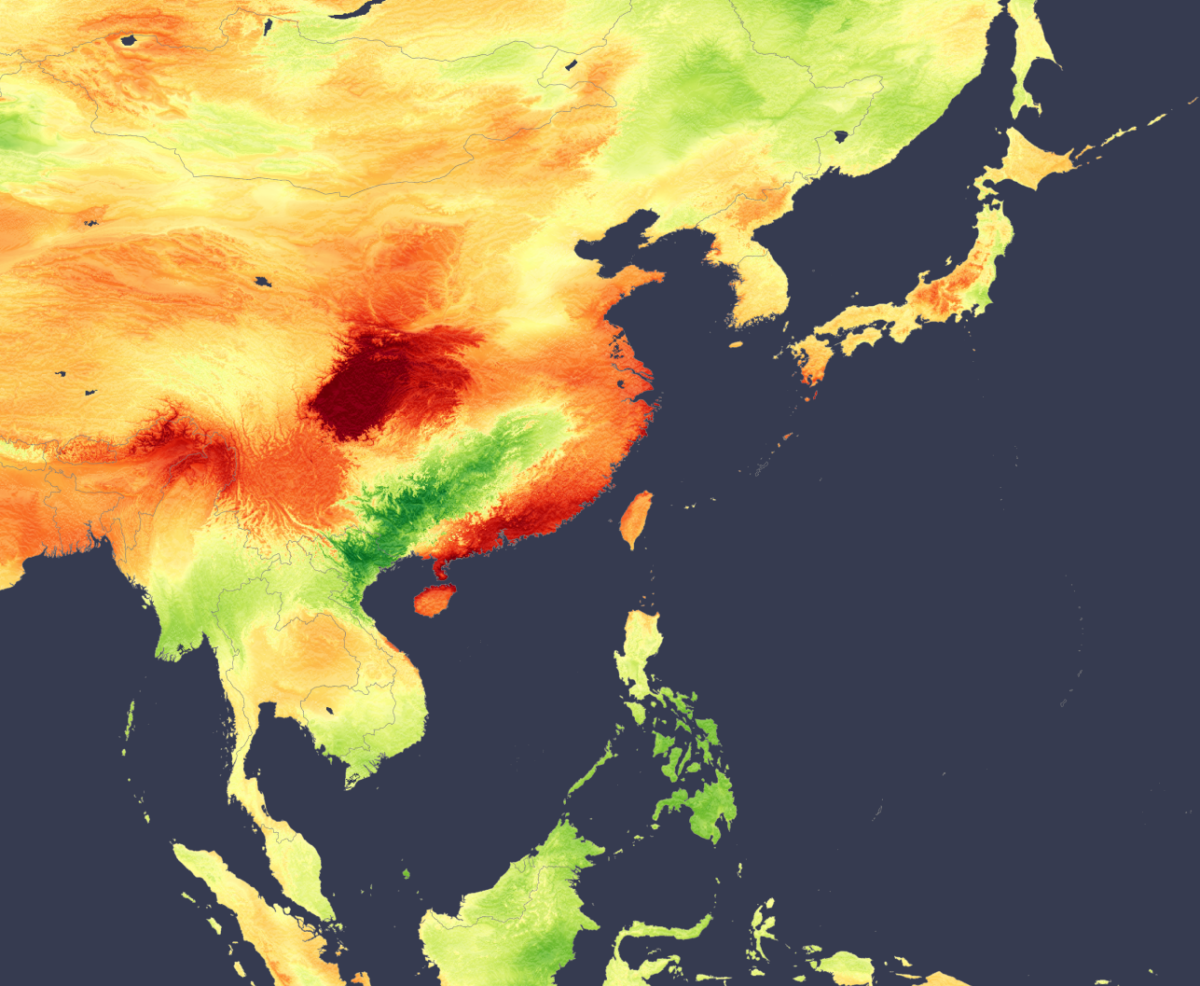





February delivered a stark regional divide in solar resource across East Asia, according to analysis using the Solcast API. Southern China and Taiwan recorded some of the strongest positive irradiance anomalies of the past 20 years, driven by exceptionally clean air and a sharp reduction in cloud cover. At the same time, maritime Southeast Asia saw the opposite pattern, with enhanced tropical convection producing widespread rainfall and some of the lowest irradiance compared with normal of the month.
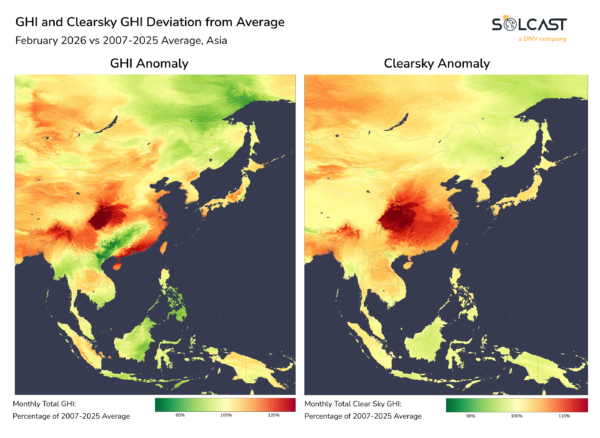
Southern China’s above-average irradiance continued from January, but the underlying mechanism shifted significantly. In inland provinces such as Sichuan and Yunnan, clearsky GHI exceeded 10% above the long term average, indicating unusually low aerosol and water vapour burden. This was the strongest clearsky signal of the winter and points to atmospheric cleanliness rather than largescale pressure patterns as the main driver. Total GHI anomalies were even larger, surpassing 20% above average in some areas, confirming that reduced cloud cover reinforced the clearsky surplus.
Unlike January,when a strong Siberian high pushed dry continental air toward the south, the February pattern was dominated by a deep low-pressure anomaly over Mongolia and northern China. Despite this less stable setup and increased atmospheric moisture, precipitation across mainland China remained close to normal, limiting cloud development inland. A temporary reduction in industrial emissions around the Chinese New Year holiday may have further reduced aerosol loading, aligning with a longer-term trend of cleaner air and strengthening irradiance across central China.
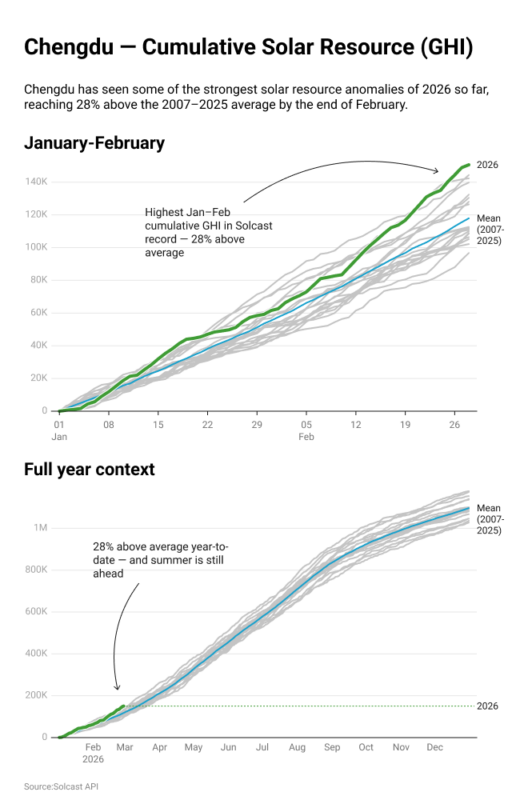
Taiwan experienced an even more pronounced shift, with February irradiance rising sharply from already elevated January levels. Taipei reached 17.7% above the 2007–2025 average, up from 11.7% in January, and Taichung saw a similar increase from 9% to 15%. Unlike southern China, the surplus in Taiwan was driven almost entirely by fewer cloudy days. Clearsky GHI was only 4–5% above normal, while overall GHI soared to 15–18% above average, indicating that February brought unusually persistent clear conditions across the island. This occurred despite the collapse of the Siberian high that had previously funnelled dry air across the Taiwan Strait. While cities such as Seoul and Tokyo returned to near normal irradiance as that winter pattern broke down, Taiwan and the nearby Shanghai region intensified into standout high irradiance zones along the East China Sea.
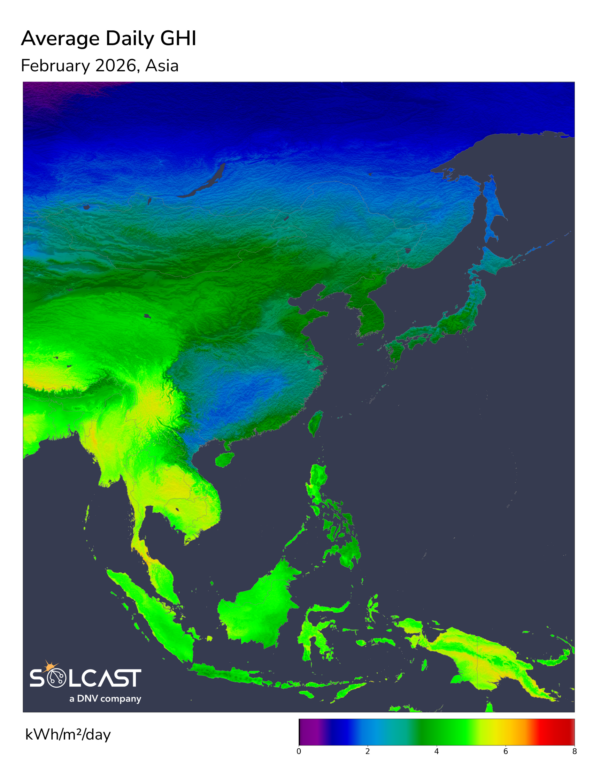
Farther south, maritime Southeast Asia saw markedly different conditions. Indonesia, the southern Philippines, and surrounding island chains recorded clearsky deficits of 10–20% below average, accompanied by substantial overall GHI reductions. Precipitation exceeded normal by 8–12 mm/day across Sumatra, Java, Borneo and the equatorial Pacific, reflecting stronger tropical convection. The combined clearsky and cloud driven deficits indicate a wetter, more moisture laden environment consistent with a transition from La Niña toward ENSO neutral conditions, which typically enhances convection over the western Pacific warm pool.
Solcast produces these figures by tracking clouds and aerosols at 1-2km resolution globally, using satellite data and proprietary AI/ML algorithms. This data is used to drive irradiance models, enabling Solcast to calculate irradiance at high resolution, with typical bias of less than 2%, and also cloud-tracking forecasts. This data is used by more than 350 companies managing over 300 GW of solar assets globally.
The views and opinions expressed in this article are the author’s own, and do not necessarily reflect those held by pv magazine.
This content is protected by copyright and may not be reused. If you want to cooperate with us and would like to reuse some of our content, please contact: editors@pv-magazine.com.


By submitting this form you agree to pv magazine using your data for the purposes of publishing your comment.
Your personal data will only be disclosed or otherwise transmitted to third parties for the purposes of spam filtering or if this is necessary for technical maintenance of the website. Any other transfer to third parties will not take place unless this is justified on the basis of applicable data protection regulations or if pv magazine is legally obliged to do so.
You may revoke this consent at any time with effect for the future, in which case your personal data will be deleted immediately. Otherwise, your data will be deleted if pv magazine has processed your request or the purpose of data storage is fulfilled.
Further information on data privacy can be found in our Data Protection Policy.