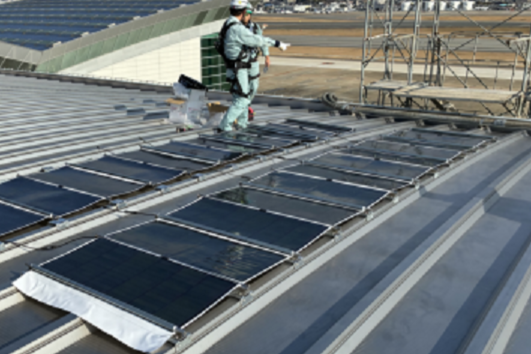





At Fukuoka International Airport, Kyuden Mirai Energy, the renewable energy subsidiary of Japanese utility Kyushu Electric Power Company, and PXP Corporation, a Japanese startup developing chalcopyrite and perovskite solar technologies, have installed glass-free flexible chalcopyrite (CuInSe2) modules on the airport terminal roof.
“The test site is 2 x 6 m and output is 1.2 kW,” Hiroki Sugimoto, CTO of PXP Corporation, told pv magazine, adding that the duration of the project is three months. It is supported by the Fukuoka Prefecture Perovskite Solar Cell Demonstration Project Subsidy.
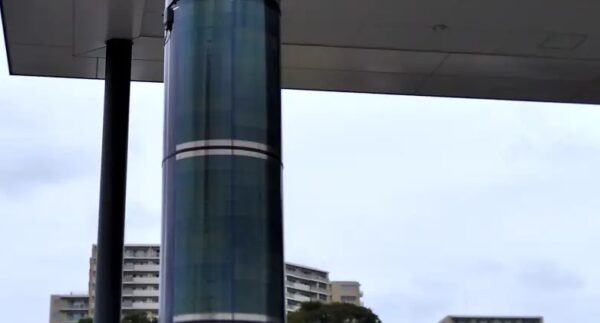
In a separate project, supported by the Kanagawa Next-Generation Solar Cell Promotion Project Subsidy, PXP panels have been used in a demonstration at a Nissan Motor Corporation car dealership in Totsuka Ward, Yokohama City.
One set of PXP modules, which typically measure 0.6mm thick and weigh 0.7kg/m2, is installed indoors in the window area at the entrance to the showroom, and the other set is on the curved surface of a portico structural support beam. The power generated is to be used by vending machines and smartphone chargers and an in-store display inside the building of the car dealership.
The demonstration is slated to run from October 2025 until February 2026. The aim is to assess the location and scope of use of the thin film solar PV technology, to grow community awareness about the advanced nature of next-generation flexible solar cell technology, and Nissan's environmental efforts, according to Sugimoto.
PXP has a growing number of demonstrations of its technology underway in Japan. Last year, pv magazine reported that Japan’s Softbank Corp. had led a consortium of investors to back PXP in a $10 million round of venture capital.
This content is protected by copyright and may not be reused. If you want to cooperate with us and would like to reuse some of our content, please contact: editors@pv-magazine.com.

This is exciting to see, especially the way they’re integrating the panels into real, everyday spaces like an airport terminal and a car showroom rather than just test fields. If the performance and longevity hold up, this kind of flexible solar could quietly change how and where we think about deploying PV in dense cities.