Emiliano Bellini


Czechia allocates $177m for solar rebates
The funds were taken from the country’s National Recovery Plan in an effort to reduce energy dependence on Russia. A call to select eligible projects will be launched on March 22. Solar-plus-storage projects will also be entitled to participate.
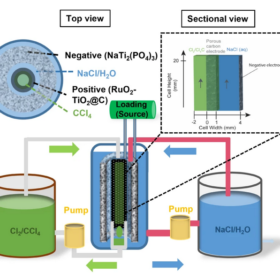
Membrane-free chlorine redox flow battery for stationary storage
A US-Chinese research group has developed a full chlorine membrane-free redox flow battery that is claimed to achieve a round-trip energy efficiency of 91% at 10 mA/cm2 and an energy density of 125.7 Wh/L. The device is based on an aqueous electrolyte made of sodium chloride (NaCl) which uses chlorine (Cl2/Cl−) redox couple as the active material for the positive electrode.
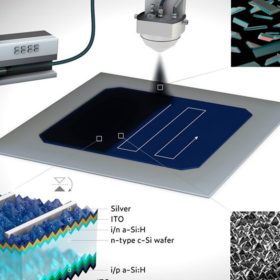
KAUST researchers achieve 20.1% efficiency in heterojunction solar cell based on 2D MXenes electrodes
The solar cell is based on the titanium carbide MXene and is claimed to have retained around 99% of its initial efficiency for more than 600 days of ambient air storage. The device was built using spray coating to directly deposit the titanium carbide flakes on the cell’s rear side.

Paving the way for green hydrogen certification
The International Renewable Energy Agency has outlined a series of technical considerations for green hydrogen tracking systems. According to the document, a degree of flexibility should be taken into account in the short term to ensure that the nascent green hydrogen market can develop.
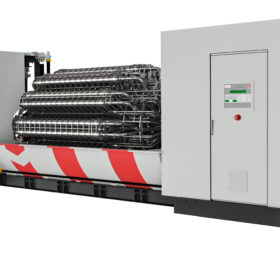
Rotation heat pump for industrial applications
Austrian tech company ecop has developed a rotation heat pump with a reported coefficient of performance (COP) of 4.0 – 7.0. The 700 kW machine operates under temperatures of 150 degrees Celsius and is based on an anticlockwise running Joule process, during which there is no phase transition of the working medium that always remains gaseous.

Italy begins loosening permits for large scale renewables
The Italian government has decided to unlock 1.4GW of new renewable energy projects since the end of 2021.
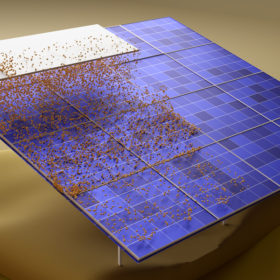
MIT scientists develop PV cleaning system based on electrostatic repulsion
Scientists from the Massachusetts Institute of Technology have developed a system that can be operated at a voltage of around 12V, with a 95% recovery rate for lost power after cleaning. The waterless system can be operated automatically via an electric motor.
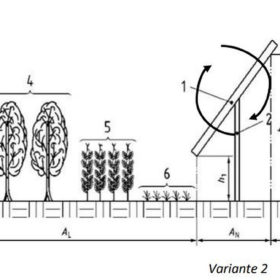
Italian solar sector defines standards for agrivoltaics
A document compiled by three Italian renewables associations identifies with extreme precision the area that is allowed to be used for power generation in the two most common agrivoltaics configurations — solar arrays with elevated solar modules and PV systems deployed between crop rows.
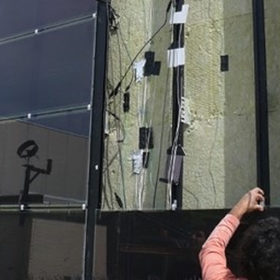
Photovoltaic forced ventilated facade for applications with air source heat pumps
Scientists in Spain have designed a BIPV forced ventilated facade that can be used as support for heating and a domestic hot water (DHW) building system based on air source heat pumps (ASHPs). In the proposed system configuration, the heat pump is expected to cover building heating demand at all times, regardless of the performance of the solar array.

Solar caravan powering the electric vehicle that tows it
The solar modules for the solar array were supplied by Chinese manufacturer Longi, which is a major partner in the project.
